Takeaways
Transak processes payments for over 450 platforms across 145+ countries. Calling Transak an "on-ramp provider" misses the bigger picture in the same way that calling AWS a "server company" misses the point of cloud infrastructure.
Transak is regulated fiat ↔ stablecoin infrastructure, and the platforms embedding it are getting programmatic payment capabilities that would otherwise take years of licensing, banking partnerships, and compliance engineering to build.
The stablecoin market processed $33 trillion in transaction volume in 2025, up 72% year-over-year. Cross-border B2B payments alone surged from under $100 million monthly in early 2023 to over $6 billion monthly by mid-2025. So, the question is how to integrate stablecoin payment infrastructure and which infrastructure layer gives your platform the most leverage for the least operational overhead.
This article breaks down how three distinct types of platforms your app can use Transak Stream to unlock programmatic payments without becoming a crypto company.
Three Platform Archetypes, One Infrastructure
Not every platform needs stablecoin infrastructure for the same reason. A non-custodial wallet has different requirements from a cross-border payroll company, and both differ from a blockchain foundation looking for global fiat liquidity. But all three converge on the same bottleneck: the fiat ↔ stablecoin/crypto/RWA bridge.
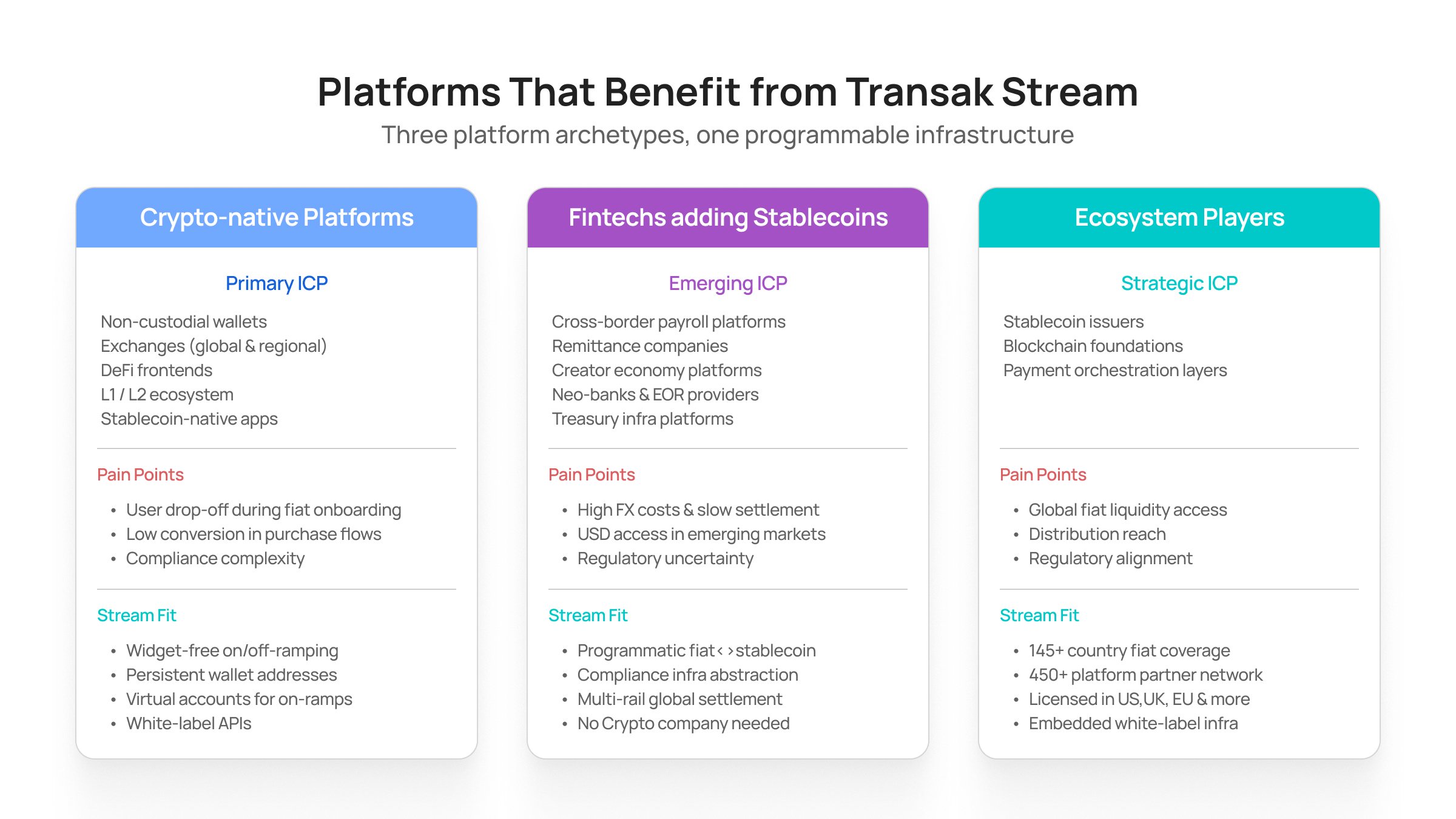
The fiat bridge is where compliance, conversion, settlement, and user experience collide. It is the hardest part of the stack to build from scratch because it requires money transmitter licenses across multiple jurisdictions, direct banking relationships for payout rails, real-time KYC/AML systems, multi-currency FX routing, and the operational infrastructure to keep all of it running 24/7.
Transak Stream abstracts this entire layer. It provides two types of persistent, programmatic endpoints (virtual bank accounts for on-ramping and dedicated wallet addresses for off-ramping) that platforms embed into their own product. Everything downstream of those endpoints is automated.
The result is that a platform can offer its users programmatic fiat ↔ crypto flows without holding a single license, managing a single banking relationship, or building a single compliance pipeline.
Also read: What Are Programmatic Payments and How Transak Enables Them
The Cross-Border Unlock for Fintechs
Cross-border payroll platforms, remittance companies, freelancer marketplaces, EOR providers, creator economy platforms, and neo-banks are exploring stablecoin rails albeit none of these are "crypto companies." But all of them are burdened by the same infrastructure, i.e., SWIFT correspondent banking chains that take three to five days, charge 6-7% in fees, and offer zero transparency into where funds are at any given moment.
Stablecoins compress that to minutes. The problem is that adding stablecoin rails requires exactly the kind of infrastructure these companies do not have: crypto licenses, custodial infrastructure, KYC for digital asset flows, on-chain monitoring, and fiat ↔ stablecoin conversion engines.
Also Read: A Step-by-Step Guide to Blockchain Payments
How Transak Stream Removes the Barrier
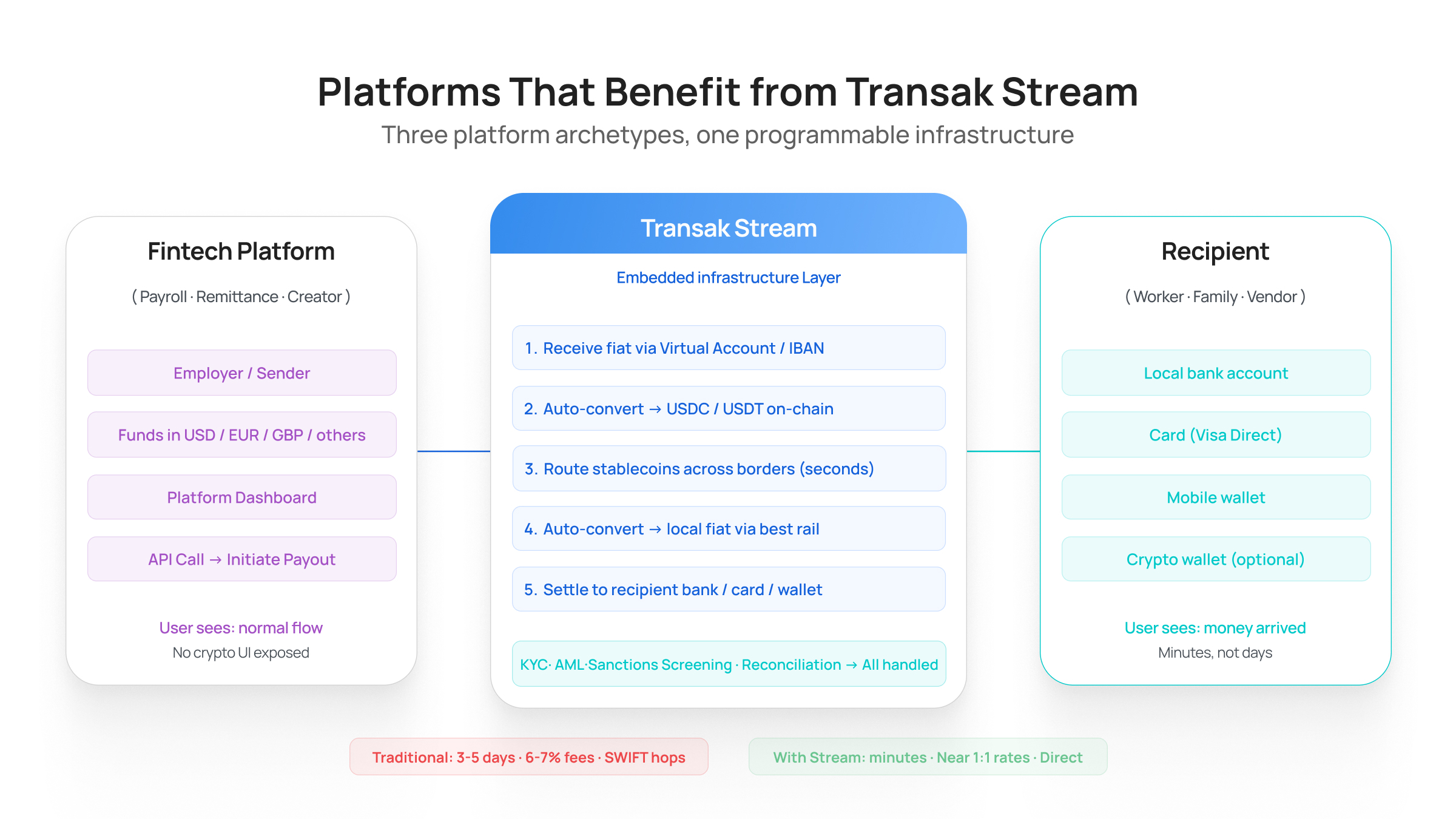
Transak Stream lets fintechs embed stablecoin-powered payment flows without exposing any crypto complexity to their end users. The platform continues to operate with a fiat-facing UI. Behind the scenes, Transak handles the stablecoin conversion, cross-border routing, and local currency settlement.
Here is the practical architecture:
- The fintech platform integrates Transak's APIs.
- When a payout is initiated (a payroll run, a remittance, a freelancer withdrawal), the platform sends fiat to a Transak virtual account or triggers a stablecoin conversion via API.
- Transak auto-converts to the optimal stablecoin, routes it on-chain in seconds, converts it back to local fiat at the destination, and settles via a predefined payout method.
- The recipient sees fiat arriving in their bank account.
- They never interact with crypto.
This is the "stablecoin sandwich" model, i.e., fiat in, stablecoins in the middle, fiat out. The key insight is that the platform does not need to become a crypto company. It needs to partner with infrastructure that already is one.
Five Scenarios, One Infrastructure
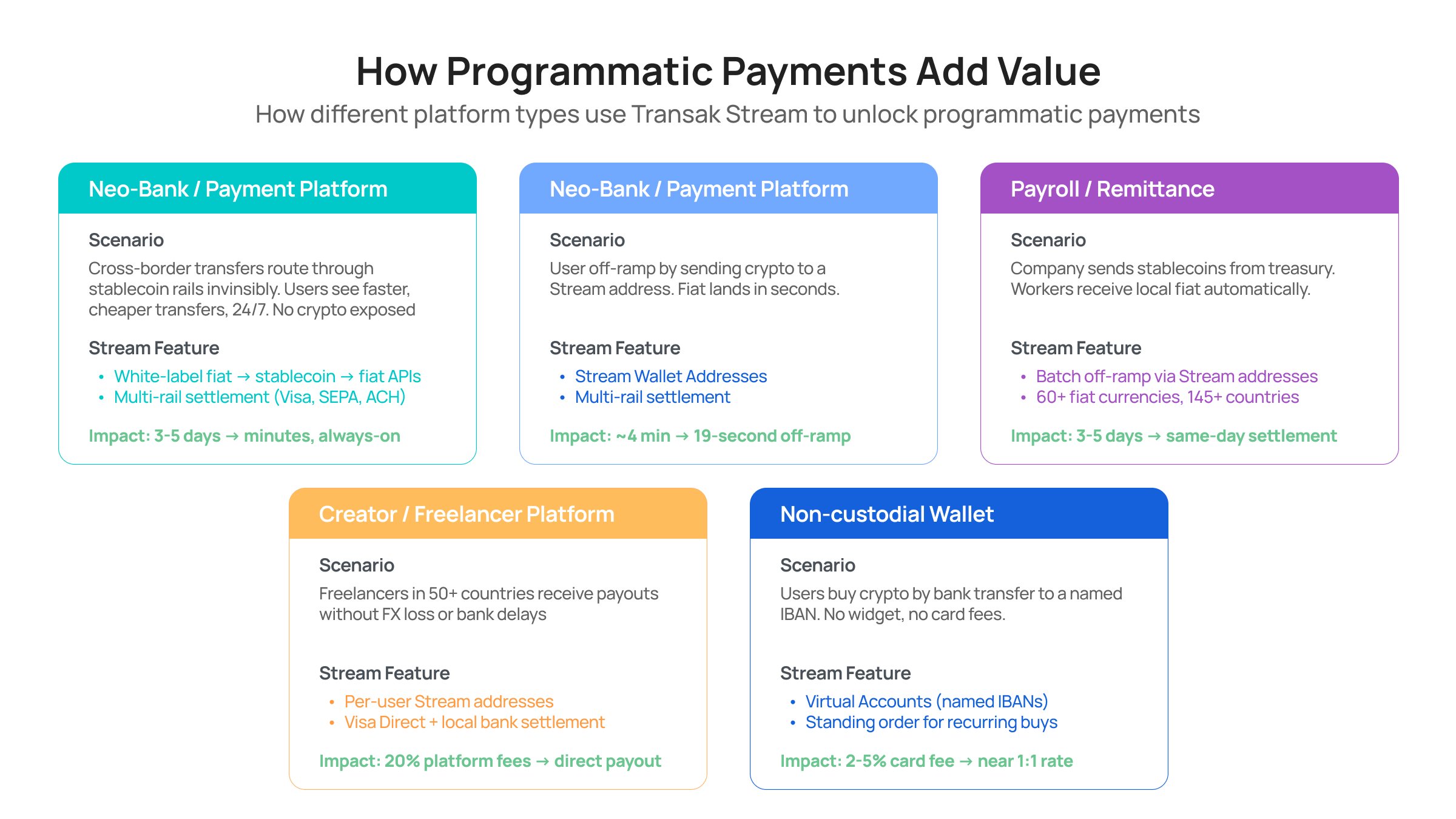
Scenario 1: A neobank wants to use stablecoins as invisible backend settlement to lower cross-border costs and enable 24/7 money movement. The platform routes transfers through stablecoin rails behind the scenes — users never see crypto. They just see faster, cheaper transfers that work on weekends.
Also Read: How Neobanks Can Increase Profits Using Stablecoin Rails
Scenario 2: A regional exchange wants instant off-ramping. Each user gets a Stream wallet address. Crypto sent to that address auto-converts to fiat and settles via the optimal local rail. Processing time drops from minutes to seconds.
Scenario 3: The payroll platform wants to pay contractors in 50 countries from a single stablecoin treasury. Stablecoins route to per-employee Stream addresses. Each employee receives local fiat in their bank account, same day. No correspondent banking, no per-country FX desks.
Scenario 4: A freelancer marketplace wants to reduce payout costs and speed for global creators. Client payments settle through stablecoin rails in the background. Freelancers receive local currency faster and at better rates than traditional payment corridors.
Scenario 5: A non-custodial wallet wants users to buy crypto without a widget. Transak assigns each user a named IBAN. Bank transfers auto-convert to stablecoins. Card fees disappear, conversion rates approach 1:1, and users set up standing orders for recurring purchases.
How to Integrate Transak Stream
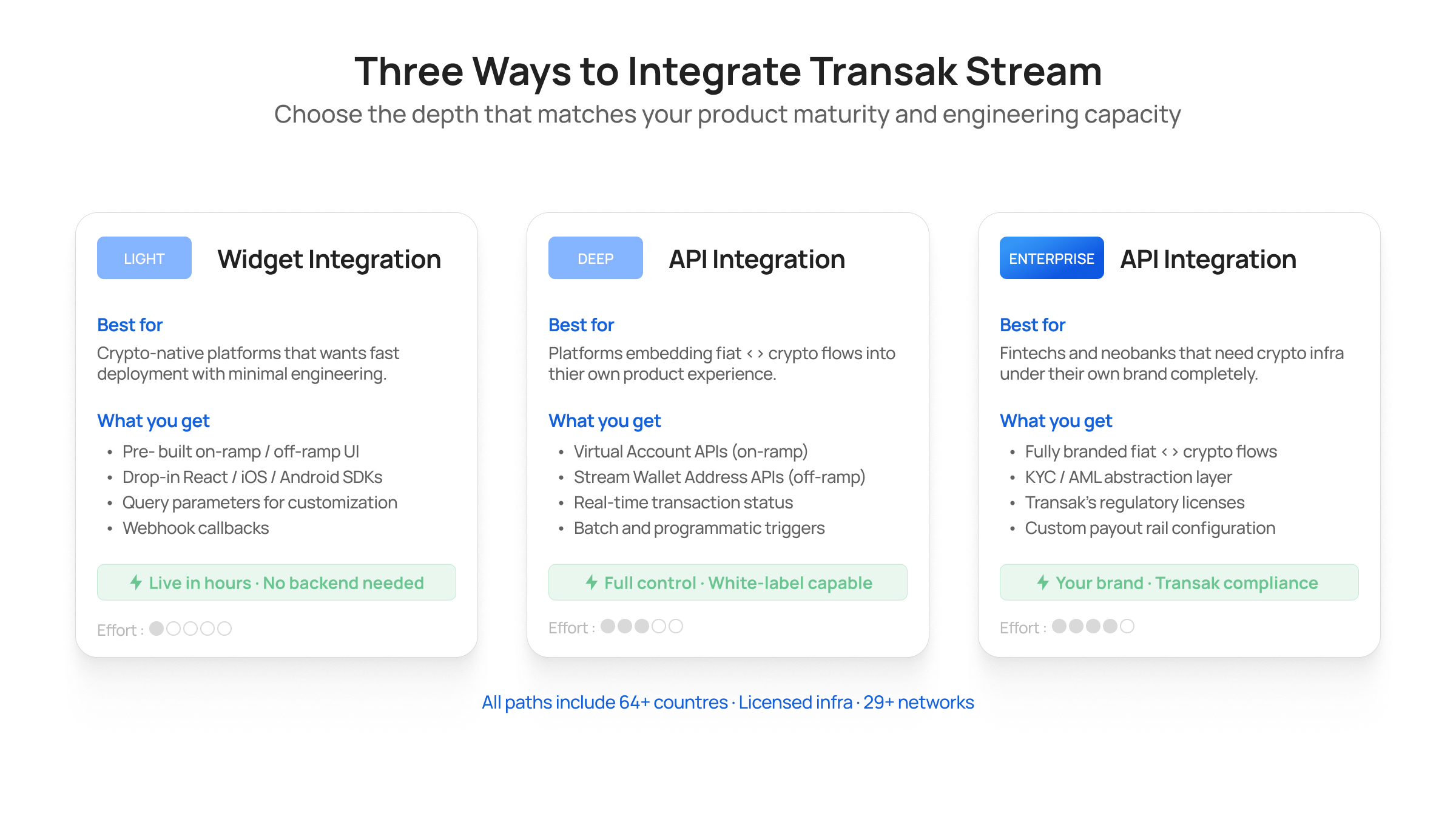
Transak offers three integration models, and the right one depends on your platform's technical maturity, brand requirements, and use case.
Also read: How to Use Transak Stream
Path 1: Widget Integration (Light)
Best for: Crypto-native platforms that want to ship fast.
Transak provides pre-built on-ramp and off-ramp UIs. The widget handles the entire user flow including KYC, payment method selection, conversion, and settlement. Platforms customize appearance and behavior through query parameters.
This is the fastest path to production. Some platforms go live within hours. The trade-off is that the user interacts with Transak's UI within the platform's app, so the experience is not fully white-labeled.
Path 2: API Integration (Deep)
Best for: Platforms embedding fiat ↔ crypto flows into their own product experience.
Transak exposes Virtual Account APIs for programmatic on-ramping and Stream Wallet Address APIs for programmatic off-ramping. The platform controls the entire user experience and calls Transak's APIs to create endpoints, monitor transactions, and receive webhook callbacks on status changes.
This is the path for platforms that need programmatic, widget-free flows. Like payroll companies triggering batch payouts, exchanges offering instant off-ramps, or marketplaces routing settlements through stablecoins.
Path 3: White-Label (Enterprise)
Best for: Fintechs and neobanks that need crypto infrastructure under their own brand.
The platform operates Transak's entire fiat ↔ crypto stack and users never see the Transak name. The platform gets the benefit of Transak's regulatory licenses, its ISO/IEC 27001 and SOC II certifications, its Visa Direct and Circle partnerships, and its Fireblocks-powered custody without building or maintaining any of it.
This is the path for platforms making a strategic bet on stablecoin-powered payments as a core product capability.
Also Read: Embedded Stablecoin Payments: The Next Evolution in Digital Commerce
FAQs
Does my platform need a crypto license to use Transak Stream?
No. Transak holds the regulatory licenses and handles all compliance infrastructure. Your platform integrates via API and operates under Transak's licensed framework.
Can my users interact with Transak Stream without seeing any crypto UI?
Yes. Through the API and white-label integration paths, the entire flow can be embedded under your platform's brand. Users see a bank transfer interface (for on-ramping) or simply send crypto to an address your platform manages (for off-ramping). No blockchain terminology, wallet addresses, or crypto jargon needs to appear in your user experience.
How does Transak handle compliance for platforms in different jurisdictions?
Transak runs KYC verification during user onboarding and maintains compliance state across sessions. Every transaction is screened against sanctions lists and risk models in real time. For platforms, this means compliance is fully abstracted: Transak handles it end-to-end, and the platform receives webhook notifications confirming transaction status and compliance outcomes.
What is the pricing model?
Transak's pricing is transaction-based, with fees varying by corridor, payment method, and volume. Virtual account on-ramps (bank transfers) offer near 1:1 conversion rates, significantly lower than the 2-5% fees typical of card-based on-ramps. For enterprise and high-volume integrations, we offer custom pricing. Contact our team for specific corridor pricing.