Takeaways
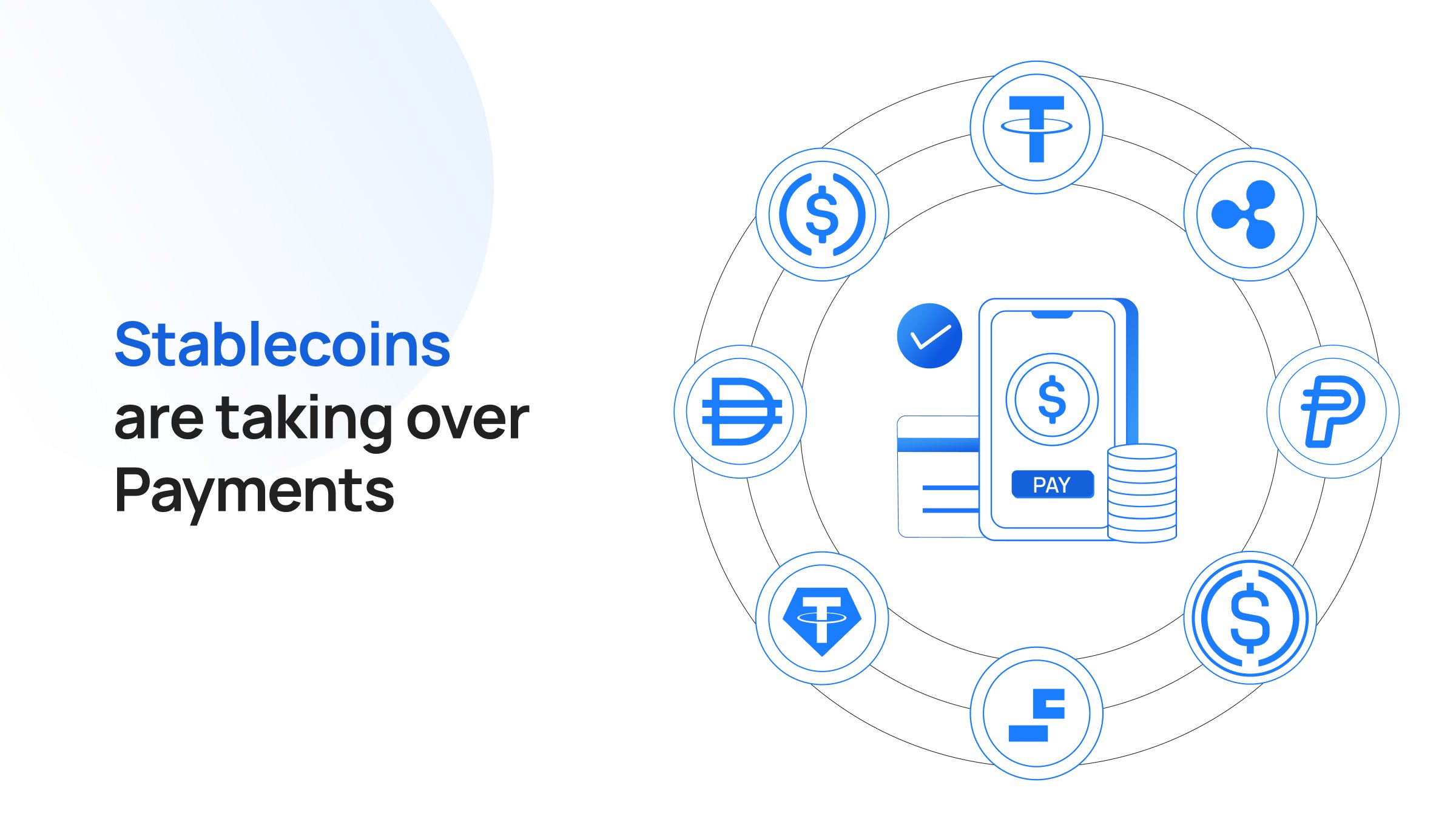
Crypto payments started with an ambitious idea: money should move as fast as information. The early days proved difficult because volatility, high gas fees, and clunky UX made it unrealistic for daily transactions. Today, that future is arriving. Stablecoins have now become the preferred medium of exchange across most blockchain regions.
In fact, data shows that stablecoins have overtaken Bitcoin as the preferred medium of exchange in on-chain transfers.

Stablecoins combine the programmable settlement of blockchain with the predictable price of fiat value. The result is instant, low-cost, and globally accessible payments that actually work at scale. That’s why the next generation of crypto payment processors rely on stablecoins as their operational backbone.
Why Stablecoins Became the Default Currency for On-Chain Payments
Billions of dollars now move through stablecoins every day. Instead of building on speculative tokens, payment platforms are standardizing on digital dollars and euros that offer consistency, transparency, and regulatory certainty.
Here are the main reasons stablecoins are winning the payments battlefield.
1. Low fees unlock microtransactions again
Card networks charge 2 to 3 percent per transaction plus additional fees. Stablecoins on chains like Solana, Polygon, and Ethereum L2s cost pennies on the dollar. This lets micropayments for gaming, streaming, and social tipping viable.
2. Borderless access without banking prerequisites
Receiving stablecoins requires only a wallet. This gives unbanked users a way to participate in digital commerce and enables merchants to accept global payments without negotiating local banking partnerships or currency setups.
3. Cross-border payments that settle in seconds
International transfers using SWIFT can take days and involve multiple intermediaries. Stablecoins settle almost instantly. Many platforms already process USDC corridors between regions like LATAM and Africa with predictable results.
4. Instant settlement plus spendable liquidity
On stablecoin rails, a confirmed transaction is final. Funds can immediately be spent, reinvested, or routed into treasury functions like automated yield strategies or on-chain working capital.
5. Transparency and programmable security
Stablecoin reserves are increasingly attested in real time, which allows automated compliance checks, audit trails, and programmable rules including escrow, conditional payouts, and travel rule compliance tagging.
6. Developers gain superpowers
With smart contract tooling, crypto payment platforms can offer experiences not possible in legacy rails. Examples include:
- Streaming payments for subscriptions
- Split payouts between sellers and service providers
- Automated hedging
- Instant credit based on receivables
7. Familiar UX without price swings
Stablecoins eliminate volatility risk while maintaining fast settlement. Merchants can auto-convert to local currency when needed or hold digital dollars as treasury assets.
Real World Use Cases
Much to a newbie’s surprise, stablecoins are already sitting inside ecommerce checkouts, remittance apps, card networks, and even humanitarian aid programs. The most interesting part is that in many of these use cases, users never see “crypto” at all. They just see faster, cheaper, and more predictable money.
Let’s look at a few.
1. Ecommerce and Online Checkout
The clearest signal that stablecoins are going mainstream is that ecommerce platforms now treat them like a native payment method.
In June 2025, Shopify announced that merchants can accept USDC payments through Shopify Payments, using Coinbase and Stripe as the crypto payment rails. Customers can pay in USDC on Base, while merchants receive funds in a form that is easy to reconcile and convert to local currency. The integration is designed so merchants do not need separate crypto plugins or custom code.
For merchants, this unlocks:
- Global card like reach, since anyone with a USDC compatible wallet can pay
- Lower processing and chargeback risk for high risk categories
- Faster settlement compared to traditional card rails
2. Cross Border Remittances and FX Volatility Hedges
Remittances are where the “Internet of Value” narrative becomes extremely tangible. Stablecoins here act as a dollar account in your pocket that is not tied to the local banking system.
MoneyGram has been building around USDC and Stellar for a while, both for on and off ramps and cross border flows. In its latest product iteration for Colombia, any USD balance that users hold in the MoneyGram app is automatically represented as USDC. The goal is to protect users from local peso volatility while still providing familiar cash in and cash out experiences.
So the user experience looks roughly like this:
- Relative abroad funds a remittance in dollars
- Dollars are represented as USDC inside the MoneyGram app ledger
- Recipient can keep value in USDC, or cash out locally in fiat when needed
3. Card Networks and Merchant Settlement
In the background, card networks and acquirers are starting to use stablecoins as a settlement rail between institutions. This does not change the card swipe for the consumer, but it changes how the money moves under the hood.
Visa began piloting USDC settlement in 2023, letting certain partners settle obligations in USDC instead of traditional bank wires. Since then, Visa has expanded this to more acquirers, more chains, and more regions, including CEMEA markets.
4. Super Apps, Everyday Retail, and QR Payments
Stablecoins are also creeping into everyday retail through super apps and local payment ecosystems.
In 2025, OKX launched a service in Singapore that allows users to pay GrabPay merchants using stablecoins such as USDC and USDT. The flow uses OKX Pay at the front and converts those stablecoins into XSGD, a Singapore dollar backed stablecoin, so that merchants ultimately receive Singapore dollars. Metro, a well known department store chain in Singapore, is among the early adopters.
5. Humanitarian Aid and Social Impact
Beyond commerce, stablecoins are being used in scenarios where speed, traceability, and targeting matter more than yield or trading.
In 2022, a United Nations program piloted disbursements to people affected by the war in Ukraine using USDC on Stellar. Recipients installed a mobile wallet app and received digital dollars that they could spend at participating merchants or cash out. This provided faster settlement, reduced leakage, and more control over who received how much assistance compared to traditional voucher systems.
6. Web3 Native Economies, Creators, and Games
Within crypto native environments, stablecoins unlock real economic activity without exposing users to wild volatility.
Several gaming platforms and creator ecosystems now use stablecoins for in-app purchases, reward payouts, and marketplace transactions. Users can:
- Buy in game assets or passes with USDC or similar stablecoins
- Receive creator earnings or tournament payouts instantly across borders
- Plug those earnings into other DeFi or payment apps without friction
7. Enterprise and B2B Cross Border Flows
Stablecoins are reshaping B2B flows, where invoice sizes are large and the pain of correspondent banking is most acute.
Here the pattern usually looks like:
- A business funds a stablecoin wallet via a Transak
- They pay overseas suppliers or partners in a dollar stablecoin
- The receiver converts to local fiat via an off ramp or keeps it on chain as working capital
Card networks like Visa, payment companies, and specialist fintechs are already offering these rails as “stablecoin settlement as a service” so that enterprises can plug in without managing the crypto complexity themselves.
Modern Payment Platforms Choose Transak
Businesses expanding into new markets often hit a familiar wall. Every country has its own payment methods, compliance rules, and banking dependencies. Scaling global payments traditionally requires local entity setup, multiple processors, correspondent banking, and high FX friction.
Stablecoins solve the currency movement problem, but most companies still need a way to move value between fiat and stablecoins without complexity. That is the gap Transak fills.
With a single integration, businesses can offer:
- Instant conversion into stablecoins for settlement or treasury
- Localized off -amps so users and merchants can cash out in their own currency
- Automated compliance and identity checks that keep regulators comfortable
Instead of building fragmented payments stacks across seas, businesses get one unified infrastructure that is already compliant, licensed, and connected to liquidity providers globally.
Stablecoins provide the global money rail. Transak provides the layer that makes it usable for real commerce.