Takeaways
Australia has 6.2 million crypto holders, a 32.5% adult adoption rate, and a financial regulator that shut down nine digital currency exchanges in a single quarter. If your platform moves money through stablecoin or crypto rails for Australian users, the infrastructure powering that flow needs to be AUSTRAC-registered. No exceptions.
This article covers what AUSTRAC requires, what changes in 2026, and how platforms can enter Australia without building compliance infrastructure from scratch.
What Is AUSTRAC?
AUSTRAC (Australian Transaction Reports and Analysis Centre) is Australia's financial intelligence unit, comparable to FinCEN in the US or FINTRAC in Canada. It collects transaction data from regulated businesses and converts it into intelligence for law enforcement and national security agencies.
For any business that touches the conversion between Australian dollars and digital currency, AUSTRAC maintains the Digital Currency Exchange Register. Registration is mandatory before operations begin. No registration, no operations.
Why This Applies to Fintechs, Not Just Crypto Exchanges
This is where many fintech teams miscalculate. You don't need to be running a consumer crypto exchange to trigger AUSTRAC obligations. If your remittance app converts AUD to USDC as part of a cross-border payout, if your payroll platform settles contractor payments through stablecoin rails, or if your neobank lets users hold USD-backed balances powered by stablecoins, the underlying fiat-to-digital-currency conversion requires AUSTRAC registration at the infrastructure level.
The user may never see the word "stablecoin." But the regulatory obligation still applies to whichever entity is executing that conversion.
This is exactly why the choice of payment infrastructure matters. If your provider is AUSTRAC-registered, you're covered. If they're not, you have a compliance gap in your Australian operations.
AUSTRAC vs. ASIC
Quick distinction. AUSTRAC handles AML/CTF compliance for fiat-crypto exchange. ASIC regulates financial products like tokenized securities and investment schemes. Most fintechs integrating stablecoin rails only need to worry about AUSTRAC. If you also offer custody or investment-like products, you may need an AFSL from ASIC on top.
What Registration Requires
AUSTRAC registration is free to apply for, but the real cost is operational readiness. Applications go through the AUSTRAC Online portal and take up to 90 days to assess.
Corporate Structure
You need an Australian legal entity (ABN/ACN), a resident director, and a designated compliance officer. No remote registration for foreign companies.
Police Clearance
Every director and beneficial owner submits a National Police History Check issued within six months of the application date.
AML/CTF Program
A written document detailing how the business identifies, mitigates, and manages money laundering and terrorism financing risk. It covers customer due diligence, transaction monitoring, employee screening, staff training, and enhanced due diligence for high-risk customers. AUSTRAC expects this to be tailored to your specific business model.
ML/TF Risk Assessment
A separate document mapping risks specific to your products, customer segments, geographies, and transaction channels.
AUSTRAC actively refuses and suspends registrations. In early 2025, the regulator suspended or refused renewals for nine providers in a single round of enforcement.
For most fintechs, the question isn't whether to build this internally. It's whether their payments infrastructure provider has already done it.
Ongoing Compliance Obligations
Registration is the entry point. What follows is continuous.
Reporting
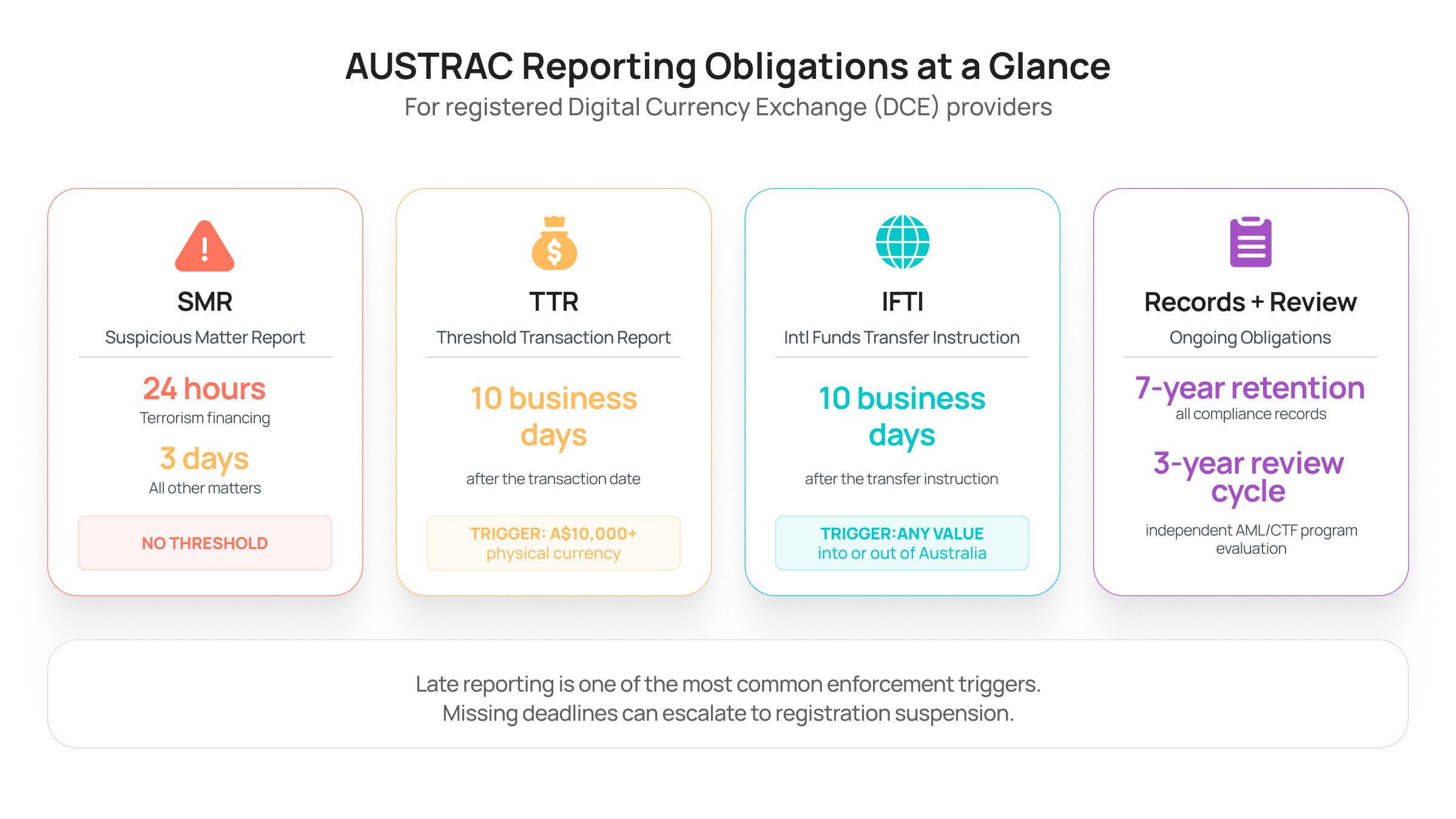
- Suspicious Matter Reports (SMRs): 24-hour deadline for terrorism-related matters, 3 business days for everything else. No materiality threshold.
- Threshold Transaction Reports (TTRs): Any physical currency transaction of A$10,000+, reported within 10 business days.
- International Funds Transfer Instructions (IFTIs): Any transfer into or out of Australia, regardless of value, reported within 10 business days.
Late reporting is a frequent enforcement trigger. In October 2025, AUSTRAC fined Cryptolink A$56,340 for late threshold transaction reports and mandated a full compliance overhaul.
Record Keeping and Review
All compliance records must be retained for seven years. AML/CTF programs require independent evaluation every three years. Customer information needs periodic review, with enhanced due diligence for high-risk accounts. Sanctions screening runs against the DFAT Consolidated List.
For fintech teams whose core product is payroll, remittance, or treasury management, building and maintaining this compliance layer specifically for Australian fiat-to-stablecoin conversion is a significant resource diversion from the actual product.
What Changes on March 31, 2026
Australia's biggest AML/CTF reform since 2006 takes effect on March 31. The AML/CTF Amendment Act 2024 received Royal Assent in December 2024.
Essentially, AUSTRAC's scope is expanding well beyond fiat-to-crypto exchange.
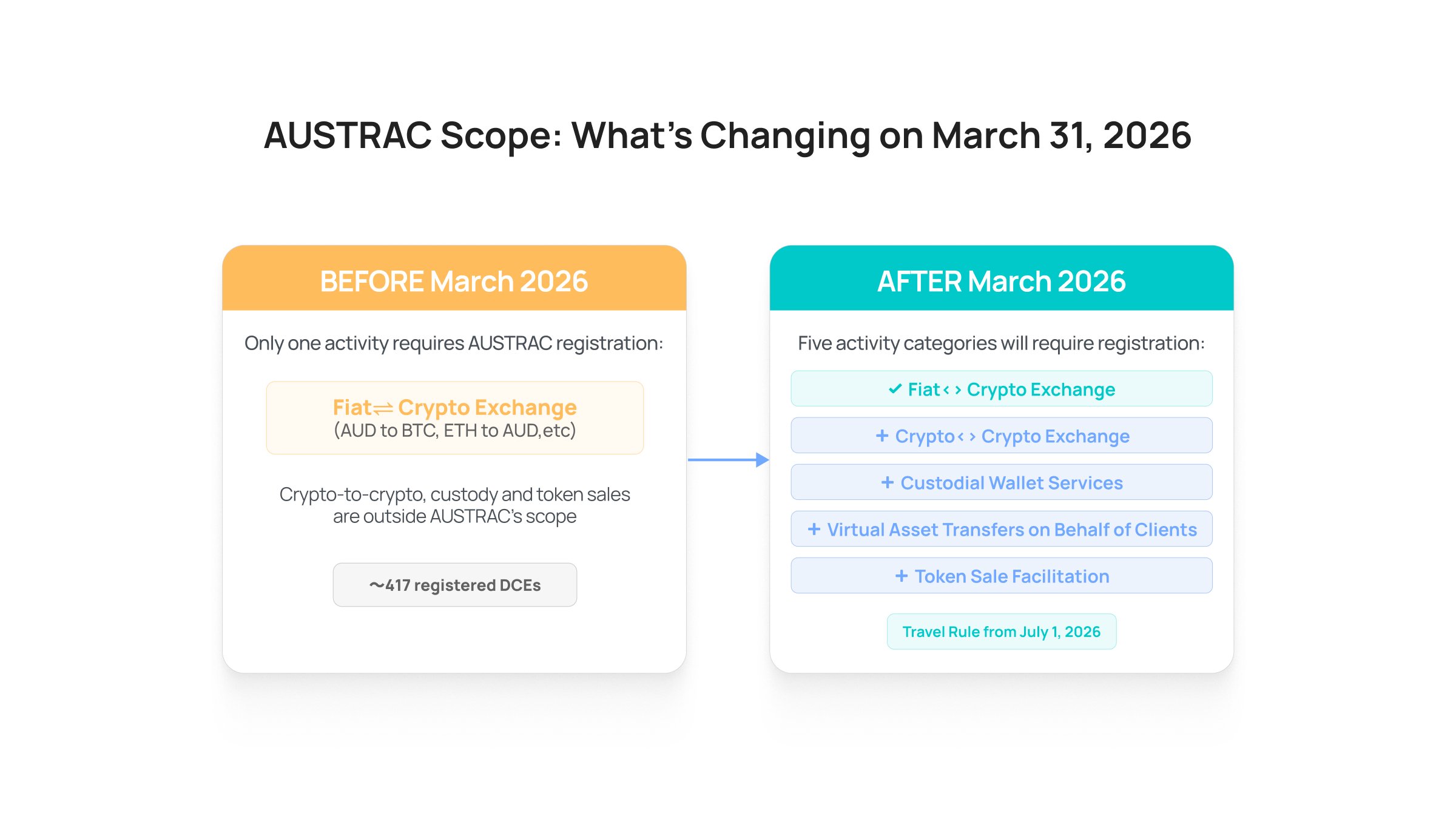
This expansion matters for fintechs using stablecoin rails. If your platform facilitates virtual asset transfers on behalf of customers, or uses custodial wallet infrastructure as part of your payment flow, the entity handling that function will need to be registered after March 31.
The Travel Rule
VASPs must collect, verify, and pass on originator and beneficiary information with every virtual asset transfer. AUSTRAC's transitional rules defer this obligation for virtual asset transfers to July 1, 2026.
Self-Hosted Wallet Reporting
Transfers to or from self-hosted wallets where the controller hasn't been KYC-verified must be reported to the AUSTRAC CEO within 10 business days.
FATF Alignment
Australia faces a FATF mutual evaluation in 2026, driving the compressed reform timeline. The framework is converging with MiCA, the UK's FCA regime, and Singapore's MAS requirements.
Two Paths Into Australia
If your platform needs fiat-to-stablecoin or fiat-to-crypto capability for Australian users, you have two options.
Build Your Own Compliance Stack
Establish an Australian entity, appoint local personnel, develop a tailored AML/CTF program, build reporting workflows, go through the 90-day AUSTRAC assessment, and maintain everything indefinitely.
Integrate with Transak
Transak is already AUSTRAC-registered and maintains the full compliance stack. Your platform uses their licensed rails to handle the fiat-to-stablecoin layer.
This is the path most fintechs take. If your core product is payroll, remittance, treasury, or any application where stablecoins are infrastructure, there's little reason to build a standalone Australian compliance operation for the conversion layer. Just use Transak.
Also Read: What is Stablecoin Orchestration?
How Transak Fits In
Transak is regulated digital assets payments infrastructure, embedded directly into platforms. We hold the licenses, manage compliance, and run the payment rails so you don't have to.
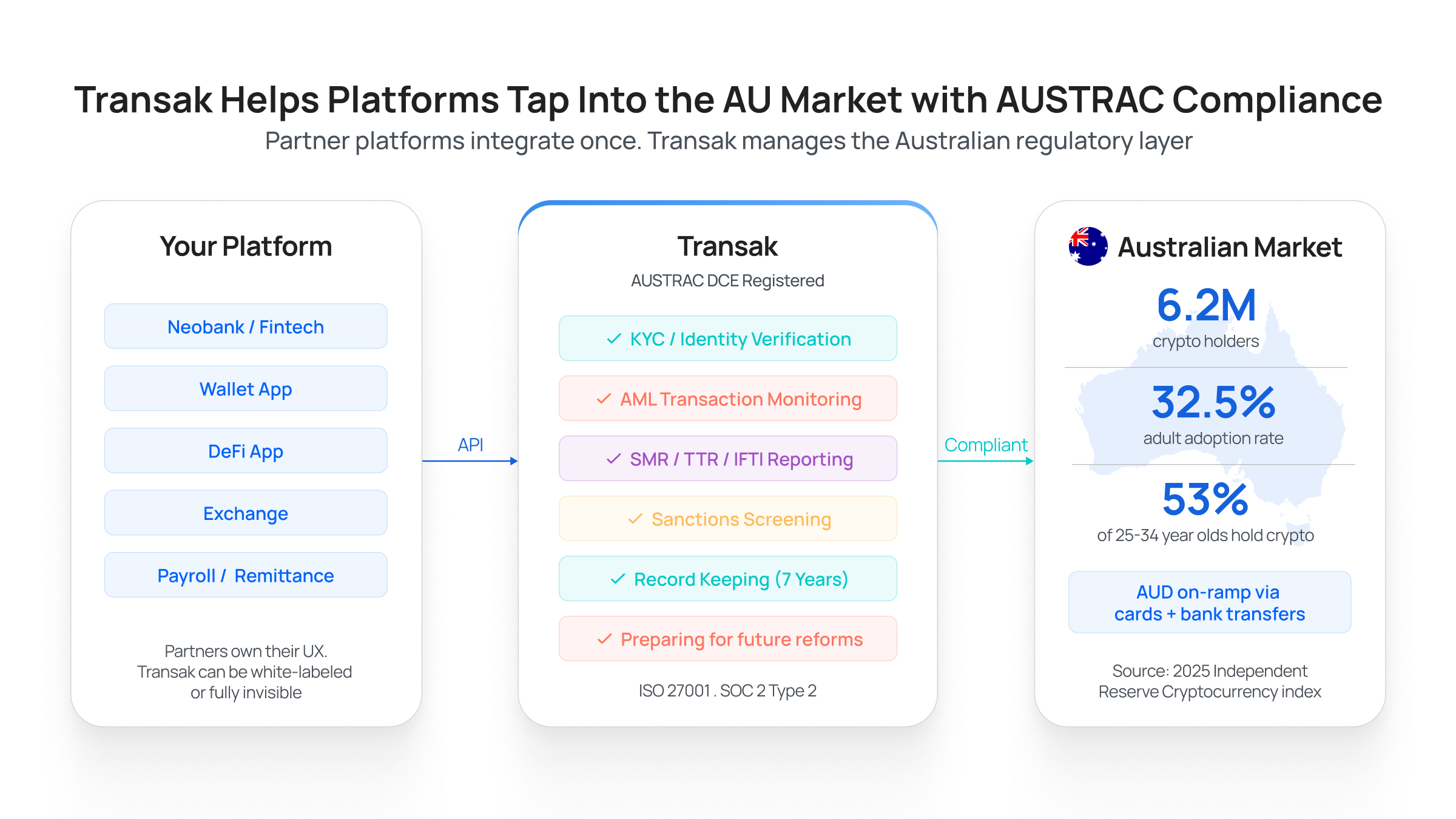
For Australia specifically:
- AUSTRAC DCE registered since early 2025, covering KYC, AML monitoring, reporting, sanctions screening, and seven-year record retention
- Part of a global regulatory footprint spanning the UK (FCA), US (11+ state MTLs), EU, Canada (FINTRAC), and more
- Localized AUD payments via bank transfers and cards
- Modular architecture that lets you use the full stack or bring your own KYC and have Transak rely on your verified identity data
- ISO 27001 and SOC 2 Type 2 certified
- Already preparing for the 2026 reforms
Check out integration options, the developer docs, or the compliance page for a full list of licenses.