Takeaways
Most content about stablecoin payroll stops at the pitch, “faster, cheaper, borderless.” That's the sales deck. This article is the architecture diagram.
If you're an engineer, product lead, or payments architect evaluating stablecoin payroll for your platform, you need to know what actually happens when a payroll instruction hits the infrastructure layer.
- What converts the fiat?
- Which chain carries the value?
- How does the recipient get local currency
- What happens when a payout in a batch of 500 fails at step three?
This is the technical breakdown of every layer of the stack, from fiat collection to last-mile delivery, including the failure modes that don't show up in product demos.
The Settlement Stack: Four Layers
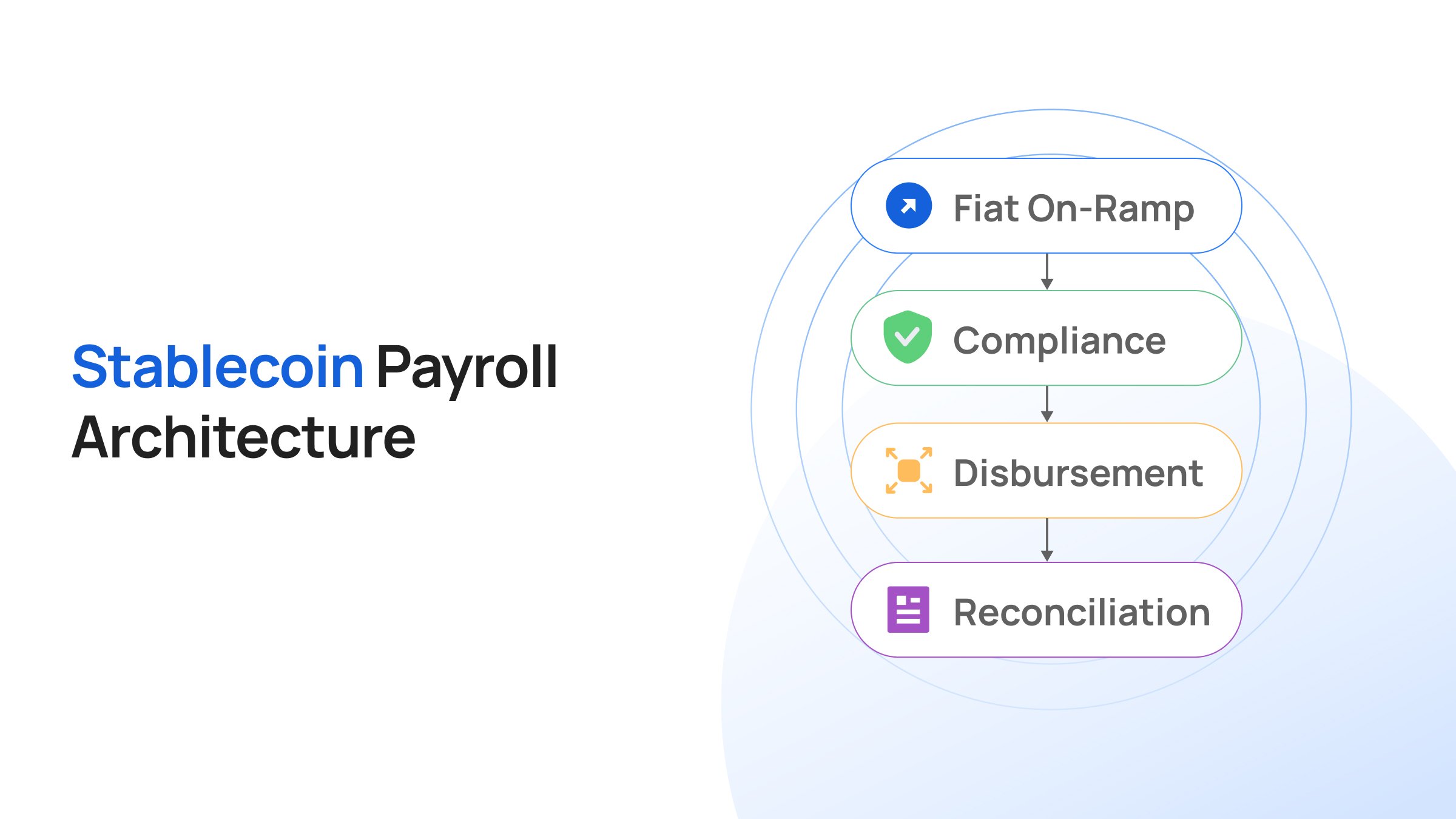
A production-grade stablecoin payroll settlement system isn't one monolithic service. It's a modular stack with four distinct layers.
Layer 1: Fiat Collection and On-Ramp
The on-ramp layer collects fiat from the employer via local rails and converts it to stablecoins. Conversion happens in four ways:
- Platform’s liquidity engine
- Established liquidity partners
- OTC-based conversion
- Direct mint-and-burn with the stablecoin issuer (Circle for USDC, typically for volumes above $30M/month)
Also Read: How Transak Abstracts the Messy Middle of Stablecoin Payments
Layer 2: Compliance and Screening
The compliance layer runs KYC/KYB verification, OFAC/EU/UN sanctions and PEP screening (on every payout cycle, not just onboarding), transaction monitoring for anomalous patterns, and jurisdictional rule enforcement per-recipient and per-corridor.
Layer 3: Disbursement and Last-Mile Delivery
Stablecoins are sent to the off-ramp provider, converted, and settled to the recipient's bank account or mobile money wallet via local rails. Settlement timing depends on the destination and payout method.
The off-ramp is the most common failure point in stablecoin payroll. On-chain transfers rarely fail. Off-ramps fail because of mismatched bank details, inactive mobile wallets, local rail outages, FX movement between quote and settlement, and regulatory holds.
When using Transak, the on-ramp and off-ramp are handled by the same infrastructure provider, us, and you get the best on-ramp and best off-ramp in a single integration.
Also Read: Payouts in Stables: What Should You Know
Layer 4: Reconciliation and Reporting
The on-chain ledger (transaction hashes, block confirmations, timestamps) is matched against the off-chain ledger (fiat funding, FX conversions, off-ramp settlements) to produce an end-to-end audit trail.
The infrastructure reports status to the payroll platform via webhooks as each payout transitions through a state machine. If failed, the payroll platform receives a reason code.
Also Read: How Stablecoins Fit Into the Modern Treasury Stack
Infrastructure Components Needed To Build In-House
Most of these components require ongoing maintenance as chains upgrade, rails change, regulations evolve, and off-ramp partners adjust their terms.
Also Read: The Stablecoin Playbook for 2026
Fiat Payment Rail Integrations
Direct connections to ACH, SEPA, Faster Payments, PIX, and many other local payment systems, each with its own API, settlement behavior, and failure modes.
Stablecoin Custody
MPC (multi-party computation) wallet infrastructure with role-based access controls, multi-user approval workflows, whitelisted address management, and velocity limits. You need hot wallets for operational throughput and warm/cold wallets for reserve management.
Blockchain Node Infrastructure
Either self-hosted nodes or managed RPC providers for every supported chain. You need reliable transaction broadcasting, mempool monitoring, gas estimation, and event indexing.
Compliance Engine
KYC/KYB provider integrations, sanctions screening APIs, transaction monitoring rules, and jurisdictional policy enforcement (all running in real-time on every transaction).
Off-Ramp Network
Relationships with local payment providers in every destination market. Each off-ramp partner has its own integration, settlement behavior, and reliability profile. Redundancy (multiple off-ramp options per corridor) is essential for production reliability.
Reconciliation System
Dual-ledger reconciliation across on-chain and off-chain records, with automated matching, exception flagging, and report generation.
Webhook and Callback Infrastructure
Event-driven notification system with guaranteed delivery, retry logic, and idempotency keys.
Where Transak Fits in the Stack
Transak provides the infrastructure so payroll platforms can focus on their core product instead of building and maintaining settlement infrastructure.
Specifically, we handle fiat on-ramp coverage across multiple countries with support for local payment rails, stablecoin conversion, compliance-as-infrastructure including KYC, AML, and sanctions screening under our own regulatory licenses, off-ramp delivery to local bank accounts and payment methods in destination markets, and reconciliation and webhook-based status reporting via API.
The integration surface for payroll platforms is an API layer. The payroll platform sends payout instructions (recipient, amount, delivery preference). Transak handles the conversion, routing, delivery, and reconciliation underneath, and reports back via webhooks at each state transition.
Want to dig deeper? Talk to us.
FAQs
Which blockchain networks are best for payroll transactions?
It depends on the corridor. Solana offers sub-cent fees and sub-second finality, making it well-suited for high-volume, low-value payouts. Ethereum Layer 2s (Arbitrum, Base, Optimism) provide low fees with Ethereum-grade security for institutional flows. Tron carries the majority of USDT volume globally and dominates in Asia and Africa.
How does stablecoin payroll settlement handle failures?
On-chain transfers rarely fail when gas and nonce management are handled correctly. Off-ramp failures (mismatched bank details, inactive wallets, local rail outages) are the primary failure mode. Production systems use automatic retries, fallback payout methods, and manual review queues. Failed payouts are quarantined without blocking the rest of the batch.
What's the typical settlement time for stablecoin payroll?
The on-chain leg settles in seconds to minutes depending on the network. The off-ramp leg depends on the destination rail. For example, real-time payment markets (Brazil, India, UK) settle in minutes while other markets may take a few hours. End-to-end, most stablecoin payroll flows complete in under an hour, compared to 3–5 business days for traditional correspondent banking.
Do payroll platforms need their own licenses to use stablecoin rails?
Not if they partner with a licensed infrastructure provider. Transak holds regulatory approvals in major countries of the world. Payroll platforms inherit this compliance coverage through the API integration and they don't need to obtain separate money transmission or payment institution licenses for the stablecoin layer.