Takeaways
- Stablecoin orchestration turns blockchain complexity into a simple enterprise payment instruction.
- Enterprises care about speed, cost, and reliability, not holding crypto.
- Most real-world deployments use fiat in, stablecoins in the middle, fiat out.
- Cross-border payments drop from days to minutes with near real-time visibility.
- Partnering beats building unless payments infrastructure is your core business.
Most enterprises still struggle with one question, “If stablecoins are so powerful, why are they still so hard to use inside real businesses?”
The answer is orchestration.
What Is Stablecoin Orchestration?
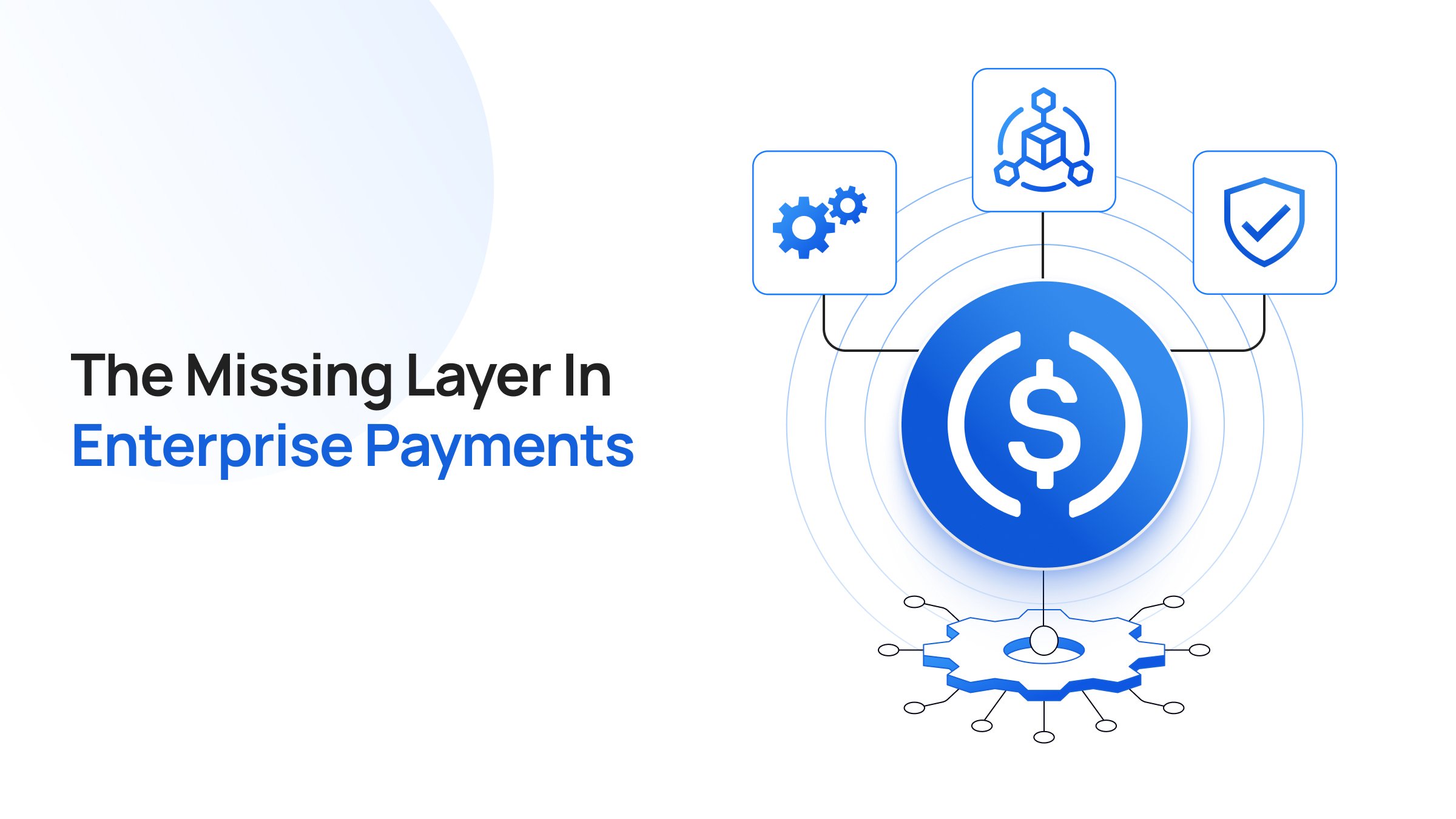
Stablecoin orchestration is the middleware layer that turns blockchains into usable payment rails for enterprises. It handles all the blockchain complexity so you don't have to. You make a high-level request, like "pay this Brazilian supplier $100,000,” and the orchestration layer figures out everything else.
The orchestration layer decides:
- Which stablecoin to use
- Which blockchain to route through
- When to convert fiat to stablecoins and back
- How to apply compliance checks
- How to settle, confirm, and reconcile the payment
Orchestration > Stablecoin Itself
Most enterprises do not need “crypto exposure.” They need faster settlement, lower cross border costs, 24/7 availability, predictable cash movement, and audit ready reporting.
Stablecoin orchestration delivers those benefits without changing how finance teams think about money. This is why orchestration, not the stablecoin, is the real value layer.
Also Read: Accept Payments in Crypto: Starter’s Guide for Businesses
Use Cases of Stablecoin Orchestration
- Cross-border B2B payments: Enterprises are paying overseas suppliers in minutes instead of days.
- Treasury operations: Multinationals move liquidity between subsidiaries instantly, even outside banking hours.
- Global payroll and contractor payouts: Companies pay international workers in stable value dollars, regardless of local banking reliability.
The "Stablecoin Sandwich": How This Works in Practice
The most common pattern today is what the industry calls the "stablecoin sandwich." It's a hybrid architecture where your payments start and end in traditional fiat, with stablecoins as the fast, cheap middle layer for cross-border movement.
Here is how it works in practice:
- Your company initiates a payment in fiat.
- The orchestration layer converts fiat into a regulated stablecoin and routes it across the most efficient blockchain.
- On the receiving side, the stablecoin is converted back into local fiat and delivered via domestic rails.
Also Read: A Step-by-Step Guide to Blockchain Payments
Example
Say, your German subsidiary needs to pay a Singapore supplier €500,000.
In the traditional route, you’d wire transfer through correspondent banks. This takes up 3-5 business days, $50 in wire fees, and 1-3% FX spread. All that and you still have no visibility of funds while they’re in transit.
In the orchestrated stablecoin route;
- On-ramp (2 minutes): Your EUR converts to USDC through a licensed provider. KYC and compliance checks happen automatically.
- Cross-border transfer (30 seconds): USDC moves on-chain. The orchestration layer chose Polygon because Ethereum was congested and fees were high.
- Off-ramp (5 minutes): Local Singapore partner converts USDC to SGD and deposits to your supplier's bank account via domestic rails.
With stablecoin rails, the total time taken for the transfer is well under 10 minutes and costs in the ball park of 0.3% all-in.
Also Read: What Is Payment Finance (PayFi)?
Risk Management
Now, let's address the elephant in the room: "What if something goes wrong?"
Concern #1: What if the stablecoin loses its peg or the issuer goes bankrupt?
Post-GENIUS Act, permitted issuers must maintain 100% reserves in cash and Treasury bills with monthly audited attestations. Circle (USDC) publishes reserve reports monthly.
Concern #2: What if our on/off-ramp provider defrauds?
This is exactly why you need a robust orchestration partner like Transak.
When you route payments through Transak's, you're relying on infrastructure that’s backed licensed in some of the most regulated environments in the world, like the UK, EU, and US. We also have strong relationships with banking partners and payment networks worldwide to ensure your enterprise gets nothing short of “best”.
Concern #3: What if regulations change and we're suddenly non-compliant?
If that happens, it wouldn’t be our first time. Regulations have been changing faster than most enterprise leaders can keep up. Yet, none of that burden was passed on to our partners.
Our team actively monitors regulatory developments worldwide and will coordinate with you (or your team) to make necessary adjustments at the earliest.
Who's Already Using Stablecoin Orchestration
Enterprises around the world are already including stablecoins and crypto payments in their strategy meetings.
- Visa is settling transactions in stablecoins. The payment network settled $3.5 billion annualized volume as of November 2025. They support USDC, PYUSD, and EURC across multiple blockchains.
- Stripe acquired Bridge for $1.1 billion in October 2024 and launched Stablecoin Financial Accounts in 101 countries. Merchants can accept USDC with 1.5% fees and get settled in USD.
- Mastercard is enabling acquiring institutions to settle with merchants using stablecoins, with pilots across Eastern Europe, Middle East, and Africa.
- Major banks including JPMorgan, Goldman Sachs, and Bank of America have announced stablecoin initiatives under the new regulatory frameworks.
Also Read: How Neobanks Can Increase Profits Using Stablecoin Rails
Stablecoin Orchestration: Partner or Build It Yourself?
You've seen the business case. You understand the technology. Now comes the critical decision: Do you build this capability in-house or partner with an orchestration platform?
Build In-House |
Partner with Transak |
|
|
Time to Market |
12-18 months minimum |
4-8 weeks |
|
Upfront Investment |
$2-5 million |
Nominal (contact us) |
|
Engineering Team Required |
8-12 specialists (blockchain, security, compliance, DevOps) |
Your existing integration team |
|
Geographic Coverage |
Build relationships market-by-market |
Global coverage from day one |
|
Blockchain Support |
Integrate each network individually |
All major chains supported |
|
Compliance |
Your team monitors and implements regulatory changes |
We take care of compliance with minimal involvement of your team |
|
Routing Optimization |
Build smart routing engine from scratch |
Intelligent routing handles automatically |
Conclusion
Unless you're processing billions annually or building payments-as-a-service for customers, building a stablecoin orchestration stack from scratch doesn't make economic sense. We’ve already invested years and millions solving the hard problems: global liquidity networks, multi-chain infrastructure, regulatory compliance, security protocols, and reconciliation workflows.
Your competitive advantage isn't in building blockchain infrastructure. It is in using that infrastructure faster and better than competitors to improve your payment rails.