![Stablecoin Payroll Infrastructure for Payroll Providers [2026 Guide]](https://6983209.fs1.hubspotusercontent-na1.net/hubfs/6983209/Stablecoin%20Payroll%20Infrastructure%20for%20Payroll%20Providers%20%5B2026%20Guide%5D_001.jpg)
Takeaways
Cross-border payroll has been broken for decades, and the companies that run payroll platforms know this better than anyone.
When you process payments for a company with employees in the Philippines, Brazil, and Nigeria, you deal with correspondents in each corridor, long settlement windows, opaque FX markups, and high per-transaction fees. And when payments fail (which they routinely do in emerging markets) the reconciliation burden falls squarely on you, the payroll provider.
Now consider the alternative where the payroll cycle is powered by stablecoins. Funds are converted from fiat to USDC, routed across a blockchain network, and delivered to recipients in their local currency. The entire cycle takes minutes, fees drop by 60–80%, and your platform captures new margin on every transaction.
Stablecoin transaction volumes reached $33 trillion in 2025, and payroll is emerging as one of the fastest-growing enterprise use cases. Over 225 businesses integrated stablecoins into their payroll and payout operations in 2025 alone.
This guide is specifically for payroll companies seeking to realize the potential of stablecoin rails for global payroll management.
Why Payroll Platforms Are Adding Stablecoin Payment Rails
The demand signal is coming from both sides of the payroll equation.
On the employer side, companies with distributed global teams are tired of paying exorbitant fees and waiting days for money to move. Finance teams at companies hiring across 10+ countries increasingly view stablecoin settlement as an operational advantage, not an experiment.
The passage of the GENIUS Act in the United States and MiCA enforcement in Europe provided the regulatory clarity that enterprise finance teams needed to move forward with confidence.
On the recipient side, workers in emerging markets are actively seeking stablecoin payouts. In countries with volatile local currencies (like Nigeria, Argentina, Turkey, the Philippines) receiving pay in dollar-denominated stablecoins is a hedge against purchasing power erosion.
For traditional payroll systems caught in the middle, stablecoin rails solve many problems at once:
- Speed: Traditional cross-border payroll settles in 3–5 business days, sometimes longer for exotic corridors. Stablecoin transfers settle in minutes, and they operate around the clock.
- Cost: Every intermediary in the correspondent banking chain takes a cut. Stablecoins reduce the number of intermediaries to near-zero.
- Reach: Banking infrastructure is still rudimentary in underbanked regions. With stablecoin rails, payroll platforms can confidently tap into these new markets.
- Capital efficiency: Without stablecoin rails, payroll platforms must prefund accounts across corridors and tie up working capital to ensure liquidity. Stablecoin settlement frees that capital because settlement is near-instant and there's no float sitting in intermediary accounts for days.
How Stablecoin Payroll Settlement Actually Works
Most enterprise stablecoin payroll flows follow what the industry calls "the stablecoin sandwich." It is a payment architecture where value starts in fiat, moves across borders on stablecoin rails, and converts back to local currency (or stays in stablecoins) at the destination.
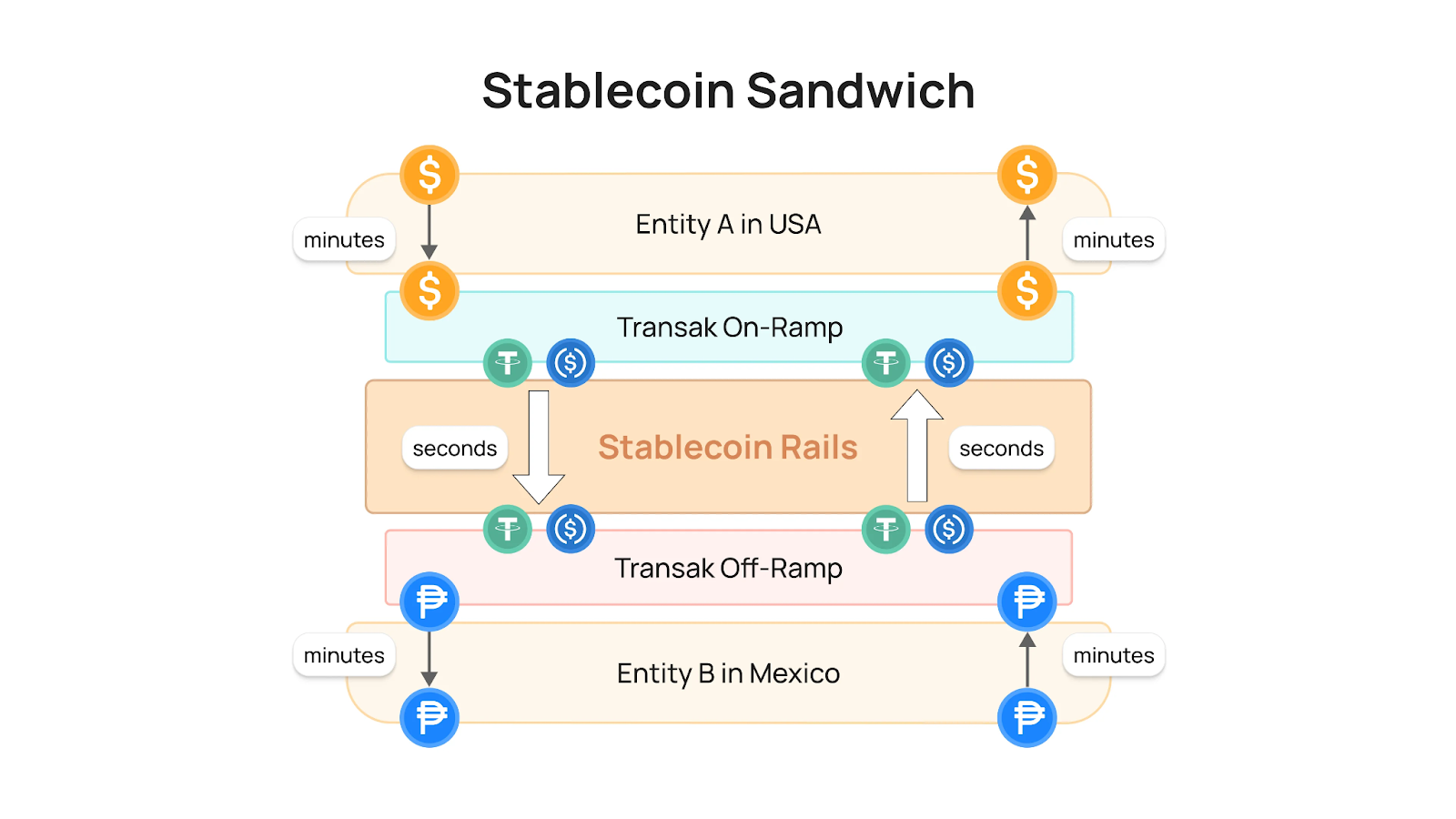
In your case, your platform would orchestrate the instruction, like who gets paid, how much, and where. The infrastructure partner (say, Transak) handles the fiat conversion, compliance, chain routing, and last-mile delivery.
Here's how the flow works in practice for a payroll platform.
Step 1: Fiat On-Ramp
The employer funds the payroll cycle in their local fiat currency (USD, EUR, GBP, etc.). Transak converts this fiat into a stablecoin (typically USDC or USDT) via a compliant on-ramp, handling KYC, payment processing, and settlement.
Step 2: On-Chain Transfer
The stablecoins are routed across a blockchain network to the destination.
Step 3: Local Delivery
At the destination, the recipient either receives stablecoins directly into a wallet or Transak converts stablecoins back to local currency and delivers to the bank account.
What Payroll Platforms Need From a Stablecoin Infrastructure Partner
Adding stablecoin rails to a payroll platform isn't as simple as calling a blockchain API. It requires a stack of capabilities that most payroll companies typically neither have nor want to build. Here's what the infrastructure layer needs to deliver.
Global Fiat On-Ramp and Off-Ramp Coverage
This is the most critical piece. Stablecoins are only useful for payroll if money can enter and exit the blockchain seamlessly. That means the infrastructure partner must support fiat-to-stablecoin conversion across dozens of countries and payment methods and stablecoin-to-fiat conversion with local payout rails in destination markets.
The "last mile" problem, i.e., getting stablecoins back into spendable local currency for the recipient, is a big one for companies to solve. A robust infrastructure partner maintains relationships with local payment providers, banks, and mobile money operators in each destination corridor.
Also Read: How Transak Abstracts the Messy Middle of Stablecoin Payments
Built-In Compliance and Regulatory Infrastructure
Payroll is very heavily regulated. Every transaction involves identity verification, tax reporting obligations, sanctions screening, and anti-money laundering checks. When stablecoins enter the equation, these requirements multiply.
The infrastructure partner must handle KYC/KYB verification, AML and sanctions screening on every transaction, jurisdictional compliance across the countries where payroll is being disbursed, and transaction monitoring and reporting capabilities for audit trails.
If you choose to integrate our stack, the compliance burden reduces dramatically because we hold licenses in major jurisdictions like the US, UK, EU, Australia, and more.
Multi-Chain Support and Intelligent Routing
Not all blockchain networks are created equal, and the optimal chain for a payroll transaction depends on the corridor, the recipient's preferences, and the cost/speed requirements. A stablecoin payroll infrastructure must support multiple chains and intelligently route transactions.
For high-volume, low-value payouts (like freelancer payments in Southeast Asia), a low-fee network like Solana or a Layer 2 solution may be ideal. For high-value enterprise payroll runs, an institutional-grade settlement layer may be more appropriate. The infrastructure should abstract this complexity away so the payroll platform simply specifies the payout instruction and the routing happens automatically.
Also Read: What Is Stablecoin Orchestration?
Fully Native Integration
Your payroll platform has its own user interfaces, workflows, and brand identity. You wouldn’t want to redirect employers or recipients to a third-party checkout.
The integration should work such that the employer sees a familiar payroll funding experience (whether they fund in fiat or stablecoins), the recipient sees a payout notification within the platform they already use, and the payroll platform's engineering team can integrate the stablecoin flow with the same effort as adding a new payment rail.
Why Building Stablecoin Infrastructure In-House Doesn't Scale for Payroll Companies
Off the top, building stablecoin payment infrastructure in-house requires
- Obtaining money transmission and payment institution licenses in every Operating jurisdiction (a process that takes 12–24 months per market)
- Establishing banking relationships for fiat on-ramps and off-ramps in each corridor
- Building KYC/AML systems that satisfy multiple regulatory regimes simultaneously
- Managing liquidity across stablecoins, chains, and fiat currencies
- Hiring blockchain engineers to build and maintain smart contract integrations
- Implementing transaction monitoring
- Fraud detection, and dispute resolution systems
- Maintaining ongoing compliance as regulations evolve (and they are evolving rapidly)
A payroll platform's competitive advantage lies in employer relationships, compliance automation, HR workflow integration, and global workforce management. It’s not in running blockchain nodes or negotiating with liquidity providers. Every dollar and engineering hour spent building infrastructure that isn't core to the payroll product is a dollar and hour not spent on differentiation.
This is exactly why the market has moved toward a partnering model. Major payroll platforms that added stablecoin capabilities in 2025 and 2026 did so by integrating third-party infrastructure for on/off-ramps, compliance, and multi-chain settlement.
As we put it in our stablecoin orchestration guide, partnering beats building unless payments infrastructure is your core business.
Also Read: Why FinTechs Are Turning to Stablecoins: Key Benefits and Challenges
How to Integrate Stablecoin Payroll Infrastructure: A Step-by-Step Approach
Adopting stablecoin rails doesn't have to be a big-bang migration. The most successful implementations follow a phased approach.
Phase 1: Define Your Use Case and Corridors
Start with the corridors where stablecoin rails deliver the most obvious value and identify which of your global payroll flows suffer from the longest settlement times, highest FX costs, most frequent payment failures, or greatest demand from recipients for dollar-denominated pay.
These corridors are your pilot candidates.
Phase 2: Select and Integrate an Infrastructure Partner
Evaluate partners based on (not exhaustive):
- On/off-ramp coverage
- Compliance
- Multi-chain support
- API maturity
For most global payroll platforms, a working integration can be deployed in days or weeks when they choose Transak.
Phase 3: Run a Controlled Pilot
Launch with a limited set of employers and corridors. Monitor settlement times, conversion rates and spreads, payout failure rates and resolution times, recipient experience and satisfaction, and reconciliation accuracy.
Use the pilot to validate unit economics and build internal confidence before broader rollout.
Phase 4: Scale and Expand
Once the pilot proves out, expand to additional corridors and employer segments, and begin monetizing the new capabilities.
Also Read: Payouts in Stables: What Should You Know
Transak for Stablecoin Payroll
Transak provides the infrastructure layer that enables global payroll platforms to offer stablecoin-powered payouts without building or maintaining the underlying payments stack.
Whether your platform processes payroll for 50 companies or 5,000, we provide the connective tissue between traditional finance and stablecoin settlement so you can modernize your payment rails without the infrastructure overhead.
Integrate Transak for Stablecoin Payroll
FAQs
What is stablecoin payroll?
Stablecoin payroll is a payment method where employers fund payroll in fiat currency, the funds are converted to stablecoins (like USDC or USDT) for cross-border settlement, and recipients receive payment in stablecoins or local currency.
What stablecoins are used for payroll settlement?
USDC and USDT are the most widely used. USDC is favored for institutional flows due to its transparent reserve attestations and regulatory compliance under frameworks like the GENIUS Act. USDT dominates in emerging market corridors (especially on Tron) due to deeper local liquidity.
Do payroll platforms need to build their own stablecoin infrastructure?
No. Building stablecoin infrastructure in-house requires licensing across multiple jurisdictions, banking relationships in every corridor, blockchain engineering, and ongoing compliance management. That’s a process that takes 18–24+ months. Most payroll platforms partner with infrastructure providers like Transak that handle on/off-ramps, compliance, and multi-chain routing via API.
Is stablecoin payroll legal and regulated?
Different corridors could invite different compliance obligations. While stablecoin-based money movement is becoming increasingly regulated, the legal landscape is still a huge labyrinth. Partnering with Transak ensure you facilitate stablecoin payroll in corridors with full compliance.
How long does it take to integrate stablecoin payroll infrastructure?
A payroll platform can integrate stablecoin payout capabilities in as little as 2–4 weeks. Your existing payroll engine handles calculations and approvals while the infrastructure partner handles fiat conversion, blockchain routing, and local delivery.