Takeaways
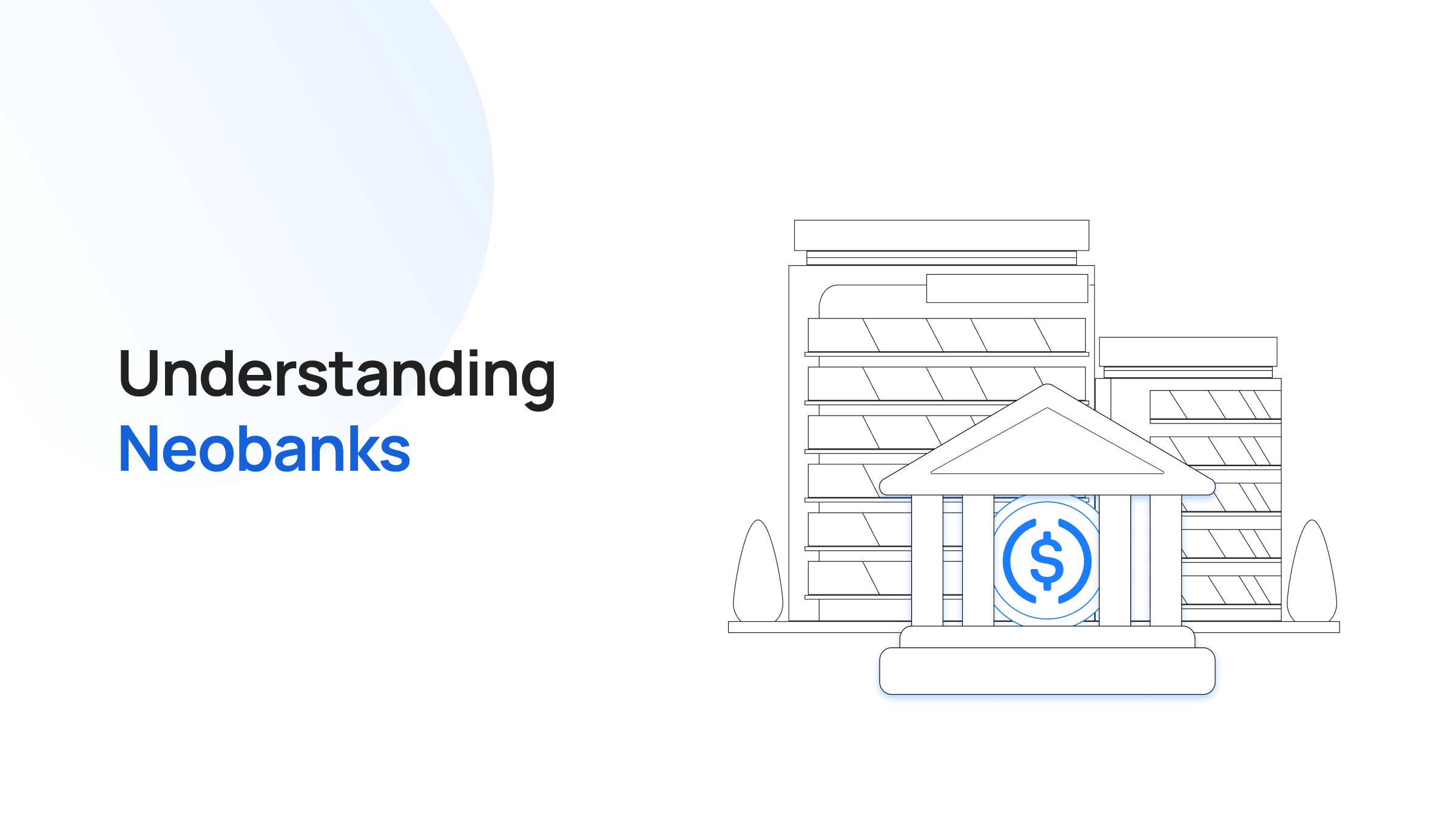
Neobanks are often described as digital banks. That description is incomplete and slightly misleading.
Unlike traditional banks, neobanks are software-first financial platforms moving money faster, cheaper, and with fewer operational constraints than traditional banks. They prioritize user experience but most still rely on legacy payment rails under the hood. That dependence limits what they can do.
Today, crypto infrastructure has matured considerably. Blockchains can be used as neutral settlement rails, with stablecoins functioning as programmable money. When used correctly, these rails can reduce settlement delays, cut intermediary costs, and simplify global payments.
This article explains what a neobank actually is, how payments work inside modern neobanks, and where crypto rails fit into the picture.
What is a Neobank?
A neobank is a digital-first financial services provider that delivers banking-like products through apps and APIs rather than physical branches.
The defining trait of a neobank is distribution, not licensing. Neobanks are built for online onboarding, real-time account access, and automated financial operations. Some hold full banking licenses. Many operate on top of partner banks or banking-as-a-service providers. To the end user, this distinction is often invisible, but it matters significantly for payments, compliance, and custody.
In practical terms, most neobanks offer a mix of:
- Current or checking-style accounts
- Debit or prepaid cards
- Domestic transfers and bill payments
- Multi-currency balances and FX
- Business accounts with invoicing and payouts
- APIs for developers and platforms
What neobanks generally do not change by default is the underlying payment infrastructure. Transfers still rely on systems like ACH, SEPA, and local clearing networks. These rails are slow to evolve, fragmented across borders, and constrained by banking hours and intermediaries.
Neobanks innovate rapidly at the product and experience layer, while the movement of money is still governed by decades-old settlement systems. Now, that is a problem. The rate of innovation is contingent upon the capability of the money rails.
The gap between these two layers is where alternative payment rails, including blockchain-based settlement, become relevant.
Why Neobanks Want Stablecoins
Neobanks are leaning into blockchain rails and stablecoins for one simple reason: they already won the UI layer, and now they want to upgrade the money-moving layer underneath it.
Here are the biggest drivers.
1. Faster settlement, 24/7, not “banking hours”
Neobanks compete on speed. Stablecoin rails settle near-instantly and run 24/7, which maps perfectly to an app-first experience where users expect money movement to feel like sending a message.
Visa expanding USDC settlement for institutional partners is a signal that stablecoin settlement is moving from “crypto feature” to core payments plumbing.
2. Cross-border payments are upgraded
Cross-border money movement is where neobanks can differentiate fastest (migrant remittances, global freelancers, international merchants). Stablecoins simplify the “value transfer” portion of cross-border flows, often reducing the number of intermediaries and reconciliation steps.
3. Better capital efficiency
Traditional payment networks often require prefunding or holding balances across corridors and partners to ensure liquidity. Stablecoin settlement can reduce how much “idle money” needs to sit around just to keep payments flowing, because value can move and settle continuously.
4. Programmability enables “new banking features” without new banking rails
Neobanks win by shipping product features quickly. Stablecoins add a programmable layer that can power:
- instant payouts (marketplaces, creator earnings, gig platforms)
- escrow-like flows
- conditional releases (delivery confirmed, milestone met)
- treasury automation for SMBs
These are hard to do cleanly on legacy rails without extra vendors, manual ops, and batch settlement constraints.
5. Cost pressure and unit economics
Neobanks live and die by unit economics. If stablecoin rails can reduce costs in cross-border, payouts, reconciliation, or chargeback-adjacent workflows, the savings compound at scale.
6. “Invisible crypto” is the winning UX
Most neobanks do not want users to feel like they are “doing crypto.” The trend is to use stablecoins internally, while the customer still sees balances in fiat, familiar card and bank transfer interfaces, and compliance controls and consumer protections
In other words, stablecoins as a backend rail and not not a front-end identity.
How Neobanks Work
Although neobanks feel like banks, many of them do not hold a full banking license themselves. Instead, they often operate through a partnership model.
Most neobanks partner with a licensed bank that provides the regulated “core” banking services behind the scenes. This partnership typically enables:
- regulated account infrastructure
- access to payment networks
- deposit protection where applicable (like FDIC insurance in the U.S. when the underlying partner bank provides it)
The neobank builds the app and user experience, and a chartered bank helps power the regulated banking layer.
As neobanks scale, especially across borders, they run into familiar constraints of legacy payment rails:
- Settlement delays due to banking hours and cutoffs
- Fragmented cross-border flows with multiple intermediaries
- Prefunding requirements that lock up capital
- Complex reconciliation across banks, processors, and regions
These issues are not visible to users at first, but they directly affect costs, speed, and the ability to launch new features.
Stablecoins introduce a new settlement layer that fits naturally into the neobank partner model.
When used responsibly and in compliance with local regulations, stablecoin rails can:
- enable near-instant, 24/7 settlement, independent of banking hours
- simplify cross-border value transfer by moving a single digital asset instead of hopping through multiple correspondent banks
- reduce reliance on prefunded accounts, improving capital efficiency
- support programmable flows, such as automated payouts, conditional releases, and treasury automation
This does not mean neobanks are turning into crypto apps. In most cases, stablecoins sit entirely in the backend. Users still see fiat balances, familiar currencies, and standard account interfaces.
Also Read: How Crypto Payment Processors Are Powering the Internet of Value
Role of Transak in Neobanks
For a neobank, integrating stablecoin rails directly can be operationally complex. You need compliance coverage, liquidity management, on and off-ramps, and reliable global payment access. That is not something most neobanks want to build alone.
Transak acts as a bridge layer between traditional banking systems and blockchain-based settlement:
- enabling compliant fiat-to-stablecoin and stablecoin-to-fiat flows
- handling regulatory requirements such as KYC, AML, and transaction monitoring
- supporting multiple payment methods and jurisdictions through a single integration
- allowing stablecoins to be used as a settlement rail without exposing end users to crypto complexity
In practice, this means a neobank can keep its familiar partner-bank structure, while upgrading parts of its payments stack underneath.
Benefits of Neobanks
Neobanks exist because they make everyday banking simpler. Not because they are trendy, but because they remove friction people have learned to tolerate.
1. They are faster to use
Opening an account takes minutes, not days. Transfers show up quickly. You do not wait in queues or fill out paper forms.
2. They are easier to understand
Fees, balances, and transaction history are visible in real time. You are not guessing where your money is or what you were charged.
3. They work better for modern money flows
Neobanks are built for online businesses, freelancers, remote teams, and global users. Multi-currency accounts, instant payouts, and API access are standard, not add-ons.
4. They reduce unnecessary costs
Lower overhead means fewer hidden fees. FX spreads and international transfer costs are often clearer and cheaper.
5. They integrate with the tools people already use
Accounting software, payroll systems, ecommerce platforms, and developer workflows plug in easily.
6. They improve control and visibility
You can freeze cards, set limits, track spending, and manage permissions without calling support.
How Neobanks Make Money
Most neobanks do not make money in one big way. They stack a lot of small, predictable revenue streams on top of each other.
- Interchange from cards: Every time you use a neobank card, the merchant pays a small fee. The neobank gets a slice of that. This is a core revenue source, especially for consumer-focused neobanks.
- FX spreads and international transfers: When users move money across currencies, neobanks earn on the exchange rate spread or a transfer fee.
- Subscriptions and premium plans: Many neobanks charge monthly fees for higher limits, extra cards, better FX rates, or business features.
- Business services: For business accounts, revenue comes from payouts, invoicing, payroll, API access, and sometimes lending or float income.
- Interest and float: Where regulations allow, neobanks earn interest on balances or short-term treasury management.
That model works, but it has limits. Fees go up as volumes scale. Cross-border payments are expensive to operate. Liquidity gets trapped across regions. Support costs rise when payments fail or get delayed.
By adopting distributed ledger technology and stablecoin rails, neobanks can greatly increase their profitability.
By using stablecoins as a settlement layer, neobanks can:
- Reduce cross-border transfer costs
- Settle payments faster, including outside banking hours
- Cut prefunding requirements across countries
- Automate reconciliation and payouts
- Offer new premium features like instant global payouts
Naturally, overhauling the settlement layer is not an easy task for neobanks. And using cryptocurrency to power payments invites a new wave of compliance checks, registrations, and license procurements. So, what’s the practical solution?
Transak provides modular stacks for neobanks to plug stablecoins natively into their ecosystem.
Instead of becoming a crypto company, a neobank can:
- Add stablecoin rails as a settlement layer behind existing payment flows
- Convert fiat to stablecoins and back using compliant onramps and offramps
- Access global liquidity without managing wallets, custody, or blockchain ops directly
- Rely on built-in KYC, AML, and regulatory coverage across jurisdictions
The result is simple. Neobanks keep their familiar user experience and regulatory posture, while gaining faster settlement, lower cross-border costs, and more efficient liquidity movement. Stablecoins become infrastructure, not a product users have to think about.
Modularity Is Key
The key idea is modularity.
Neobanks are not replacing banks. They are orchestrating a network of partners:
- Licensed banks for custody and compliance
- Card and payment processors for distribution
- Blockchain and stablecoin infrastructure for faster, more flexible settlement
This modular setup is what allows neobanks to evolve faster than traditional institutions, experiment with new rails like stablecoins, and still deliver a simple, trustworthy experience to users.
FAQs about Neobanks
What does neobank mean?
A neobank is a digital-first financial platform that offers banking-like services through apps and APIs. It focuses on software, automation, and user experience, and often operates using partner banks rather than holding a full banking license itself.
Why are neobanks popular?
Neobanks are popular because they are faster to use, easier to understand, and cheaper for many everyday use cases. Account setup is quick, fees are more transparent, and features like instant transfers, spending controls, and multi-currency support feel native to modern users.
Are neobanks FDIC insured?
Neobanks themselves are usually not FDIC insured. However, many partner with FDIC-insured banks that hold customer deposits. In those cases, funds are insured up to applicable limits, but the protection comes from the partner bank, not the neobank.
Are neobanks safe?
Neobanks can be safe when they work with regulated banking partners and follow strong compliance and security practices. Safety depends on who holds the funds, how data is protected, and how disputes and errors are handled, not just on the app experience.
Are neobanks profitable?
Some neobanks are profitable, but many are still focused on growth. Profitability depends on scale, card usage, business accounts, and cost control. Payments, FX, and subscriptions are common profit drivers, while inefficient settlement and cross-border costs can pressure margins.
Are neobanks and digital banks the same?
No. A digital bank usually has a full banking license and operates entirely online. A neobank refers more to a digital distribution model and may rely on partner banks for licenses and core banking functions.
Are neobanks fintechs?
Yes. Neobanks are a category within fintech. They apply software, APIs, and automation to deliver financial services, often by integrating multiple regulated providers behind a single interface.
Are neobanks banks?
Some are, but most are not. A few neobanks hold full banking licenses. Most operate as regulated financial service providers that sit on top of licensed banks.
Who regulates neobanks?
Regulation depends on the country and the neobank’s structure. Partner banks are regulated by traditional banking regulators. Neobanks themselves are typically regulated under payments, money services, or electronic money frameworks, and must comply with KYC, AML, and consumer protection rules in each market they operate in.