Takeaways
When your car needs a wash, you simply drive to a car wash and pay for that one service. If you need a haircut, you visit a salon and pay once for that appointment. You are free to choose a membership if you visit often, but for most occasional needs (like when you’re visiting a new city), paying once feels natural and fair.
You could say that this “pay-per-use” feature is the default for the real world. But the digital world went in a completely different direction.

Today, every app runs on subscriptions. You’ce probably subscribed to more streaming services that you can list in 10 seconds, yet you might only use one of them each day. The others sit idle while you still keep paying. Sometimes you just want to watch a single film or access one specific feature without committing to a monthly bill.
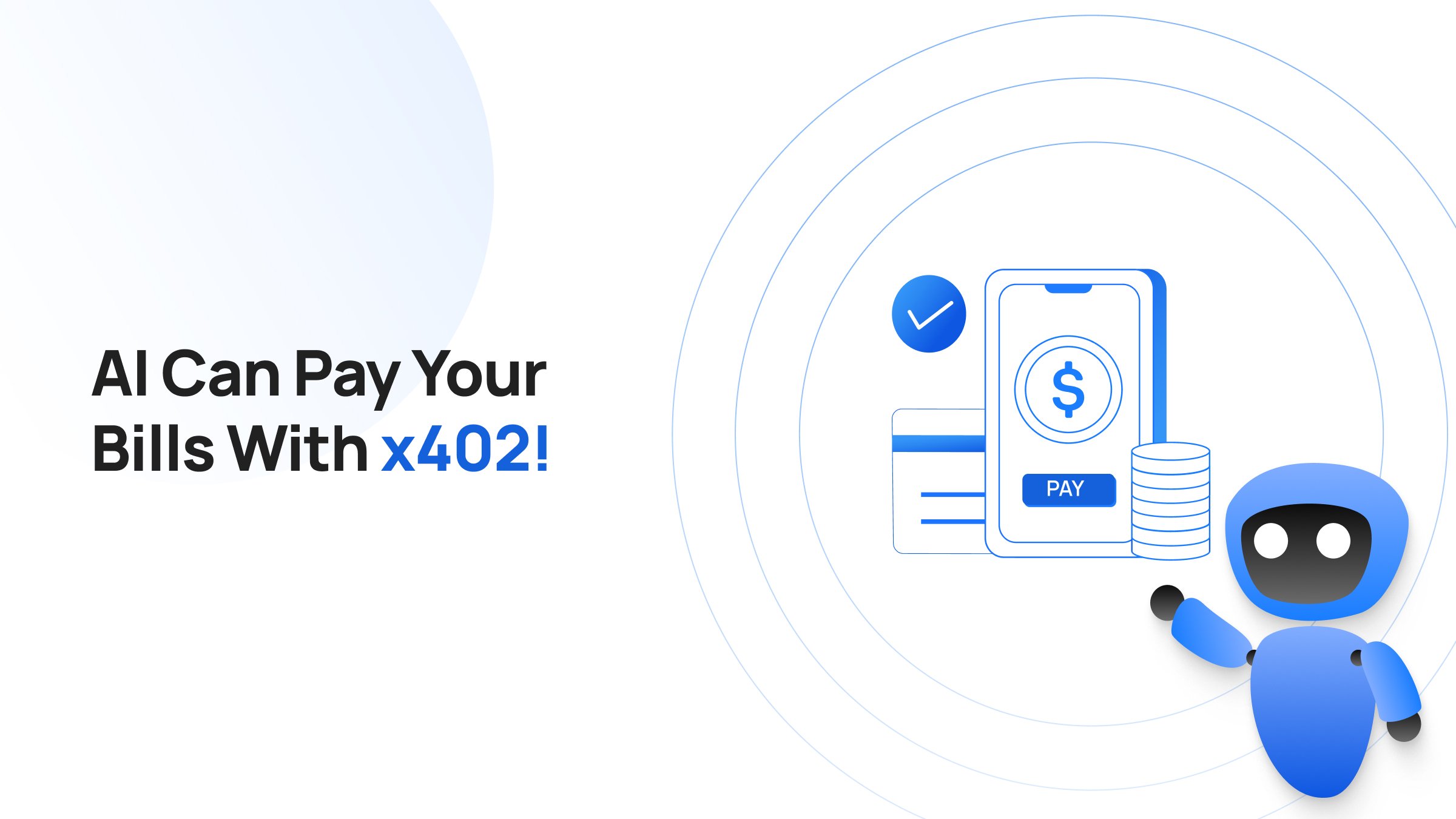
The x402 payment protocol fixes that brilliantly! This article will explain what x402 is and the brilliance behind its innovation.
What is x402?
x402 is an open-standard internet payment protocol designed to let web resources (APIs, services, content) request and accept payments directly via HTTP, before giving access.
The first thing most people notice about x402 is the peculiar nomenclature, specifically, then numbers. The reason behind that is x402 uses the HTTP status code 402 Payment Required (which historically was “reserved”/unused) to signal that payment must be made.
Coinbase authored x402 to be blockchain-agnostic, and more importantly, cater to the next generation of finance, i.e., agentic finance. The expectation is that AI agents would grow exponentially and become significant economic actors of the web, and x402 is the highway that lets these agents discover services, verify price, make a payment, and instantly access what they need without human involvement.
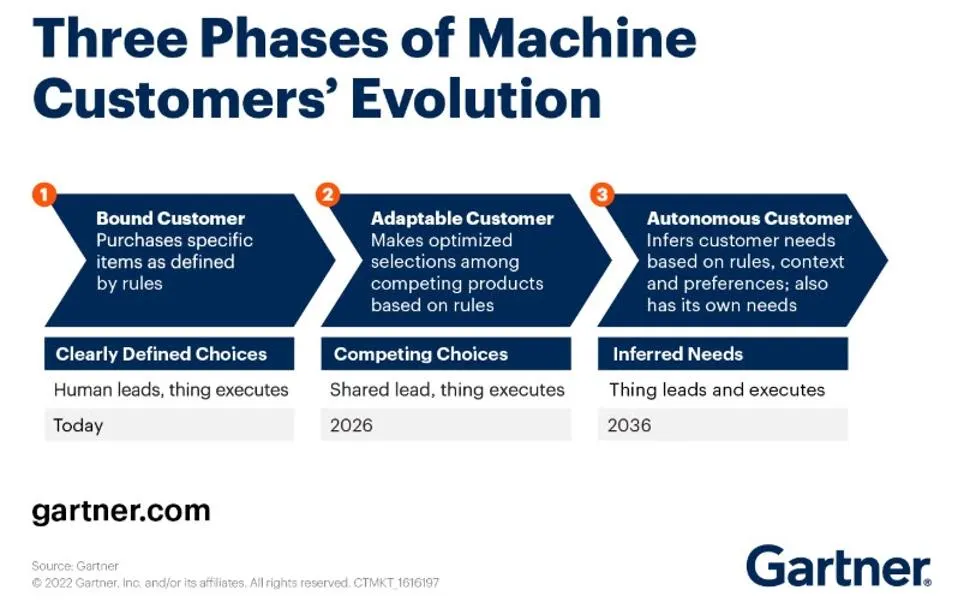
Coinbase’s thesis is very well supported by current trends in the industry and growth data. According to Gartner, “machine customers” will contribute over $30 trillion in purchases by 2030. Even if a fraction of that $30 trillion volume finds utility in x402, the implications would be massive.
At this point, a protocol like x402 needs a strong neutral governance body so that it does not become a single-vendor product. That is why Coinbase and Cloudflare have come together to launch the x402 Foundation, a collaborative effort that will promote standardization, interoperability and global adoption.
Why is x402 Needed?
The entire web mainly runs on two business models:
- Income from ads
- Income from subscriptions
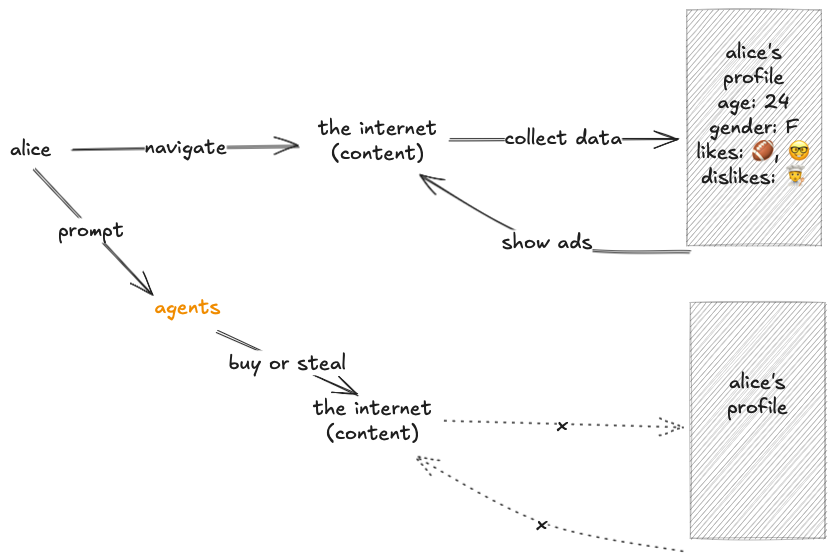
For content that is free, ads made up for the revenue. Harvesting user data for advertising purposes became the dominant economy, and providing ad space (in this case its the websites and apps that allow ads) were the go-to business model.
As the web shifts toward AI agents consuming content instead of humans, ads stop working because you cannot target ads at software. Agents will either scrape content or pay for it, and scraping is unsustainable because the content host (website/app owners) still has to bear the cost of “traffic,” but without economic incentive.
And pay-per-use (particularly penny-sized transactions) was never a practical solution with traditional rails. The moment you try to make payments feel as seamless and granular as clicking a link or calling an API, the old system collapses under fees, human authentication steps, geographic restrictions and minimum transaction limits.
That’s why x402 uses web-native settlement with stablecoins to give both humans and AI agents a way to pay and get access in the same simple request without subscriptions, logins or manual checkout friction.
How x402 Works
There are two main roles in any x402 interaction:
- the client, and
- the server.
Imagine you are the client for a moment. You visit a website and request access to a paywalled article. Instead of showing you a login screen or subscription prompt, the server responds with a 402 Payment Required status. Along with that status is a small payment instruction that lists the price and where to send the funds.
You complete the payment using stablecoins and then resend the request with proof of payment. The server verifies it and immediately unlocks the article for you.
The beauty of this entire process, if you hadn’t already noticed, is that nowhere in the process did you have to go through an account creation process or choosing the right subscription. You just paid for the one instance you used the application and went your merry way.
Here’s the typical sequence:
- Client requests a resource: An app, a browser or an AI agent sends a normal HTTP request to an API or webpage.
- Server responds with 402 Payment Required: If the resource is behind a paywall, the server replies with status code 402 and includes the payment details. This usually contains price, asset type, network and a payment reference.
- Client handles the payment: The client uses a facilitator or wallet to perform the transaction specified in the 402 response. This can be a stablecoin transfer on a supported network.
- Client retries the request with proof of payment: The client resends the original request but adds a payment receipt inside a specific header.
- Server verifies and returns the paid resource: Once the server confirms the payment on chain or via the facilitator, it sends back the requested data with a standard 200 OK.
Key Infrastructure Components of x402
A natural question that comes up is this: if a publication wants to charge for a paywalled report using x402, does it now need to run blockchain infrastructure, verify on-chain payments and maintain settlement logic itself? That would be unrealistic for most websites, which is why the onus of creating and maintaining the infra is not on the application or website (although that is still very much an option for teams that choose to).
The backbone of x402’s infrastructure is the “facilitator.” A facilitator takes up the critical task for checking the payment status and pushing the confirmation message to the server, which would then unlock the asset for the client.
By offloading the “check out process,” the server can remain simple while still benefiting from trustless blockchain settlement.
Coinbase currently operates a hosted facilitator that supports USDC on Base and does not charge facilitator fees. Websites can choose that option, rely on community-run facilitators or host their own if they want full control. Meanwhile, the x402 Foundation is actively working to increase facilitator diversity so that no single operator becomes a bottleneck.
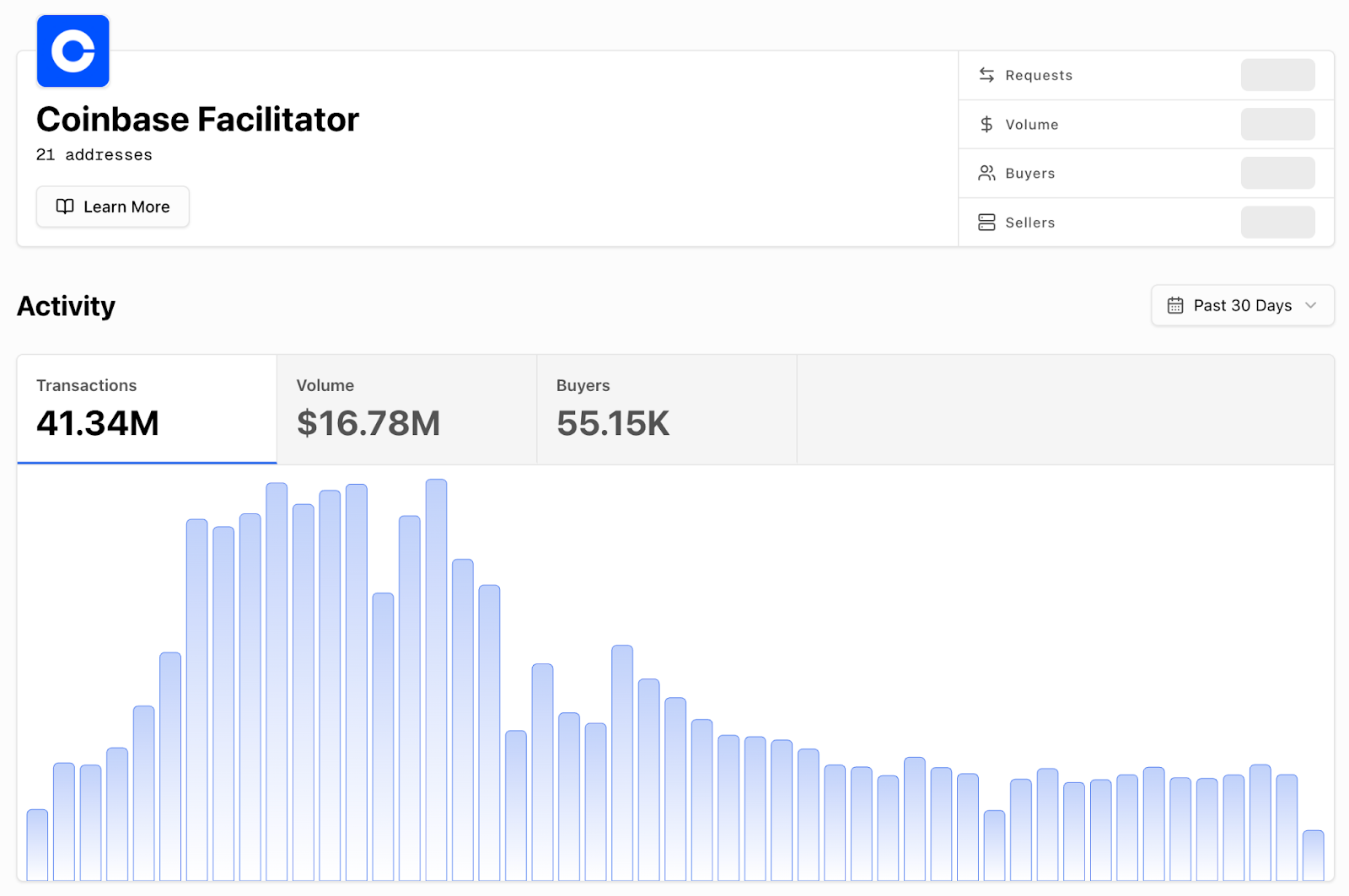
Source: x402scan
As more x402 services appear, developers and AI agents need an easy way to locate them. That is where x402 Bazaar fits in.
Introduced by Coinbase, x402 Bazaar serves as a machine-readable directory that lets software discover, compare and pay for services on demand without requiring manual integration or sign-ups. In many ways, x402 Bazaar is like a Yellow Pages for the agentic web, built for automated discovery rather than human browsing.
x402scan: Keeping Up With The x402 Ecosystem
You can start exploring the x402 ecosystem right away (and for free) with x402scan.
x402scan describes itself as the “ecosystem explorer” for the x402 protocol. It is essentially an analytics platform where you can view transactions, sellers, origins and resources.
It works as an indexer and dashboard that tracks live usage of x402-enabled services. Say, how many payments are being made, what endpoints are active, which facilitators are used, which networks, etc.
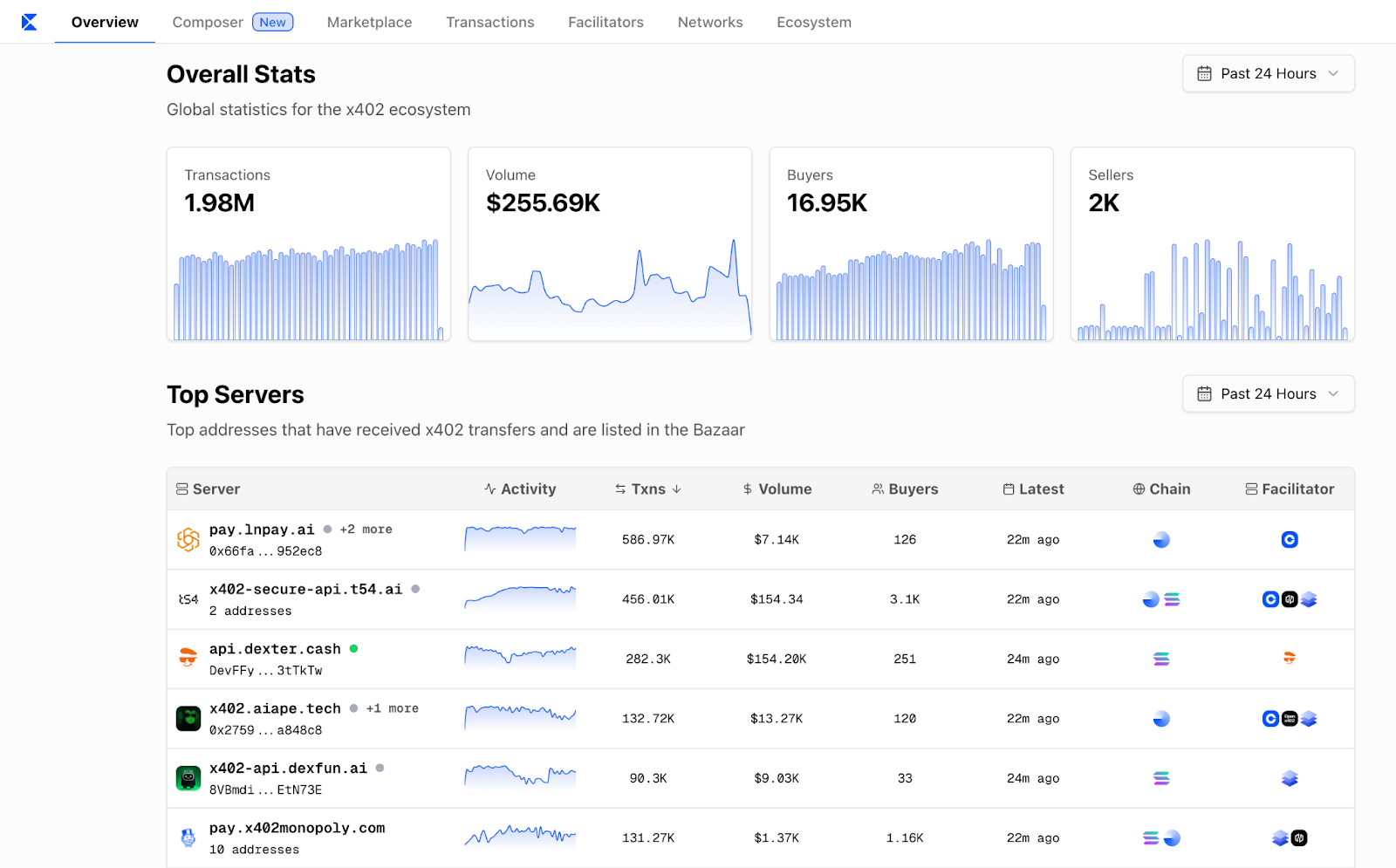
Some of the key metrics and data layers that x402scan provides:
- Transaction volume: Number of x402 payments, total value transferred, growth trends. For example: a report cited the number of transactions hitting 163,600 in a week with a volume of $140,200 and large month-on-month growth.
- Endpoint discovery: Which resource servers (APIs, content portals) are receiving payments under x402, what they charge, which asset/chain they accept.
- Facilitator performance: Which facilitator services are being used, how many verifications/settlements they handle, how reliable they are.
- Network/chain data: Which blockchains (e.g., Base, Solana, Ethereum) are being used for x402 payments, along with latency, fee influence, settlement behaviour.
- Agent/client behaviour: Which clients or AI agents are making payments, how often, what services they call. Some implementations show “agent feed” style tracking.
How Transak Complements x402 for Real Business Use
If you start accepting x402 payments, you’re receiving stablecoins directly onchain. That solves access control and monetization. But it doesn’t solve what happens before and after the payment. That is where Transak becomes valuable.
Many customers will want to pay for your content or API but may not already have stablecoins in their wallets. Sending them to an external exchange interrupts the flow and most will drop off. Integrating Transak inside your platform lets them instantly acquire the supported asset using familiar payment methods like cards or bank transfers. This keeps the experience simple and boosts conversion.
As AI agents begin to pay for services directly through x402, funding those agent wallets becomes an ongoing need. Transak can automate top ups so agents never run out of balance, preserving a fully autonomous pay per use loop.
FAQs about x402 Payment Protocol
What is x402 payment?
x402 payment (the protocol) is an open-standard payment layer built into the web. It lets a client (human, app or AI agent) request a resource, receive a HTTP 402 Payment Required response with payment details, then make a payment with stablecoins and receive the resource once payment is verified.
What is the code x402?
The “code” x402 comes from the HTTP status code 402 Payment Required, which until now had been reserved and unused in the HTTP specification. The x402 protocol revives and repurposes that status code as the trigger for a payment-first access flow on the internet.
Who created x402?
The protocol was authored in large part by Coinbase (via its Developer Platform) as an open-source standard for internet-native payments.
How to invest in x402?
Since x402 itself is a protocol and does not have an official token, there’s no “x402 coin” to buy per se. What you can do is explore the ecosystem of services and projects built on x402 using the explorer x402scan. Some of these projects issue their own tokens (for example the token PING, a memecoin, is cited as the first token issued using the x402 standard). If you decide to invest in such projects you should proceed with caution as they are speculative, carry risk and are distinct from the core protocol.