Takeaways
Companies want to give employees the option to receive part of their salary in stablecoins like USDC or USDT. The demand is real. Over 53% of contractors on platforms like Rise already choose stablecoin payouts, and USDC accounted for 63% of all crypto payrolls in 2024.
But the gap between employee demand and employer willingness keeps growing, because existing solutions require the company to enter the crypto flow.
We built an infrastructure layer that closes this gap entirely.
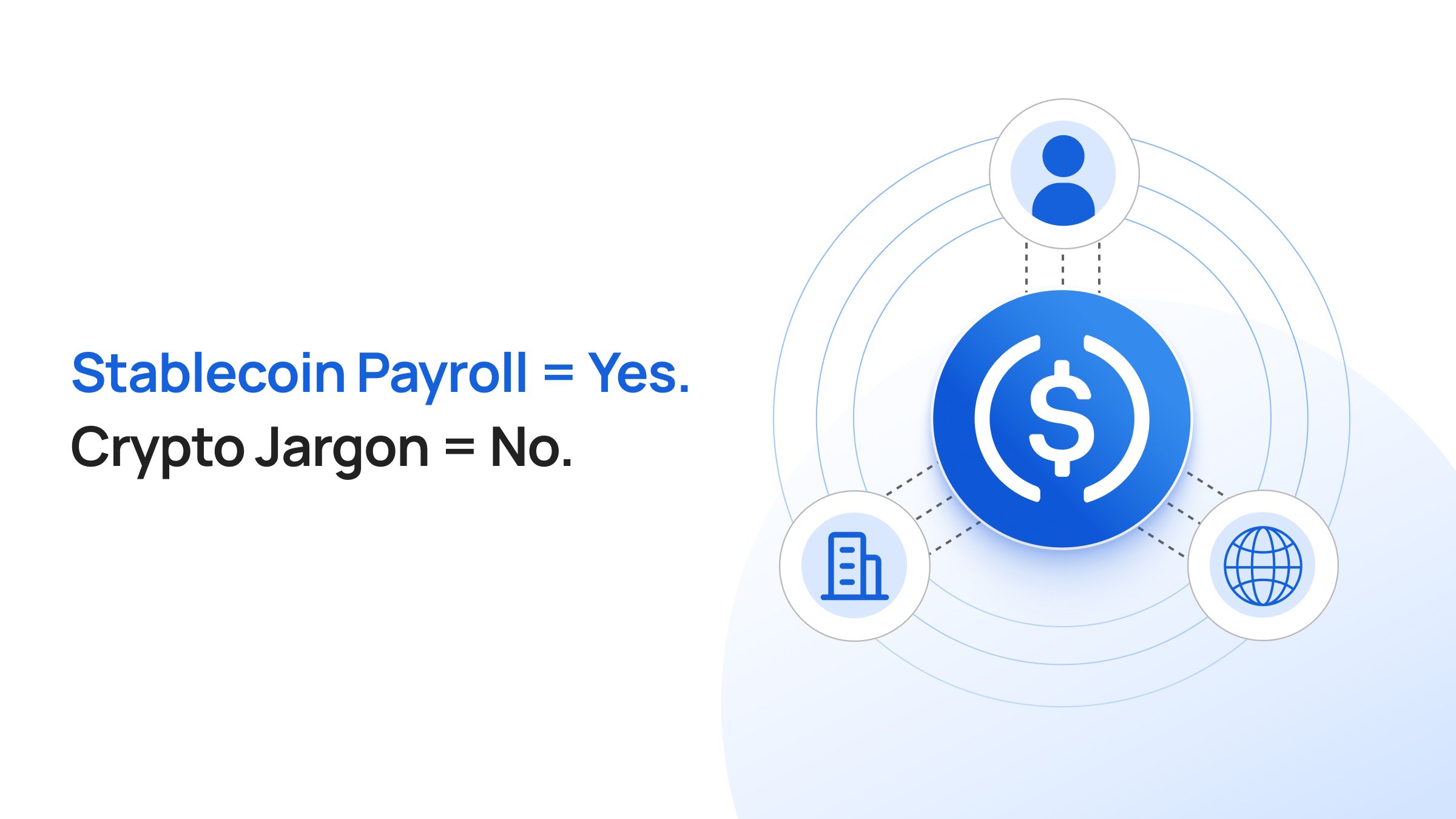
The company sends fiat. The employee receives stablecoins. Transak handles everything in between, under our own regulatory licenses, without the employer ever holding, converting, or transmitting a single digital asset.
The Catch-22 For Payroll Teams
Companies increasingly want to offer employees the option to receive part of their salary in stablecoins. This is particularly relevant for international payroll, where employees in markets like India, Southeast Asia, or Latin America want access to dollar-equivalent assets without depending on traditional banking corridors.
But companies have no appetite to touch cryptocurrency themselves.
Also Read: Are Stablecoins Safe? Stablecoin Risks and Safety Guide for Businesses
How Transak Removes The Company From The Crypto Flow
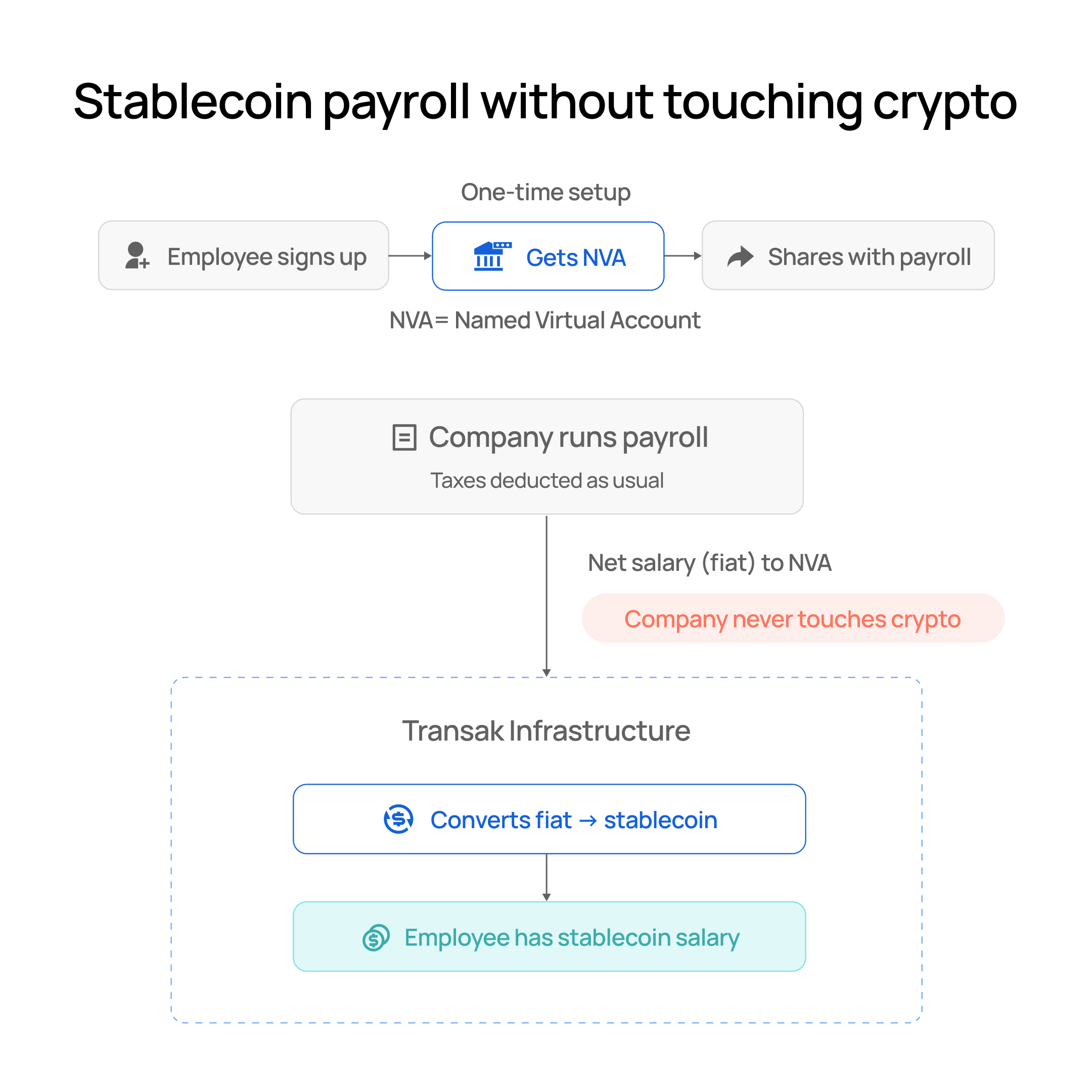
Our approach restructures the entire payment flow so the company never enters the digital asset layer. The design principle is simple:
- Company A sends fiat
- Employee receives stablecoin
- Transak operates as the regulated infrastructure between the two.
This is not a crypto product for companies. It is a payment infrastructure layer that sits behind a normal payroll run. From the employer's perspective, the only thing that changes is a bank account number.
The Setup (One-Time Task)
The employee creates a Transak account and specifies what percentage of their net salary they want in stablecoins. They choose between USDC, USDT, or other supported stablecoins. The remainder of their salary continues flowing to their regular bank account.
Transak then issues the employee a named virtual account (NVA). This is a real bank account in the employee's legal name, with a sort code, account number, and IBAN where applicable. It looks identical to any other bank account. The employee hands these details to their company's payroll team the same way they would share bank details for any salary payment.
The named virtual account is the infrastructure unlock that makes this entire model work. Because the NVA is in the employee's name, the inbound transfer from the company is legally a payment to the employee, not a payment to Transak.
The Payroll Run (Every Pay Cycle)
The company runs payroll exactly as before:
- Calculate gross salary and all statutory deductions (income tax, social security, pension)
- Pay statutory obligations to the relevant tax authorities through normal processes
- Transfer the net salary to the employee's NVA via standard bank wire
From the company's books, this is a fiat payment to an employee's bank account.
The Conversion and Delivery (Transak Handles This)
|
Step |
What happens |
Time |
|---|---|---|
|
Fiat lands in NVA |
Transak's infrastructure detects the inbound transfer |
Instant |
|
Conversion |
Fiat is converted to the employee's chosen stablecoin at prevailing market rate |
Real time |
|
Delivery |
Stablecoin is credited to the employee's configured payout method |
Minutes |
Named Virtual Accounts Are Underdogs
Named Virtual Accounts create a clean legal boundary between the employer's fiat payment and the employee's stablecoin conversion.
Three properties make this possible:
The NVA is in the employee's legal name. The inbound transfer from the company is legally a payment to the employee, not to Transak. This matters for regulatory classification and how compliance officers evaluate the arrangement.
The conversion is a separate transaction. The fiat-to-stablecoin conversion happens between the employee (as the named account holder) and Transak (as the licensed payment infrastructure provider). The employer is not a party to this transaction.
The company's regulatory posture stays unchanged. No digital asset licenses required. No modified regulatory filings. No crypto custody obligations. The employer's payroll compliance documentation reads the same as it did before.
How This Differs From Other Stablecoin Payroll Solutions
Most stablecoin payroll providers require some level of crypto interaction from the employer. Transak's architecture eliminates it entirely.
|
Transak |
Rise |
Bitwage |
|
|---|---|---|---|
|
Company touches crypto |
No. Fiat wire to NVA only |
Company can fund in USDC |
Integrates with existing payroll (ADP, Gusto) |
|
Who handles conversion |
Transak, under our own licenses |
Rise platform |
Bitwage platform |
|
Named virtual account |
Yes, in employee's legal name |
No |
No |
|
Statutory payroll unchanged |
Yes |
Yes |
Yes |
|
Regulatory licenses held |
Several MTLs in the US and multiple jurisdictional licenses on other countries |
Rise holds its own compliance |
Bitwage licensed as MSB |
Who This Is Built For
Transak's stablecoin payroll infrastructure is designed for companies that want to offer employees payment flexibility without restructuring their own operations.
- Global companies with distributed teams: Employees in emerging markets want access to dollar-denominated assets. Stablecoins provide that access with ease. Our model lets the employer offer stablecoin payroll as a benefit without changing their own regulatory status.
- Payroll providers and EOR platforms: Deel, Remote, Papaya Global, and Velocity Global are all adding stablecoin payout options. Our virtual account infrastructure can power these flows at the backend, handling conversion, compliance, and delivery while the payroll platform maintains its existing employer relationships.
- Fintechs adding stablecoin capabilities: Neobanks, remittance companies, and contractor payment platforms that want to offer stablecoin payouts without building the licensing, KYC, conversion, and custody infrastructure from scratch. Building this in-house costs $5 million to $15 million and takes 12 to 18 months. Transak provides it through a single API integration.
Frequently Asked Questions
Does my company need any crypto licenses to use Transak's stablecoin payroll?
Your company's only action is a standard fiat bank transfer to the employee's named virtual account. All stablecoin conversion, custody, and delivery happen under Transak's own regulatory licenses including FinCEN (US), FCA (UK), and AUSTRAC (Australia). Your company never holds, converts, or transmits digital assets.
What stablecoins can employees receive?
The support for stablecoins depends on the jurisdiction. Common choices include USDT and USDC. They specify their preference and the percentage of salary during onboarding and can adjust these settings at any time.
How fast does the stablecoin conversion happen?
Conversion is automatic and happens in real time when the fiat salary lands in the employee's named virtual account. The stablecoin is typically delivered to the employee's wallet within minutes of the employer's bank transfer clearing.
Can my employees convert their stablecoins back to local currency?
Yes. Employees can off-ramp their stablecoins to local fiat through our off-ramp infrastructure at any time or set up Transak Stream Off-Ramp for programmatic off-ramping. The process works across 64 countries and supports payout to local bank accounts.