Takeaways
Every finance team that moves money across borders knows the feeling. You send a payment Friday afternoon, and it lands sometime next week, minus fees you cannot fully predict.
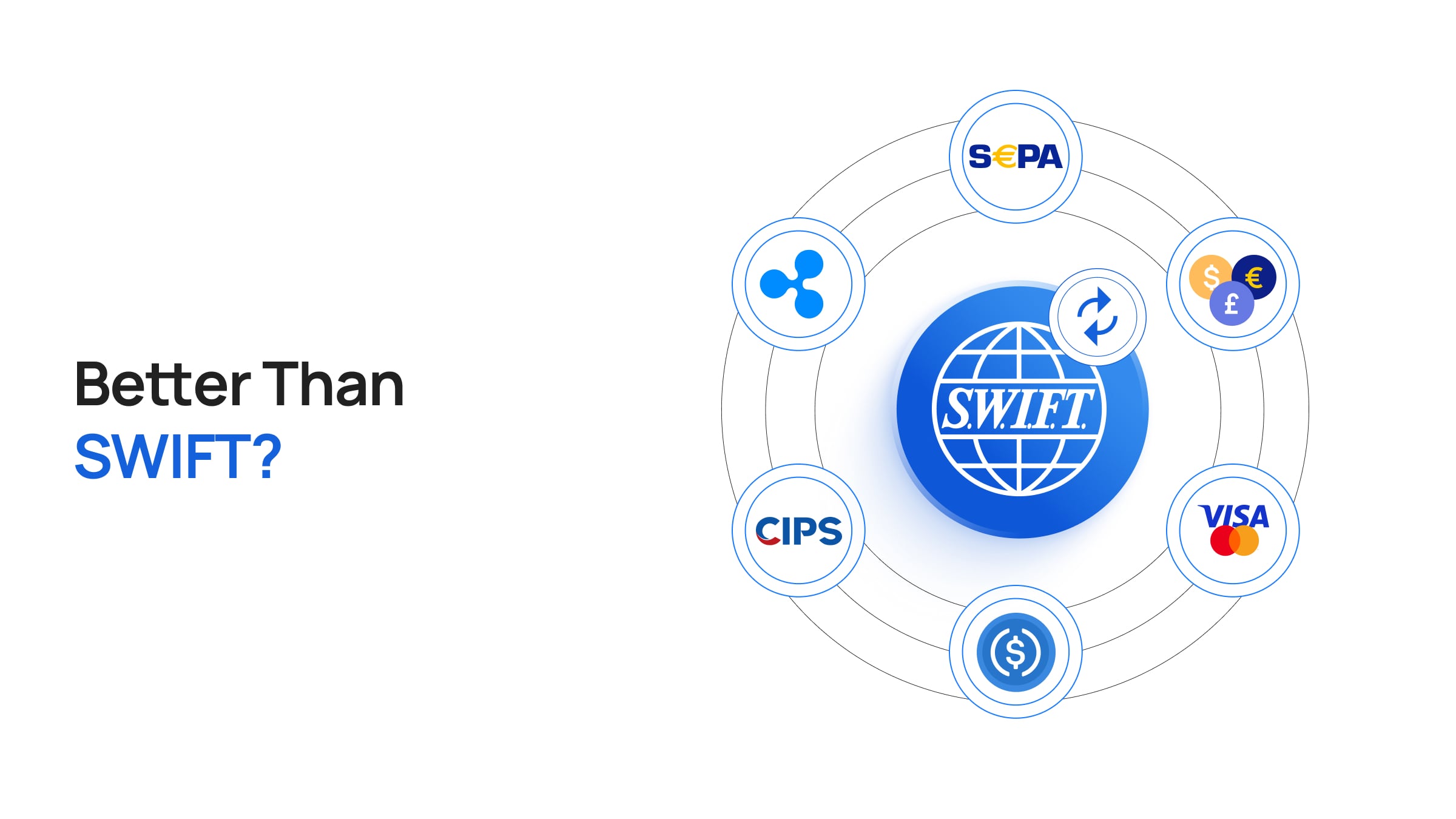
SWIFT alternatives have moved from a niche conversation to a board-level priority, because slow, opaque settlement now shows up directly in working capital and customer churn.
This guide breaks down the realistic options for businesses in 2026, what each is genuinely good at, and where it falls short.
Why Businesses Are Looking Beyond SWIFT
SWIFT alternatives exist because SWIFT moves messages, not money.
The actual funds still crawl through a chain of correspondent banks, each adding a fee, a delay, and a point where the payment can stall. The World Bank pegged the global average cost of sending remittances at 6.36% in Q3 2025, and banks averaged a steep 14.99%.
Four problems push businesses to look elsewhere. Costs stack at every hop. Settlement can take multiple days. Pricing is opaque, with lifting fees deducted mid-route so the beneficiary receives less than expected. And visibility is poor, leaving treasury teams to chase payments by phone.
To be fair, SWIFT has not stood still. But the structural issue remains. As long as value travels through prefunded correspondent accounts, cost and delay are baked in, and the alternatives below attack that structure from different angles.
1. SWIFT GPI (the in-house fix)
SWIFT GPI is SWIFT's own upgrade, adding end-to-end tracking and faster settlement on top of the existing network. According to SWIFT, nearly 60% of GPI payments reach the beneficiary within 30 minutes and almost all within 24 hours, with over $300 billion moved daily. It is the lowest-friction option because banks already use SWIFT.
The honest trade-off is that GPI improves the old model rather than replacing it. Tracking is far better and speed has improved on major corridors. Yet funds still move through correspondent banks, so prefunding, FX markups, and weekend gaps persist.
For a bank that wants visibility without overhauling its stack, GPI is the obvious first step. For a fintech trying to eliminate trapped capital, it is a patch, not a cure.
2. Regional Instant Payment Schemes
Domestic instant schemes settle in seconds, around the clock, at very low cost, which makes them the fastest rails on earth inside their own borders. The catch is reach. Each one stops at a national or currency-bloc boundary, so a single scheme cannot cover a global payout flow on its own.
The European Central Bank reported that instant transfers made up 23% of the number and 7% of the value of euro-area credit transfers in the first half of 2025. The US FedNow Service has grown to more than 1,500 participating financial institutions as of mid-2026.
Emerging markets have leapfrogged hardest. India's UPI handled more than 600 million transactions a day as of mid-2025, and Brazil's PIX processes billions more each month. These systems prove instant settlement works at national scale, but linking them across borders is the unsolved part. Use them as the local leg, then solve the cross-border hop with a different rail.
3. Visa B2B Connect and Mastercard Cross-Border Services
Card networks have built dedicated cross-border rails that bypass much of the correspondent chain.
Visa B2B Connect reaches over 190 countries and 160 currencies, while Mastercard Move spans more than 180 countries and 150-plus currencies with access to over 95% of the world's banked population.
The strength here is reach plus trust. These networks settle to bank accounts, wallets, cards, and cash pickup, with predictable delivery and built-in compliance, so a payroll or marketplace platform that needs broad payout coverage tomorrow fits well.
The downside is cost and control. You rent a closed network, pricing reflects that, and you inherit the network's corridor logic rather than owning the routing.
4. Fintech Multi-Currency Networks
Several fintechs have spent years building proprietary networks of local accounts and partner banks, then exposing them through clean APIs.
Providers such as Wise, Airwallex, and Payoneer let businesses hold balances in many currencies and pay out locally, sidestepping a full correspondent hop on supported corridors.
For a small or mid-sized business, the experience is excellent. Onboarding is fast, FX is transparent, and many transfers feel near-instant because the provider is moving money within its own books.
The limit shows up at scale and at the edges. You depend on one provider's corridor coverage, balance-sheet capacity, and pricing, less common currencies still route through traditional banking, and it is a product rather than infrastructure you own.
5. CIPS (China's Cross-Border System)
CIPS, China's Cross-Border Interbank Payment System, is the main alternative for renminbi settlement (using the Yuan to invoice and pay for cross-border trade and investments) and a frequent talking point in any SWIFT replacement debate.
By the end of 2025 CIPS had grown to roughly 190 direct and over 1,500 indirect participants across 124 countries and regions.
CIPS matters most for businesses with meaningful China or RMB exposure, shortening the chain for renminbi flows and cutting reliance on USD intermediaries. But it is not a global SWIFT substitute. CIPS is currency-specific and still uses SWIFT messaging for many transactions. Treat it as a specialized rail for RMB corridors, not a universal replacement.
6. RippleNet and XRP-Based Settlement
Ripple's cross-border product uses a digital asset to bridge currencies, aiming to remove prefunded nostro accounts on supported corridors. Its network spans hundreds of financial institutions, and a subset of partners use the XRP token for on-demand liquidity.
The pitch is capital efficiency. Source liquidity on demand instead of parking cash in every destination market, and you free up working capital while settling fast on live corridors.
The caveats are coverage and concentration. Real-world XRP-based liquidity sits in specific corridors rather than everywhere, and adoption is partner-dependent. It works where it works, and you have to verify your corridor is one of them.
7. Stablecoin Rails
Stablecoin rails move tokenized fiat (typically dollars) directly between parties on public blockchains, settling in minutes, 24 hours a day, 7 days a week, with no correspondent chain. This is the structural break the other options only approximate. McKinsey put annual stablecoin transaction volume at around $27 trillion, and total supply crossed $300 billion in 2025.
Three properties make this compelling.
- Settlement is continuous, so weekends and holidays disappear as a constraint.
- Funds move peer-to-peer, collapsing the multi-hop chain into a single transfer. And because value can move on demand, the prefunded capital trapped in nostro accounts shrinks dramatically.
- Idle balances drop, and the same capital does more work.
That last property is the one treasury teams feel most. Instead of pre-loading liquidity into a dozen markets and waiting days to recycle it, a business funds a corridor only when a payment is needed.
What stablecoins do not solve on their own
A raw stablecoin transfer is fast, but a business still needs compliant fiat-to-stablecoin conversion at both ends, KYC and Travel Rule handling, and licensing in each market. This is the messy middle that decides whether the speed reaches your customer. The blockchain leg is the easy part. The on-ramp and off-ramp legs are where most projects stall.
With a regulated partner handling conversion, compliance, and payout, the on-chain settlement translates into clean local currency and you get the atomic settlement that legacy systems cannot.
SWIFT Alternatives Compared
|
Alternative |
Settlement speed |
Geographic reach |
Best for |
|---|---|---|---|
|
SWIFT GPI |
Minutes to 24 hours |
Global (existing network) |
Banks wanting tracking without re-plumbing |
|
Instant schemes (SEPA, FedNow, UPI, PIX) |
Seconds |
Single country or currency bloc |
The fast local leg of a payout |
|
Visa B2B Connect / Mastercard Move |
Near real time to 1-2 days |
180-190+ countries |
Broad, reliable payout coverage now |
|
Fintech multi-currency networks |
Near instant on supported corridors |
Provider-dependent |
SMBs wanting transparent FX fast |
|
CIPS |
Same day |
RMB corridors, 124 countries |
China and renminbi exposure |
|
RippleNet / XRP |
Minutes on live corridors |
Hundreds of institutions, selected corridors |
Reducing prefunding on supported routes |
|
Stablecoin rails |
Minutes, 24/7 |
Anywhere with compliant on/off-ramps |
Eliminating settlement delay and trapped capital |
When SWIFT Still Wins
For all its problems, SWIFT still wins on two things its challengers cannot yet match. The first is reach. It connects more than 11,000 institutions worldwide, so almost any bank can receive a payment, including in corridors no fintech or instant scheme touches.
The second is trust. Decades of operation and universal familiarity make SWIFT the default for high-value, low-frequency transfers where certainty beats speed.
So the question is rarely "rip out SWIFT entirely." It is "which payments should leave SWIFT first." Recurring, time-sensitive, high-volume corridors are where alternatives pay off. Rare, exotic-currency transfers may stay on SWIFT for years.
A Decision Framework
Pick the rail by matching it to the payment, not to the hype. Run each major corridor through four questions, and the answer usually picks itself.
- Speed sensitivity. Does a multi-day delay hurt the customer or your working capital? If yes, instant schemes or stablecoin rails move to the top.
- Corridor and currency. Is this a single-country flow, an RMB flow, or a many-market payout? That alone eliminates several options.
- Capital efficiency. Are you bleeding cash into prefunded accounts? Stablecoin rails and on-demand liquidity directly attack that cost.
- Compliance and licensing burden. Can you carry the regulatory load in each market, or do you need a partner who already holds the licenses?
Most businesses land on a portfolio. They keep SWIFT for the long tail, use instant schemes for the local leg, and adopt stablecoin rails for the high-volume corridors where speed and capital efficiency matter most.
How Transak Helps
Start by auditing your three highest-volume corridors. Pull the true cost, settlement time, and prefunded balance tied to each, then test one on a faster rail before touching the rest. That single comparison usually exposes more savings than a year of negotiating SWIFT fees.
If a meaningful share of your money flow is via recurring cross-border payments, stablecoin rails are likely the biggest win available, provided the on-ramp and off-ramp are handled by a regulated partner.
Transak gives neobanks, remittance apps, payroll and EOR platforms, and PSPs that exact capability.
A single API converts between local fiat and stablecoins, settles in minutes around the clock, and carries the licensing and compliance load, so a remittance app can cut settlement from days to minutes and a payroll platform can pay contractors globally in stablecoins without trapped capital. To map this to your corridors, talk to our team.
Frequently Asked Questions
What can replace SWIFT?
No single system fully replaces SWIFT today. Instant schemes (SEPA Instant, FedNow, UPI, PIX), card networks like Visa B2B Connect, fintech multi-currency networks, CIPS, and stablecoin rails each replace part of it. Most businesses combine several, choosing the right rail per corridor rather than one universal substitute.
Is ISO 20022 replacing SWIFT?
No. ISO 20022 is a richer messaging standard that SWIFT itself adopted, not a competitor. It improves the data carried with payments, enabling better automation and compliance. It runs on SWIFT and other networks alike, so it strengthens the existing system rather than replacing the network underneath it.
Does SWIFT have a competitor?
Yes, several, though none matches its global reach. CIPS handles renminbi flows, card networks and fintech rails serve specific corridors, and stablecoin rails offer 24/7 settlement. Each competes on speed, cost, or capital efficiency in particular use cases rather than replacing SWIFT across every market at once.
Who are the competitors of SWIFT?
The main contenders are regional instant schemes (SEPA Instant, FedNow, UPI, PIX), CIPS for RMB, Visa B2B Connect and Mastercard Move, fintech multi-currency networks, RippleNet, and stablecoin rails. They divide the market by corridor and use case, so businesses typically route payments across multiple rails simultaneously.