
Takeaways
Your product team ships a clean signup flow. Then the identity check loads, the user is asked to photograph a passport they already showed another app last week, and a measurable share of them close the tab.
KYC Reliance breaks that pattern by letting a user who already passed verification bring it with them, so the flow does not stop to check the same identity twice. This helps financial apps improve onboarding conversion and reduce compliance cost.
What is KYC Reliance?
KYC Reliance lets a partner reuse an app user's existing, already-completed KYC verification instead of asking the user to verify again with Transak.
When someone has already proven their identity on your platform, you pass that verification to Transak, and the user moves straight to the transaction rather than repeating document upload and manual review.
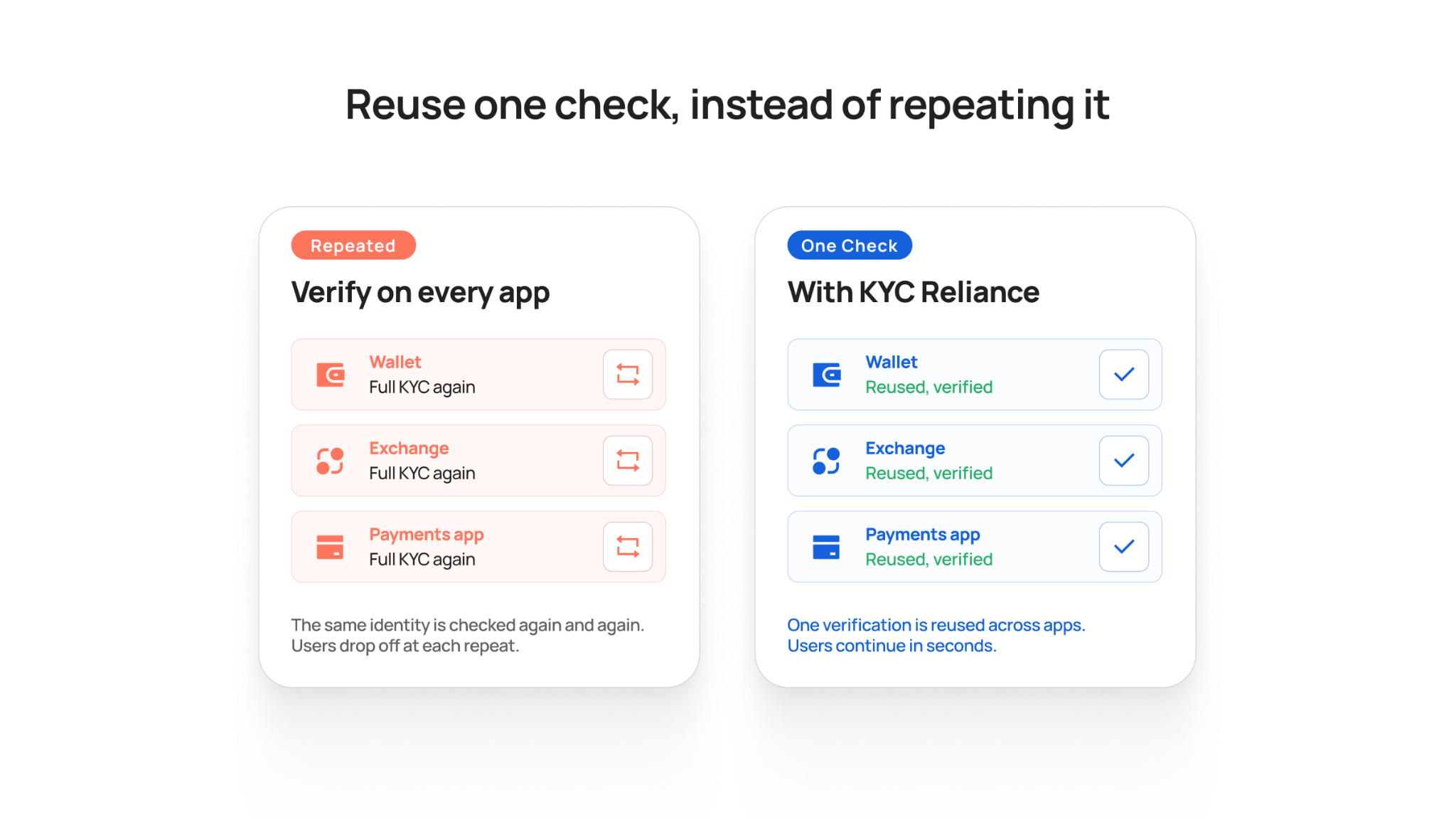
Traditional onboarding treats every platform as an island. A user verifies on an exchange, then verifies again inside a wallet, then again in a payments flow, submitting the same passport and selfie each time.
KYC Reliance reuses the work that already happened. The same person does not get checked twice inside a single funding journey, which is the friction most on-ramp flows quietly lose users to.
Note that it is not a new identity network or a promise to remove verification. It is a way for one regulated business to accept a check another trusted party already performed, under controls that keep the process compliant.
The conversion cost of repeated identity checks
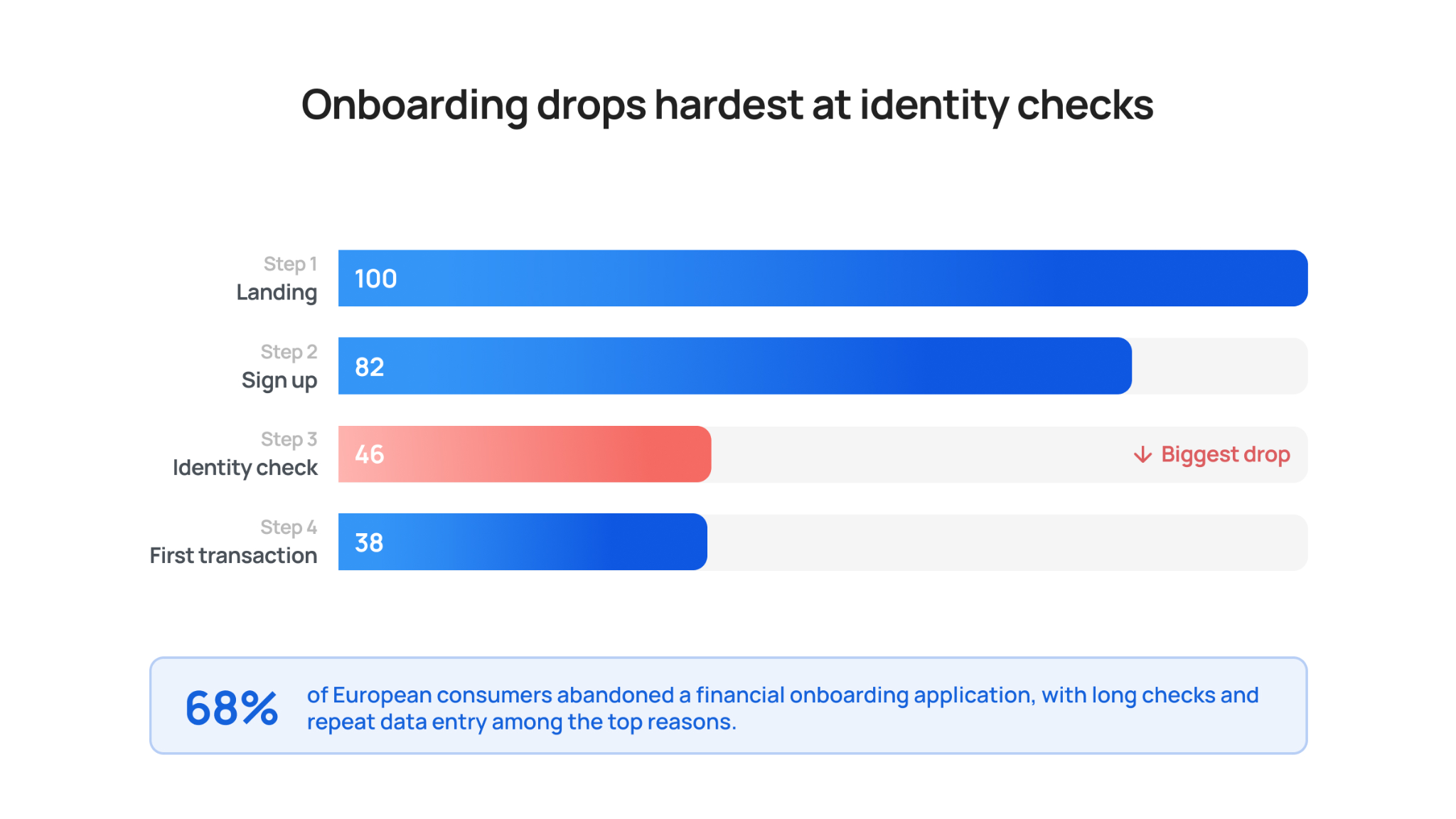
Repeated identity verification is one of the most expensive leaks in fintech onboarding. Users who already proved who they are elsewhere resent doing it again, and many quit mid-flow. As a result, you’d see an uptick in lost signups, acquisition spend, and accounts that get created but never fund.
68% of European consumers abandoned a financial services onboarding application in 2022. Among the top reasons users gave were the process taking too long and being asked for too much personal information. Both describe the KYC step almost exactly.
Further, Fenergo's 2025 research found that 70% of financial institutions lost clients due to slow or inefficient onboarding, up from 48% in 2023.
When verification is the slowest part of onboarding, verification is what loses the customer.
How KYC Reliance works
KYC Reliance integrates in two ways.
- The first submits the user's existing verification to Transak by API.
- The second passes a Sumsub share token for partners who already verify through Sumsub.
Both cover Standard KYC, and Transak validates whatever it receives before it verifies the record.
The API-based method
In the API-based method, the partner submits the user's already-completed verification to Transak's KYC Reliance API in sequence, covering identity details, document details, and biometric details.
Transak validates the submitted data, runs its own risk checks, and creates the verified record. Users must be between 18 and 150 years old, and the method covers Standard KYC.
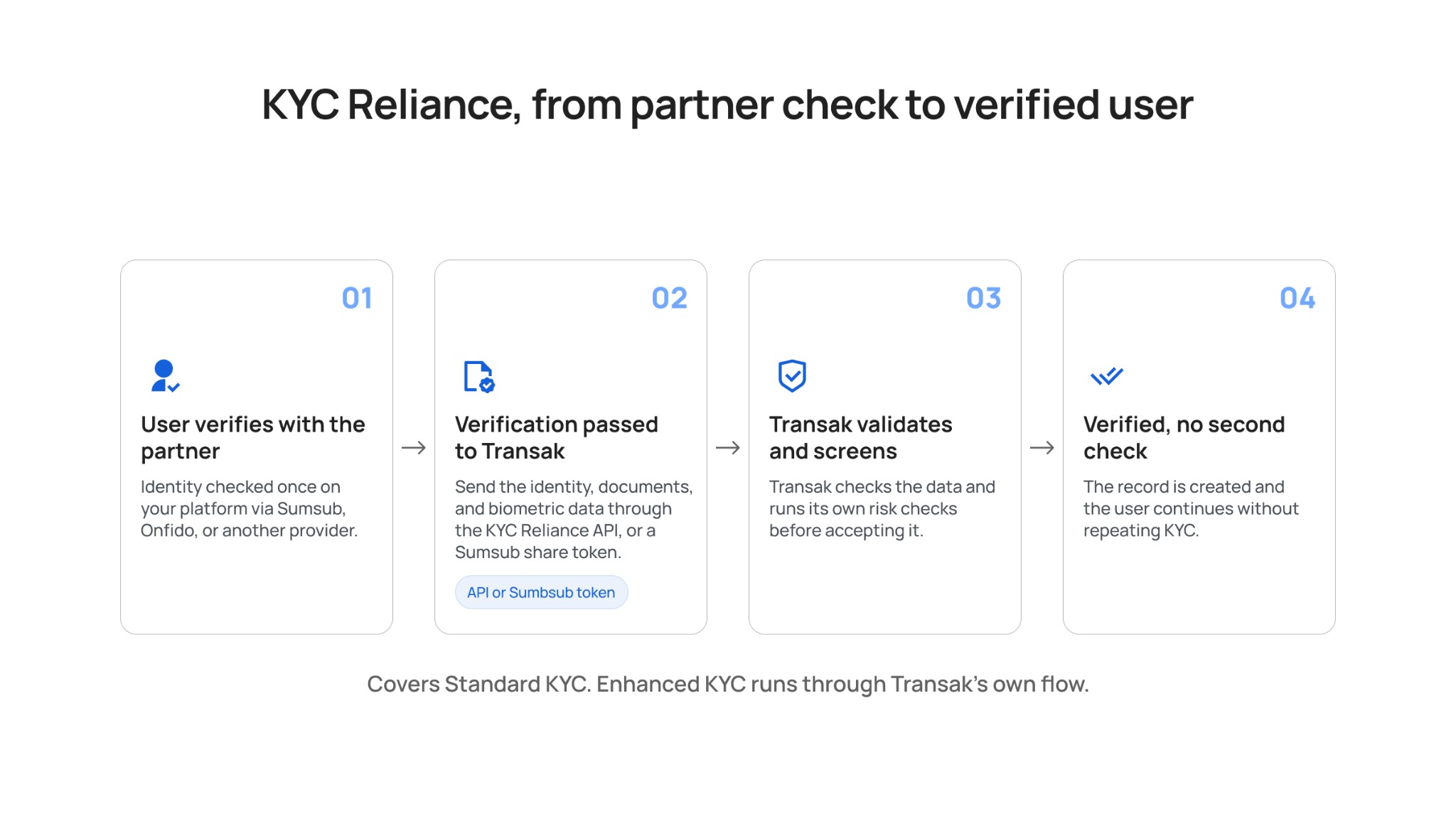
Here is the sequence:
- The user completes KYC on the partner platform, using the partner's own verification vendor, such as Sumsub or Onfido.
- The partner submits the user's identity, document, and biometric verification data to Transak through the KYC Reliance API.
- Transak validates the data and applies its own risk checks before accepting it.
- Transak creates and verifies the user's record, and the user proceeds without a second identity check.
If the partner already verifies users through Sumsub, there is no need to resubmit data. The partner passes a Sumsub share token, and Transak reuses that verified profile directly. It is the same outcome with less integration work for teams already on Sumsub.
Note that while both methods cover Standard KYC, the Enhanced KYC still runs through Transak's own verification flow.
Who owns compliance responsibility?
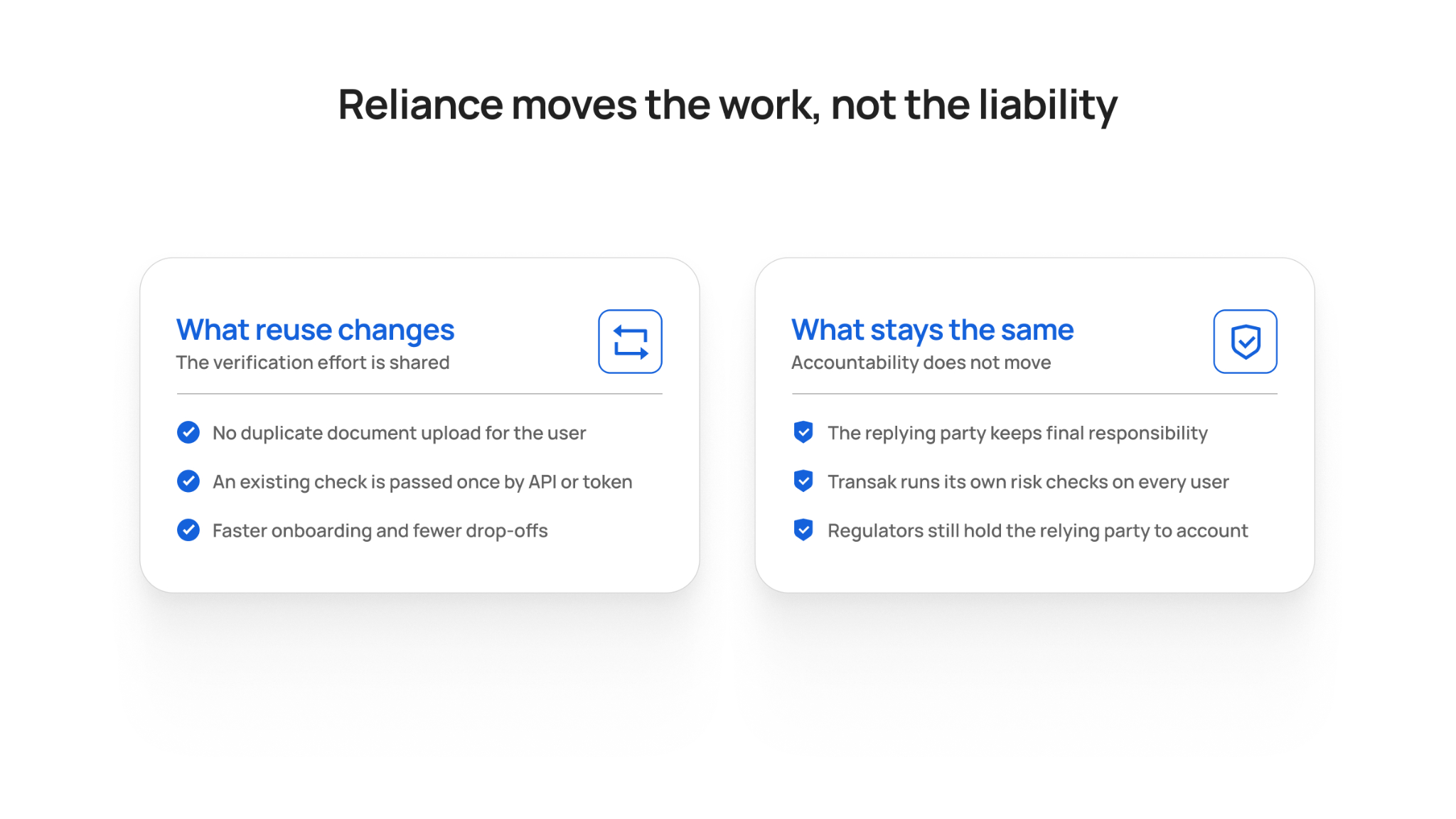
KYC Reliance changes who does the verification work, not who is accountable for it. The relying business keeps final compliance responsibility and continues to run its own risk checks, regardless of whose verification it reused. Reuse removes duplicate data collection. It does not remove the obligation to get onboarding right.
Even when Transak accepts a partner's verification through KYC Reliance, we validate that data and apply our own risk checks before verifying the customer, and we stay responsible for the compliance outcome.
KYC Reliance is a legitimate efficiency, and it sits inside a seriously regulated process. Transak operates as a registered money services business across several jurisdictions and holds ISO 27001:2022 certification with SOC 2 Type II compliance.
Conclusion
KYC Reliance is powerful and can help teams provide better user experiences to their users.
Galxe used Transak's KYC Reliance to simplify onchain onboarding. The Galxe and Transak case study shows the pattern in a live product.
Teams already on Sumsub can start with a share token, while others use the API-based method. If an embedded on-ramp is part of that flow, seeing how reused verification runs alongside embedded stablecoin payments is the fastest way to judge fit for your own funnel.
Frequently asked questions
What is KYC Reliance?
KYC Reliance is a method by Transak that lets one regulated business reuse a user's existing, already-completed KYC verification instead of running it again. When a user has verified on a partner platform, that verification is passed to Transak, so the user can transact without repeating document upload and review.
How does KYC Reliance work?
It works in two ways. In the API-based method, the partner submits the user's identity, document, and biometric verification data to Transak's KYC Reliance API. In the Sumsub method, a partner already using Sumsub passes a share token. Transak validates the data, runs its own risk checks, and verifies the record.
Does the relying platform skip its own risk checks with KYC Reliance?
No. Reusing a verification removes duplicate data collection, not the relying platform's own controls. Transak applies its own risk checks even when it accepts a partner's KYC, and it retains final compliance responsibility. A reused check is an input to the decision, never a replacement for the relying party's judgment.
Which KYC providers work with KYC Reliance?
Partners can submit verification completed with providers such as Sumsub or Onfido through the API-based method. Teams already verifying with Sumsub can pass a Sumsub share token directly. Both routes cover Standard KYC, while the enhanced tier still runs through Transak's own verification flow.
Does KYC Reliance reduce onboarding abandonment?
It targets a leading cause of it. With 68% of European consumers abandoning financial onboarding in 2022 per Signicat, and long or repetitive verification cited among the top reasons, removing the repeat check attacks the exact step where users quit. Reuse does not fix every drop-off, but it addresses one of the largest.