Takeaways
Twelve months ago, shoppers who landed on a retail site from an AI assistant converted 38% worse than people arriving from paid search or email. By March 2026, that same traffic converted 42% better, a record, according to Adobe Analytics.
This guide covers what agentic commerce actually is, how a purchase runs end-to-end, what each of the new protocols does, and the parts that break.
What is agentic commerce?
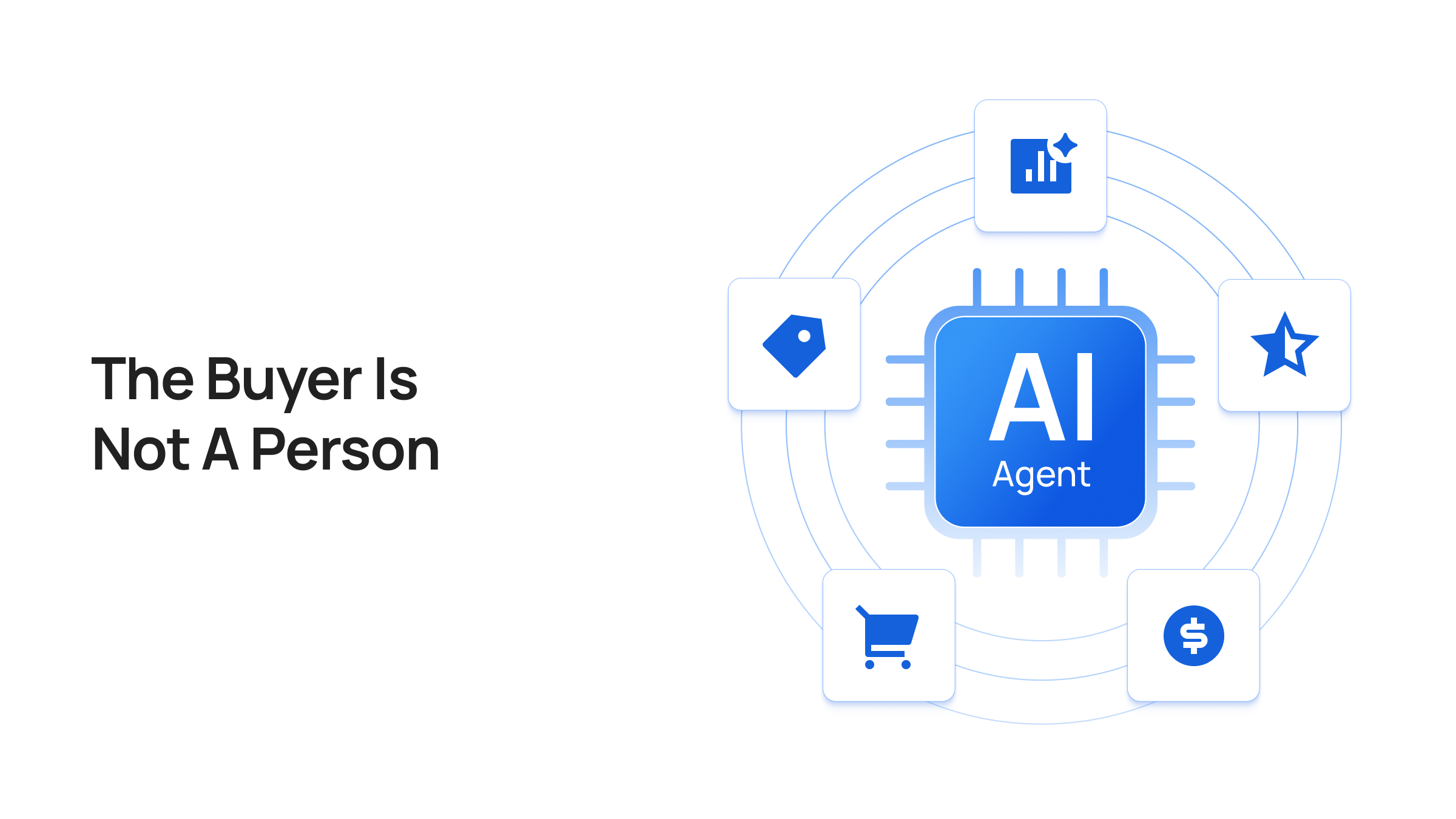
Agentic commerce is when an AI agent finds, compares, and buys products for a person or business. The buyer sets a budget and rules upfront, so the agent can complete the purchase on its own.
An ordinary tool waits for instructions at every step. An agent is given a goal and decides which steps get it there.
When you ask a chatbot to find running shoes under a certain price and it returns a list. That is AI-assisted shopping, and it has existed for years. But when you tell an AI agent to keep your household stocked and let it reorder when supplies run low, and the purchase now happens without you watching. That is agentic commerce.
Agentic commerce vs AI-assisted shopping
|
Model |
Who chooses |
Who checks out |
What the merchant sees |
|
Traditional ecommerce |
Person |
Person |
A human session with normal browser signals |
|
AI-assisted shopping |
AI recommends, person decides |
Person |
A human session, often with an AI referrer |
|
Agentic commerce |
Agent, within set limits |
Agent |
A machine session, no human present |
Most retailers reporting "AI traffic" today are seeing the middle row. An assistant recommended them, and a human clicked through and bought. The bottom row is where the interesting problems live, because a machine session fails every check designed to confirm a person is real.
How does agentic commerce work?
An agentic purchase runs through four stages:
- Intent and limits. The person grants authority up front. Budget caps, approved categories, an expiry, and a way to revoke. This replaces the moment of consent that a checkout button used to provide.
- Discovery. The agent finds candidate products. It reads structured product data rather than looking at your page, which is why a beautiful storefront with no machine-readable feed is invisible to it.
- Checkout. The agent submits an order to the merchant, using a protocol both sides understand rather than filling in a web form.
- Authorisation and settlement. The payment is authorised, signed, and settled, with a record linking it back to the human who granted authority. For recurring agent-initiated funding, named virtual accounts remove the checkout step entirely.
Different standardization protocols
Agentic commerce involves multiple operational layers, and because the ecosystem is evolving rapidly, key players are racing to establish standardization protocols across each one.
These standards will be essential for driving widespread adoption and ensuring seamless interoperability across platforms.
|
Layer |
What it decides |
Protocol |
|
Discovery and journey |
How an agent finds products and moves through a purchase |
UCP |
|
Checkout |
How an agent submits an order to a merchant |
ACP |
|
Payment authorisation |
How a payment is authorised and signed |
AP2 |
|
Tool access |
How an agent reaches systems and data |
MCP |
|
Delegation |
How one agent hands work to another |
A2A |
ACP, the Agentic Commerce Protocol, was co-developed by OpenAI and Stripe and released under Apache 2.0 on 29 September 2025. It powers Instant Checkout in ChatGPT, which launched the same day with Etsy sellers and later extended to Shopify merchants. It handles agent-initiated checkout, and merchants can adopt it with their existing payment provider.
AP2, the Agent Payments Protocol, was announced by Google on 16 September 2025 with more than sixty payment and technology partners, among them PayPal, Mastercard, American Express, Adyen, and Worldpay. It covers the payment authorisation step, using signed mandates so a merchant can verify an agent genuinely had permission to spend.
UCP, the Universal Commerce Protocol, is the newest and the broadest. Sundar Pichai announced it at the NRF 2026 keynote on 11 January 2026, co-developed by Google and Shopify with Etsy, Wayfair, Target, and Walmart, backed by more than twenty retailers and payment firms. It covers the entire journey from discovery through post-purchase support.
UCP is composable. It defines the shape of the conversation and then plugs into AP2 for payment authorisation, MCP for tool access, and A2A for delegation between agents.
The card networks have added their own layer on top. Visa's Trusted Agent Protocol, announced in September 2025, issues a Verified Agent ID so a merchant can tell an approved agent from a scraper. Mastercard's Agent Pay does something similar. Expect identity-of-the-agent to become the contested layer, because that is where liability gets decided.
Also Read: How Transak abstracts the messy middle of stablecoin payments
Is agentic commerce actually happening?
Adobe Analytics measured AI-referred traffic to US retail sites up 393% year on year in Q1 2026, following a 693% year-on-year jump over the November to December 2025 holiday period.
Volume is the less interesting number. Quality is the story.
|
Adobe Analytics metric |
Result |
|
Conversion vs other channels, March 2025 |
38% worse |
|
Conversion vs other channels, March 2026 |
42% better |
|
Revenue per visit vs non-AI traffic |
37% higher |
|
Time on page vs other channels |
48% longer |
|
Consumers who have used AI to shop |
39% |
A channel that went from significantly worse to materially better in twelve months is not a fad, and the revenue-per-visit figure suggests these are high-intent buyers rather than browsers.
On the forecast side, McKinsey estimated in October 2025 that agentic commerce could orchestrate up to $1 trillion in US retail revenue by 2030, roughly 30% of projected business-to-consumer retail revenue, and $3 trillion to $5 trillion globally.
What breaks when the buyer is a machine
Bot defences block your best customers
Fraud tooling is built to stop non-human traffic. An agent buying legitimately looks exactly like the thing you paid to block. Adobe's own research found retail sites lagging badly on machine readability even as AI traffic surged. Blanket-blocking bots is now a revenue decision, not a security one.
Your product data is the storefront
Agents read feeds, not layouts. If your structured data is thin, stale, or missing stock and shipping detail, you are not in the consideration set. No amount of design fixes that.
Liability is genuinely unsettled
An agent buys the wrong size, the wrong quantity, or the wrong item entirely. Who eats it? Chargeback frameworks assume a cardholder who either did or did not authorise a transaction. "The human authorised the agent, and the agent made a bad call" fits neither box. The Verified Agent ID work from the card networks is an attempt to answer this, and it is early.
Returns get worse before they get better
More automated purchasing means more mistaken purchasing. Model your returns rate going up, not down.
Discovery economics invert
If an agent selects the product, the click you have been buying for a decade may never happen. Brands that spent years optimising for a human scanning a results page now have to be legible to a model comparing structured attributes.
What to do about it now
Four things, in order of how much they matter.
- Make your catalogue machine readable. Complete, current, structured product data with real inventory and shipping fields. This is the highest-return action and most teams are behind on it.
- Fix your bot policy before you fix your protocol choice. Distinguish agents acting for real customers from scrapers, rather than blocking both.
- Pick the layer you actually need. If you sell goods, checkout and discovery come first. If you move money for others, authorisation and settlement matter more.
- Write down your authorisation model. Spend limits, expiry, revocation, and an audit trail linking every payment to a human. Do it before your first agent transaction, not after your first dispute.
Notice that only one of those four is about protocols. The protocol question is the one everyone asks and the one that matters least right now, because the standards are converging and your catalogue is not.
Also Read: How apps embed crypto and stablecoin payments
Conclusion
Agentic commerce is not a new payment rail. It is the removal of the person who used to stand at the end of the old one, and everything that quietly depended on their presence has to move earlier or be rebuilt.
Start with the unglamorous thing. Open your product feed and check whether it carries current price, stock, and shipping data in a structured format a machine can parse without rendering your site. That single check predicts more of your agentic commerce readiness than any protocol decision you will make this year.
Then write down what an agent is allowed to spend on your behalf, and how you would switch it off.
Building agent-ready payments into your app
If you run a wallet, a neobank, a marketplace, or a payroll platform paying contractors in stablecoins, the hard part of agentic commerce is not the shopping. It is moving money when nobody is at the screen to approve it.
That is the layer we build. Transak provides fiat and stablecoin payment infrastructure that runs programmatically, so funds can arrive, convert, and settle without a checkout page in the path. You can reuse your own authentication and identity checks rather than sending users through a second signup, and our off-ramp and Stream products handle payouts on an API call rather than a screen. Our documentation is published in machine-readable Markdown with an MCP server, so your engineers can point a coding assistant at it and get a working integration faster.
Talk to our team about which layers you already own and which are worth handing over.
Frequently asked questions
What is agentic commerce in simple words?
Agentic commerce is shopping where an AI agent does the buying for you. You set the goal, the budget, and the rules once. The agent then finds products, compares them, and completes the purchase without you at the checkout screen. A person stays accountable for what the agent spends.
Can you give an example of agentic commerce?
A household assistant tracks supplies and reorders detergent when it runs low, staying inside a monthly budget you set. In retail, ChatGPT's Instant Checkout, launched on 29 September 2025 with Etsy sellers, lets a shopper complete a purchase inside the chat rather than being sent to a merchant's website.
What does agentic mean in business?
Agentic describes software that pursues an outcome rather than waiting for instructions at each step. A conventional system executes the command you give it. An agentic system decides which steps are needed to reach a goal and carries them out inside limits a human has set in advance.
What is the difference between agentic commerce and agentic payments?
Agentic commerce covers discovery and purchase, meaning how an agent finds a product and places an order. Agentic payments cover the money movement underneath, meaning authorisation, transfer, settlement, and reconciliation. Commerce problems are solved in your product surface. Payment problems are solved in your infrastructure.
What is the Agentic Commerce Protocol?
The Agentic Commerce Protocol, or ACP, is an open standard for agent-initiated checkout, co-developed by OpenAI and Stripe and released under the Apache 2.0 licence on 29 September 2025. It defines how an AI agent submits an order to a merchant, and merchants can adopt it while keeping their existing payment provider.
Is agentic commerce the future of retail?
The measured data points that way. Adobe Analytics recorded AI-referred retail traffic up 393% year on year in Q1 2026, converting 42% better than other channels by March 2026. McKinsey estimated in October 2025 that agentic commerce could orchestrate up to $1 trillion in US retail revenue by 2030.
How do I make my store ready for AI agents?
Start with structured product data covering current price, stock, and shipping, because agents read feeds rather than page layouts. Then review your bot policy so agents acting for genuine customers are not blocked alongside scrapers. Protocol adoption matters, but it is a later step than most teams assume.
Is agentic commerce safe?
It is as safe as the limits around it. The controls that matter are spend caps per agent, scoped permissions, an expiry, a revocation path, and independent risk screening on every transaction. The realistic risk is not a malicious agent. It is a correctly functioning agent executing a bad instruction very quickly.