Takeaways
Two very different people rely on wire transfers.
One is closing on a house and needs a five-figure sum to land by Friday. The other runs a payments team moving thousands of cross-border payouts a week. They reach for the same tool, and they hit the same three limits, i.e., cost, speed, and finality.
This guide covers what a wire transfer is, how it works, what it really costs, and the faster rails now changing the math for individuals and businesses alike.
Also Read: What Are Stablecoins
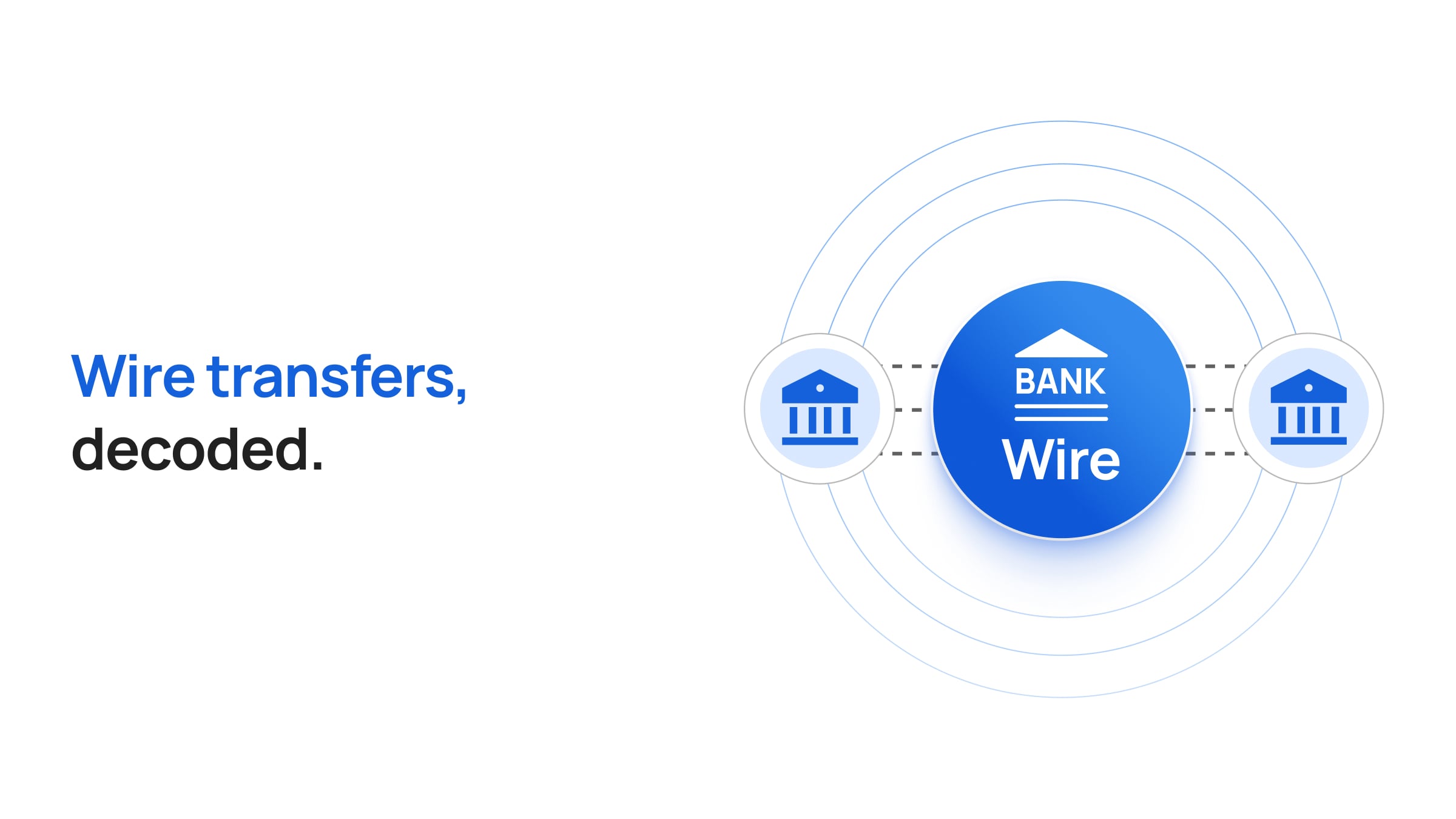
What is a wire transfer?
A wire transfer is an electronic method of moving money directly from one bank account to another, used mostly for large sums or time-sensitive payments. The sender's bank messages the receiving bank with payment instructions, and the funds settle without passing through a clearing batch.
That direct, account-to-account path is what sets a wire apart. There is no pool of pending transactions waiting for an overnight cycle. The sending bank confirms the money is good, sends the instruction, and the receiving bank credits the account.
The use cases split along the same line as the readers. An individual wires money for a home down payment, a tuition bill, or a brokerage deposit. A business wires money to pay an overseas supplier, settle an invoice, or fund a treasury account. The common thread is size and certainty. When the amount is high and the deadline is real, a wire is the tool most banks still point to.
How does a wire transfer work?
To send a wire, you give your bank the recipient's full legal name, their bank account number, and a routing number (domestic) or SWIFT code and IBAN (international). Your bank transmits those payment instructions over Fedwire or SWIFT, and the receiving bank deposits the funds into the recipient's account.
Underneath, a wire transfer is really a secure message between two financial institutions.
In the United States, domestic wires move over Fedwire, the Federal Reserve's real-time settlement system. International wires travel over SWIFT, a messaging network connecting more than 11,000 banks worldwide.
The sending bank pulls the money from your account before it sends the instruction, which is why a wire feels final from the moment you confirm it.
On international transfers, one or two intermediary banks may sit in the middle to bridge institutions that have no direct relationship. Every bank in that chain can take a cut, and every handoff is a place the payment can stall.
Domestic vs international wire transfers
Domestic wire transfers move money between two banks in the same country and currency, settling the same business day.
International wire transfers cross borders, usually involve a currency conversion and intermediary banks, and take one to five business days to complete.
The difference comes down to how many parties touch the payment.
A domestic transfer is a short, direct hop. An international transfer is a relay race, and each handoff adds time, cost, and risk.
Feature |
Domestic wire |
International wire |
|
Network |
Fedwire (U.S.) |
SWIFT |
|
Speed |
Hours, same business day |
1 to 5 business days |
|
Typical outbound fee |
~$27 average |
~$44 average |
|
Currency conversion |
None |
Usually, at a marked-up rate |
|
Intermediary banks |
Rare |
Common (1 to 2) |
Also Read: Which Stablecoin Should Your Business Use in 2026? A Decision Guide
What does a wire transfer cost?
Outgoing wire transfer fees typically run $0 to $50 per transaction. Bankrate's 2026 data puts the industry average at about $27 for a domestic outbound wire and $44 for an international one. Many banks also charge $0 to $15 to receive a wire.
For a one-time payment, that fee is not as much as a dealbreaker as it is an annoyance.
The bigger cost on international wires hides in two places. Intermediary banks can deduct $10 to $20 each as the payment passes through, and the exchange rate your bank applies usually carries a margin above the real mid-market rate. That spread often costs more than the wire fee itself!
|
Bank |
Outbound domestic |
Outbound international |
|
Industry average |
$27 |
$44 |
|
Bank of America |
$30 |
$0 to $45 |
|
Chase |
$0 to $35 |
$0 to $50 |
|
Citi |
$0 to $65, depending on account tier |
Now scale that up.
A business running thousands of cross-border payments a month pays the fee, the intermediary deductions, and the FX margin on every single one. What reads as a $44 nuisance for a household becomes a recurring line item that eats real margin for a payments operation. This is the point where the cost of wires stops being trivial and starts shaping the decision.
How long does a wire transfer take?
Domestic wire transfers usually clear within hours and almost always the same business day, as long as you send before your bank's cutoff time. International wire transfers take one to five business days, depending on the countries, currencies, and intermediary banks involved.
Timing changes on the cutoff. To get same-day domestic processing, initiate the wire at least one to two hours before your bank's deadline.
Fedwire and SWIFT do not run on weekends or bank holidays. A wire sent Friday afternoon may not move until Monday, and a holiday in either country can push an international transfer out further. For a business, those idle days are working capital sitting in transit and a backlog to reconcile the following week.
Wire transfer vs bank transfer, ACH, and Zelle
A wire transfer is one kind of bank transfer, alongside ACH and internal transfers. Wires are the fastest and most final, which is why they cost the most. ACH is cheap and slower. Zelle is instant and free but capped at small amounts, and it is not a wire transfer.
People use "bank transfer" as a catch-all, then assume every electronic payment behaves the same way. It does not. The network underneath each one sets its speed, cost, and reversibility.
Method |
Network |
Speed |
Typical cost |
Best for |
|
Wire transfer |
Fedwire / SWIFT |
Hours to 5 days |
$0 to $50 |
Large, time-sensitive, cross-border |
|
ACH transfer |
ACH (Nacha) |
1 to 3 business days |
Free to low |
Payroll, bills, recurring payments |
|
Zelle |
Early Warning Services |
Minutes |
Free |
Small person-to-person payments |
|
Stablecoin rails |
Public blockchains |
Seconds to minutes |
~0.1% to 0.5% |
Cross-border value, programmable payouts |
Zelle is not the same as a wire transfer. It moves money between U.S. bank accounts on its own bank-owned network, almost instantly and at no cost. It cannot handle the high limits, documentation, or international reach of a wire. Same goal, different machine.
The real drawbacks of wire transfers
The main drawbacks of wire transfers are cost and finality.
Outbound fees of $25 to $50 are steep, and a wire is irrevocable once accepted, so a wrong account number can mean lost money. International wires add intermediary fees, marked-up exchange rates, and delays of up to five business days.
When a wire goes out, it is gone. There is no chargeback, no dispute window, no easy clawback. If you make a mistake like mistyping a digit or falling for a scam, your bank could ask the receiving bank to return the funds, but it cannot force the issue. That is exactly why wire fraud targets home closings, where one fake email redirects a buyer's life savings.
The same finality bites businesses too. A payment that stalls at an intermediary bank or bounces on a mismatched detail does not fail cleanly. It sits in limbo, and someone on the operations team has to trace it, often across time zones. Multiply that by payout volume and the hidden cost is the labor, not just the fee.
A faster set of rails is moving money underneath
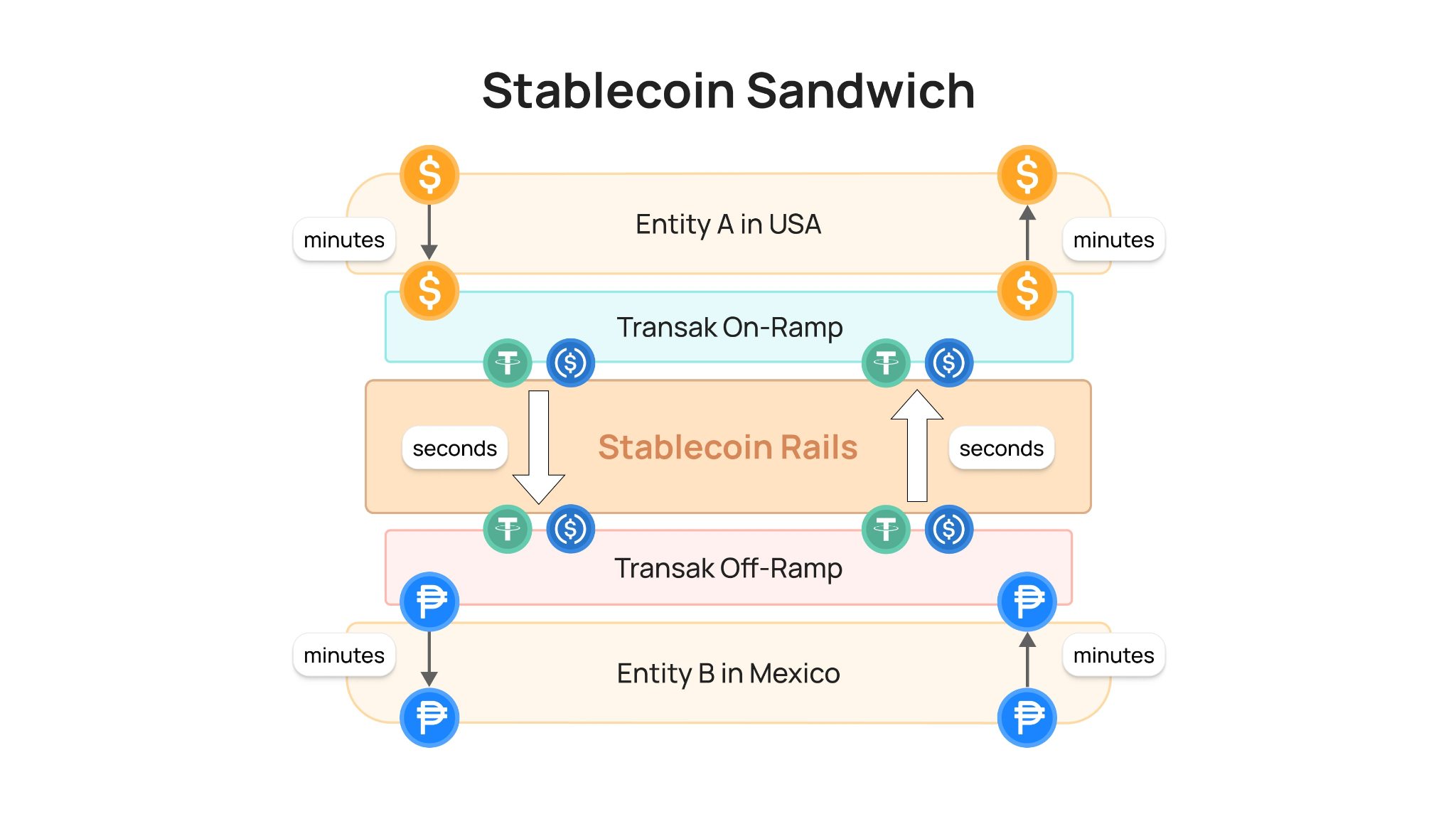
Stablecoin payment rails now move cross-border value in seconds to minutes, at roughly 0.1% to 0.5% of the amount, versus 2% to 7% for traditional wires. Both sender and recipient can stay in their local currency while a stablecoin carries the value across borders underneath.
Also Read: Are Stablecoins Safe? Stablecoin Risks and Safety Guide for Businesses in 2026
Cross-border wire infrastructure was built decades ago, and it shows. A newer approach keeps the familiar bank experience on both ends and swaps the slow middle for a faster rail. The pattern is sometimes called the "stablecoin sandwich." Fiat goes in, a stablecoin moves the value across borders in seconds, and fiat comes out the other side.
For the person sending money
If you send money through a modern remittance app or wallet, you may already be using these rails without knowing it.
You enter a recipient and an amount, confirm, and the money arrives. The app handles the conversion in the background. You never buy a token, manage a wallet, or learn what a blockchain is. The experience looks like the transfer you have always done, only faster and cheaper on the corridors where it counts.
|
What the user sees |
What happens underneath |
|
Enters recipient and amount, taps send |
App converts fiat to a stablecoin (USDC, USDT) |
|
"Transfer in progress" |
Stablecoin settles cross-border in seconds to minutes |
|
Recipient receives local currency |
App converts the stablecoin back to local fiat |
|
A normal, bank-style confirmation |
KYC, AML, and licensing handled by the provider |
For the business moving money
You decide to route value over stablecoin rails because the economics are better, and you keep the wire-style experience your users already trust. They send what feels like an ordinary transfer. Underneath, the value moves on a faster rail.
|
For the business |
Traditional wire |
Stablecoin rails underneath |
|
Settlement |
1 to 5 business days |
Seconds to minutes (cross-border leg) |
|
Cost |
2% to 7% all-in |
~0.1% to 0.5% |
|
Finality |
Irrevocable, can stall at intermediaries |
Atomic: completes fully or not at all |
|
Compliance |
Build licenses per market (12 to 24 months) |
Held by the infrastructure provider |
Also Read: How Fintech Apps Integrate Stablecoin Payments in 2026
Where Transak fits
Everything above describes the rail swap in theory. Transak is one way to run it in practice. Your users keep sending what feels like an ordinary transfer, while regulated on-ramp and off-ramp infrastructure moves the value over stablecoin rails underneath.
One integration covers on-ramp, off-ramp, virtual accounts, and compliance. It connects bank transfers, cards, SEPA, and ACH to stablecoins like USDC and USDT, with KYC and AML handled for you. Transak holds 18+ active licenses across 64+ countries and already powers 600+ apps, from neobanks and remittance platforms to payroll products and marketplaces.
The payoff is cross-border settlement in seconds at roughly 0.1% to 0.5% of the amount, with no crypto exposure for the end user. You ship the product. We handle the rails.
Frequently asked questions
How does a wire transfer work?
You give your bank the recipient's name, account number, and routing or SWIFT details. Your bank sends payment instructions over Fedwire (domestic) or SWIFT (international), the receiving bank credits the account, and the funds settle directly without waiting for a clearing batch.
What is the difference between a bank transfer and a wire transfer?
A wire transfer is one type of bank transfer. "Bank transfer" is the umbrella term that also covers ACH payments and internal transfers. A wire is the fastest and most final of the group, settling in hours instead of days, which is why it costs more and suits high-value transactions.
What are the disadvantages of a wire transfer?
Wires are expensive, often $25 to $50 to send, and irrevocable once accepted, so a mistyped account number can mean lost funds. International wires can take up to five business days, route through intermediary banks that add fees, and apply marked-up exchange rates that raise the true cost.
Can a business offer wire-style transfers using stablecoins without exposing users to crypto?
Yes. The familiar transfer experience stays on both ends while a stablecoin moves the value underneath. The user sends and receives in local currency and never sees crypto. Regulated on-ramp and off-ramp infrastructure handles the conversion, settlement, and compliance, which is how finance apps cut cost and settlement time without changing the user experience.
Sending the same payment over and over?
Whether it is a monthly remittance or a weekly batch of cross-border payouts, the next step is the same. Price one corridor against a traditional wire on the all-in cost, including the exchange-rate margin, not just the headline fee.
Then see how stablecoin rails would handle that flow. Transak's regulated on-ramp and off-ramp infrastructure settles cross-border value in seconds while users stay in their local currency.