Takeaways
When Transak began, it had one simple job. Someone inside a wallet wanted to buy crypto, we took the card payment and delivered the asset on the chain. Today, the world has changed, and we evolved.
Stablecoins have found real product-market fit outside trading, and the companies knocking on our door stopped looking like wallets.
- Payroll platforms wanted to pay contractors across a dozen countries.
- Neobanks wanted their uses outside of the US to hold dollars.
- Remittance companies wanted settlement without capital parked abroad.
Almost none of them wanted a button that said "buy crypto."
What they wanted was narrower. One had already built its compliance stack and needed only our payout rails. Another wanted everything except the interface. A third had a large verified user base and refused, correctly, to make anyone verify again.
Transak could already do everything, just not in the way these new financial apps wanted. So, we reengineered.
What is modularity in payments infrastructure?
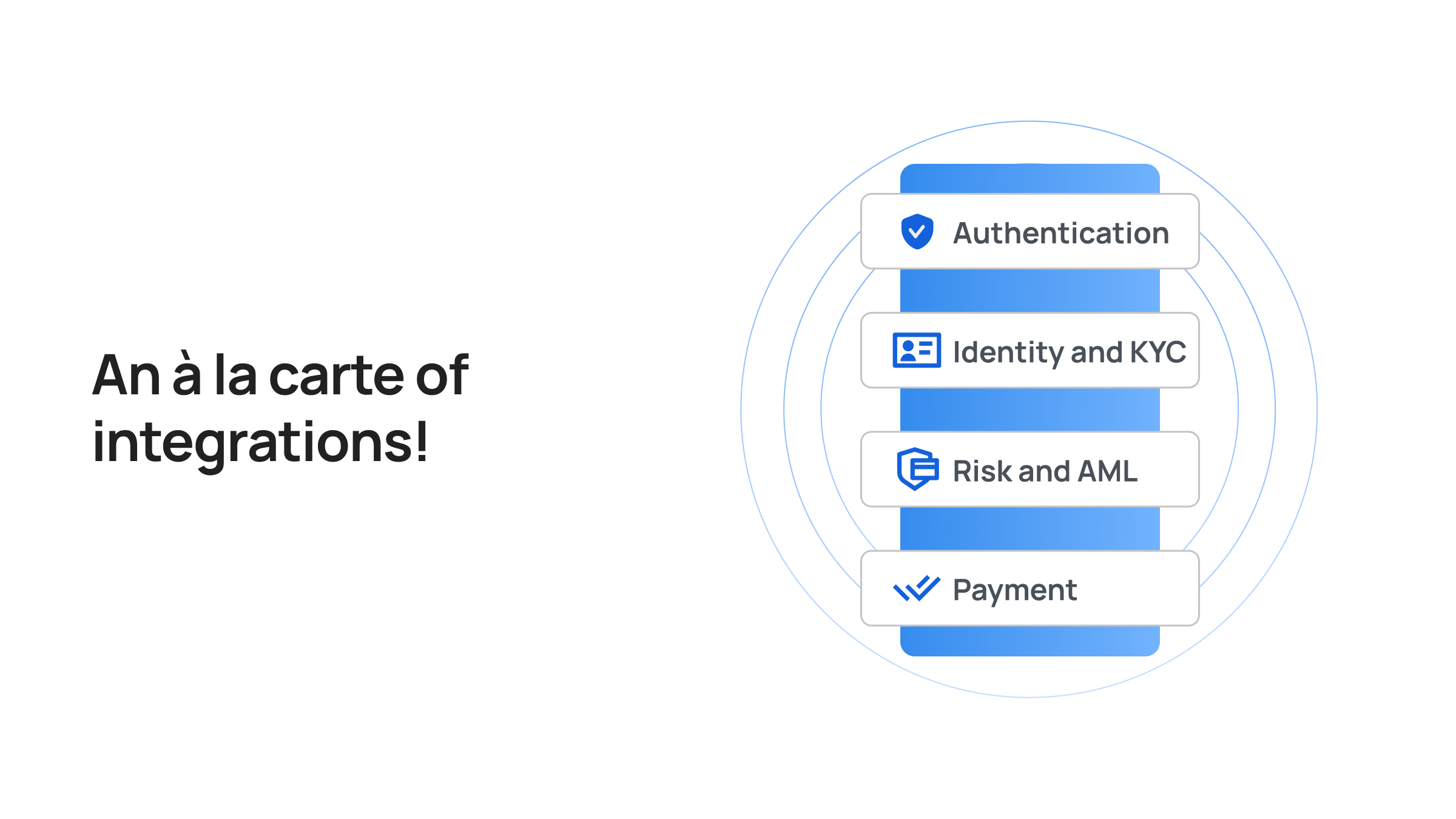
Modularity means treating a payment integration as separate layers or “modules” that you can adopt one at a time, instead of ripping out your entire payments infrastructure to rig in a new one.
The traditional banking infrastructure is monolithic. A single entity handled (and had to) deposits, ledger, KYC, risk, card issuance, fraud, settlement, and everything in between.
Modularity breaks that chain into separately purchasable layers. A neobank today might hold deposits through a BaaS partner, run its ledger on a third-party provider, use one vendor for identity verification, another for card issuing, another for fraud scoring, and route acquiring through a PSP.
|
Function |
What it does |
Responsibility |
|
Authentication |
Is this user logged in, and who are they |
You, or Transak |
|
Identity and KYC |
Has this person been verified to the right standard |
You, or Transak |
|
Risk and AML |
Should this specific transaction proceed |
Transak |
|
Funding |
How does money get in |
Transak |
|
Conversion |
Fiat to stablecoin, on the right chain |
Transak |
|
Payout |
How does money get out, and on which rail |
Transak |
Conventional providers answer all six for you as a single offering. While that may work for some, it becomes the wrong call the moment you already own (or want to own) one of those layers yourself.
Also Read: How Transak abstracts the messy middle of stablecoin payments
What Are Transak Modules
A module is one layer of the payment stack that you can switch on, hand to us, or keep for yourself. There are four, and they cover the six decisions above. Funding, conversion, and payout sit in one module because nobody takes one of those without the other two.
Authentication Module
If you already authenticate users, choose Auth Reliance. Your backend passes us an authenticated user identifier and your own access token, we trust your session, and there is no Transak login anywhere in the flow.
If you would rather not run auth for payments at all, use ours. The user signs in through Transak, tied to identity and payments.
KYC Module
KYC Reliance means we accept your verification. If a user has already passed identity checks, through your stack or a provider you already pay for, that data comes to us and the user skips the whole thing. It is provider agnostic, so you are not forced to switch vendors.
If you would rather not handle identity documents, use ours. We run ID checks, liveness, and fraud screening, and you trust the result.
Risk Module
This one is not a choice. Every transaction runs through our risk engine regardless of what else you picked. It weighs identity signals, wallet history, session behaviour, sanctions and AML screening, and third-party intelligence, and it can decline even when you did the authentication and the KYC.
We are the regulated entity in the flow, registered in the United States, the United Kingdom, Canada, Australia, and Hong Kong, and holding ISO 27001:2022 and SOC 2 Type II. A licence you can borrow is only worth something if the party lending it is allowed to say no.
That is the trade. You skip the regulatory build. We keep the final word on risk.
Payment Module
How money enters, converts, and leaves. The only decision here is whether your user ever sees a payment screen.
With a checkout: Your user picks an amount and a payment method, in our widget or in an interface you built on our APIs. Headless components go further and put a card or Apple Pay field directly inside your own checkout. This suits wallets and exchanges, where a person is deliberately making a transaction.
Without a checkout: Nothing user-facing happens. Money moves because your system decided it should. Inbound, Virtual Account Payments issues a named account in EUR, GBP, or USD, and anything landing there converts and settles on chain automatically. Outbound, Stream turns a crypto balance into fiat in a bank account, which is how payroll, marketplace payouts, and remittance disbursements need to work.
Also Read: How MetaMask launched Deposit using Transak's white-label APIs
Many partners use both. A neobank might run a widget for user top-ups and virtual accounts for salary deposits, on one integration.
Also Read: What are virtual accounts and virtual IBANs?
Conclusion
Open your own product and count two things.
Count how many times a user is asked who they are before money moves, then ask how many of those answers you already have. If the number is above zero, you are paying for a layer twice and charging the difference to your conversion rate.
Then look at where your payments start. If they start with a person tapping a button, you want a checkout. If they start with a payroll run or a scheduled disbursement, a checkout is the wrong shape and no amount of theming will fix it.
Tell our team which layers are genuinely yours. We will cover the rest.