Takeaways
Capital formation is moving on-chain.
Companies, funds, and even individual creators are starting to raise money and trade ownership on public blockchains instead of relying only on banks, brokers, and listed exchanges. The shorthand for this shift is internet capital markets.
So, if markets move on-chain, how do ordinary users actually get money in and out?
What is an Internet Capital Market (ICM)?
An internet capital market is a market where financial assets are issued, priced, and traded directly on a public blockchain, open to anyone with an internet connection and a digital wallet. Instead of routing through brokers, investment banks, and clearing houses, transactions settle through smart contracts. This lowers the cost and the barriers to both raising capital and investing in it.
The idea borrows its logic from the early internet.
The internet removed gatekeepers from publishing and made information global and instant. Internet capital markets aim to do the same for capital. Anything of value, in principle, can be represented as a digital token, owned in fractions, and traded around the clock by people anywhere.
The two meanings of "internet capital markets"
"Internet capital markets" now describes two things that share a name but barely share a purpose.
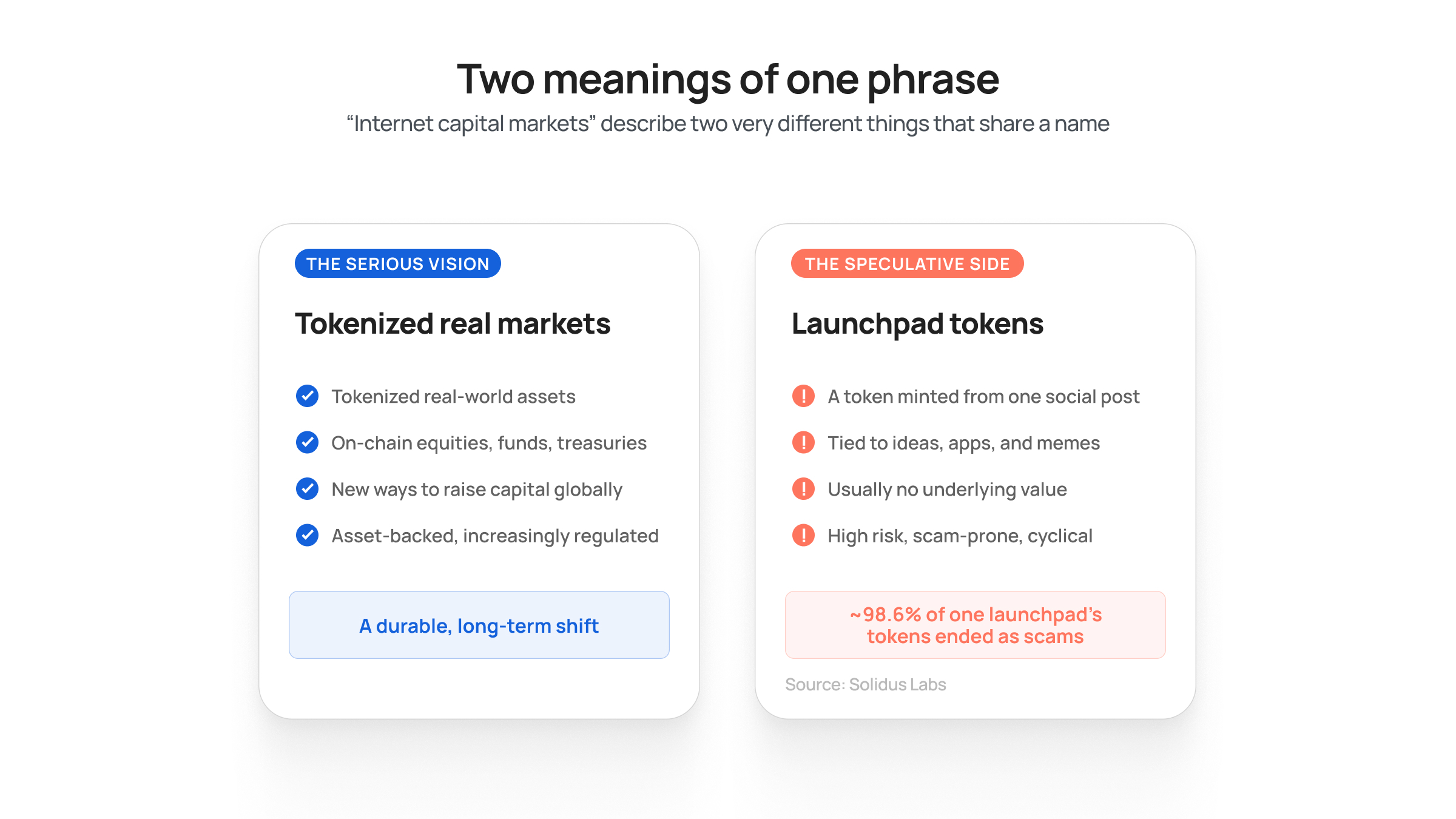
The infrastructure vision
This is the original meaning. It covers tokenized real-world assets, on-chain equities, and new ways for companies to raise capital from a global pool of investors. Tokenized US Treasuries, tokenized stocks, and tokenized funds all sit here.
The goal is to rebuild capital markets so they are cheaper to access, open all day, and reachable by people who are currently locked out.
The speculative token phenomenon
As the term gained attention, the memecoin community adopted it.
Here, "internet capital markets" came to mean a new class of launchpad tokens, where anyone can turn an idea, an app, or a meme into a tradable token in seconds.
Platforms such as Believe, whose LAUNCHCOIN token reached a multi-billion-dollar valuation at its peak, and pump.fun, both running on Solana, built large user bases around this model. It raised awareness of the term and blurred its meaning at the same time.
Why internet capital markets are gaining traction now
The push behind internet capital markets is a response to a real and growing problem. Access to wealth creation has narrowed, and a lot of people have been shut out of it.
Start with public markets, which are shrinking. In the United States, 81% of companies with more than $100 million in revenue are privately held, which puts them out of reach of everyday investors. Fewer firms are choosing to list at all.
Global IPO proceeds in the first half of 2025 fell 9.3% year over year to $44.3 billion, the weakest in nearly a decade. The most valuable technology companies, from Stripe to OpenAI, are staying private, and some have signalled they may never go public.
Going public has also become expensive. Software companies with deal sizes between $100 million and $250 million face IPO costs of $7.6 million to $29.5 million, most of it underwriting, legal, and accounting fees.
When companies stay private for longer, most of their growth happens before retail investors can touch them.
Amazon went public in 1997 at a valuation of around $440 million, and public shareholders captured the climb to well over a trillion dollars. A company that stays private until it is worth $90 billion hands almost all of that upside to insiders and a small group of accredited investors.
In the US, only accredited investors can legally buy into private equity, venture funds, and most unregistered securities. To qualify, an individual generally needs income above $200,000, or $300,000 with a spouse, or a net worth over $1 million excluding their home. While the rule was built to protect people, in practice, it locks most of the population out of the highest-growth investment opportunities.
The gap is wider outside North America and Western Europe. Roughly three-quarters of the world's population has no brokerage account that can reach major exchanges.
India, with about 1.4 billion people, had close to 190 million share-holding (demat) accounts in early 2025, which works out to well under 15% of the population. About 1.4 billion adults worldwide remain entirely unbanked.
Equities remain one of the most reliable engines of long-term wealth. In the US, 58% of households own stocks, with median holdings around $52,000. Most people on earth cannot easily buy them.
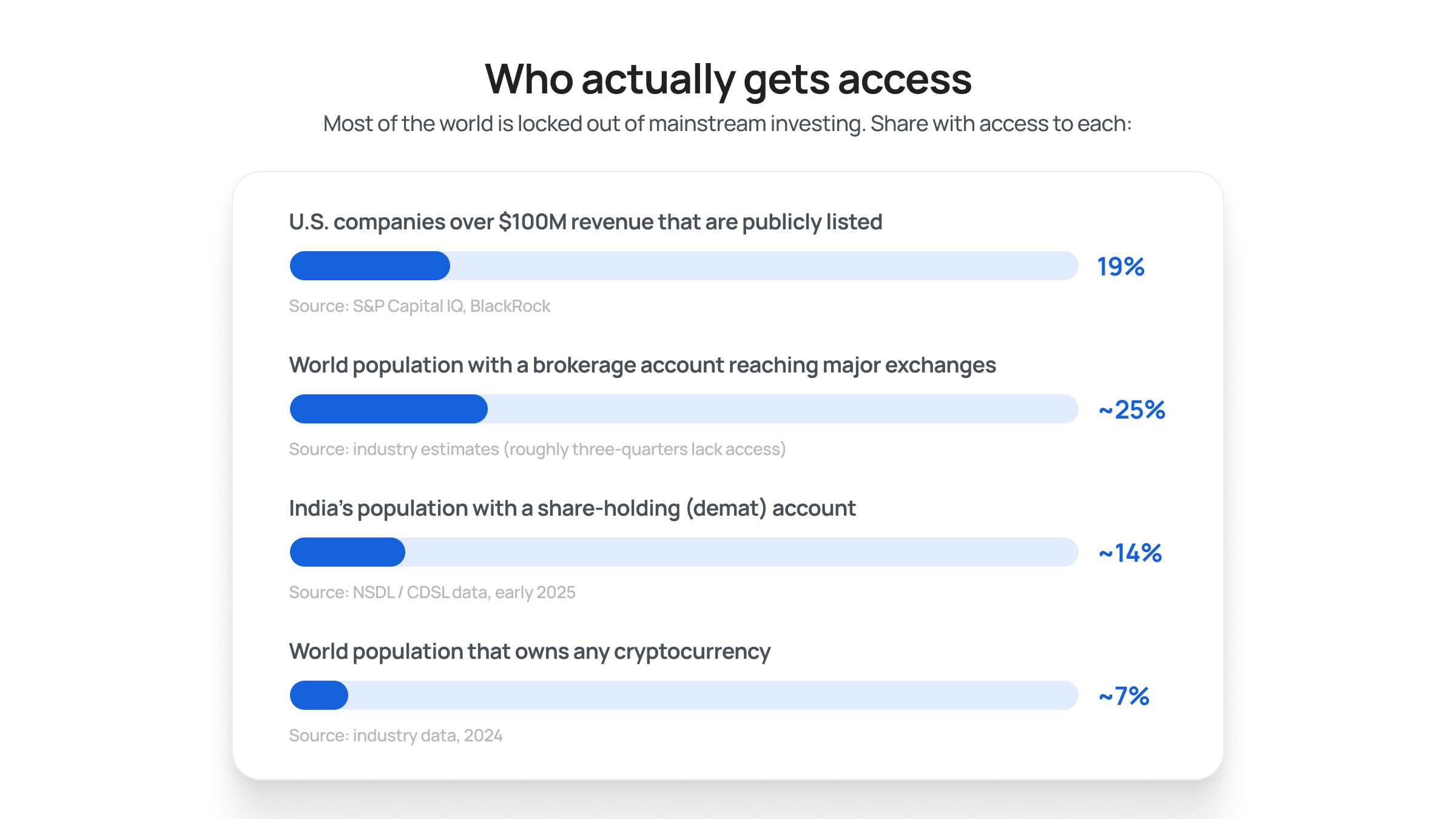
Seen this way, the appetite for internet capital markets is less a fad than a symptom. When the real growth is gated behind accreditation rules and cross-border barriers, people pour into whatever doors are open, including risky ones.
How do internet capital markets work?
Internet capital markets replace the traditional stack of intermediaries with code.
The same core functions still happen. Assets get issued, priced, traded, and settled. They just happen on a blockchain rather than through a chain of brokers, custodians, and clearing houses.
Tokenization
The starting point is tokenization, which means representing an asset as a digital token on a blockchain. The asset can be a share, a bond, a fund, a commodity, or the equity in a brand-new project.
A tokenized asset can be split into small fractions, which lets someone own a sliver of something that was previously too expensive or too illiquid to touch. Tokenized assets can span equities, real estate, treasuries, and commodities.
Smart contracts and on-chain settlement
A smart contract is a program that runs on a blockchain and executes automatically when its conditions are met.
In internet capital markets, smart contracts handle issuance, transfers, and the rules around ownership. Settlement happens on-chain, often in seconds, rather than over the days that traditional securities settlement can take. There is no separate clearing house standing in the middle.
Price discovery and liquidity
Traditional exchanges match buyers and sellers through an order book. Many on-chain markets use automated market makers instead, where liquidity sits in pools and prices adjust by formula as people trade. These mechanisms give continuous price discovery and let trading happen without a traditional broker or market maker on the other side.
Always-on, global access
Internet capital markets run 24 hours a day, every day, and they are reachable by anyone with a wallet and an internet connection. That is the headline benefit and, on the speculative side, also the headline risk.
Traditional Capital Markets vs Internet Capital Markets
Feature |
Traditional capital markets |
Internet capital markets |
|
Access |
Brokerage account, often accreditation |
Internet connection and a wallet |
|
Hours |
Exchange business hours |
24 hours, 7 days a week |
|
Intermediaries |
Brokers, banks, clearing houses |
Smart contracts |
|
Settlement |
One to two business days |
Often seconds, on-chain |
|
Trading mechanism |
Order books, market makers |
Automated market makers, bonding curves |
|
Minimum size |
Whole shares or high minimums |
Fractional, down to small amounts |
|
Investor protection |
Strong, well established |
Limited and uneven |
What are internet capital markets on Solana?
Internet capital markets on Solana refer to the on-chain issuance and trading of assets built on the Solana blockchain, which has become the most active network for this activity.
Solana's high throughput and very low fees suit markets where many assets trade frequently in small sizes. Its founders described an ambition to build an on-chain equivalent of a high-speed exchange.
Solana has leaned into the idea formally. In 2025 the team published an internet capital markets roadmap aimed at making the network the base layer for global on-chain markets by 2027. The momentum shows up in the data. Tokenized real-world assets on Solana reached an all-time high of around $873 million in late 2025, with the number of asset holders growing sharply.
The point worth holding onto is that Solana is where both meanings of the term live. The same network hosts regulated tokenized Treasuries and tokens with no underlying value at all.
The risks
Internet capital markets are often sold as pure democratization. The reality includes serious downsides, and a fair guide names them.
Speculation and scams dominate the token side. Most launchpad tokens have no business, no revenue, and no clear use beyond trading.
Research from Solidus Labs found that about 98.6% of tokens launched on pump.fun ended as scams, through liquidity drains or rapid creator sell-offs. With a bonding curve, early buyers often profit by selling to later ones, and when the buying stops, the price collapses. The activity is also cyclical. Launchpad revenue fell sharply from its 2025 peak as attention moved on.
Liquidity can be thin and concentrated. When one platform accounts for almost all of a market's volume, that market is closer to a single product than a broad ecosystem. A regulatory action or a technical failure at that one venue could drain liquidity overnight. Daily trading volumes in some tokenized markets still swing widely, which means large orders can move prices.
None of this cancels the long-term promise. It does mean the serious infrastructure vision and the speculative casino need to be judged on completely different terms.
The Fiat Bridge: How people actually get in and out
Here is the part that gets lost in the excitement. Internet capital markets are only as open as the on-ramps and off-ramps that feed them. A tokenized share or an on-chain fundraise means nothing if people cannot move their local currency into and out of it.
Across analyses of on-chain markets, fiat on-ramps and off-ramps appear repeatedly as the critical layer, the connection between the traditional financial world and the on-chain one.
Stablecoins do the settlement work inside these markets, and they have become the default unit of account on-chain. Stablecoins settled about $33 trillion on-chain in 2025. But a stablecoin is only useful to most people if they can buy it with a debit card or a bank transfer and cash it back out to their bank when they need to.
We are that conversion layer. Transak is an embedded fiat on-ramp and off-ramp infrastructure that 600+ apps have integrated so their users can buy and sell crypto and stablecoins with cards, bank transfers, and local payment methods, without leaving the app.
We support stablecoins such as USDC and USDT across major networks, including Solana. For a wallet, exchange, or fintech building toward on-chain markets, the ramp is the difference between a product a few crypto natives can use and one a first-time buyer can.
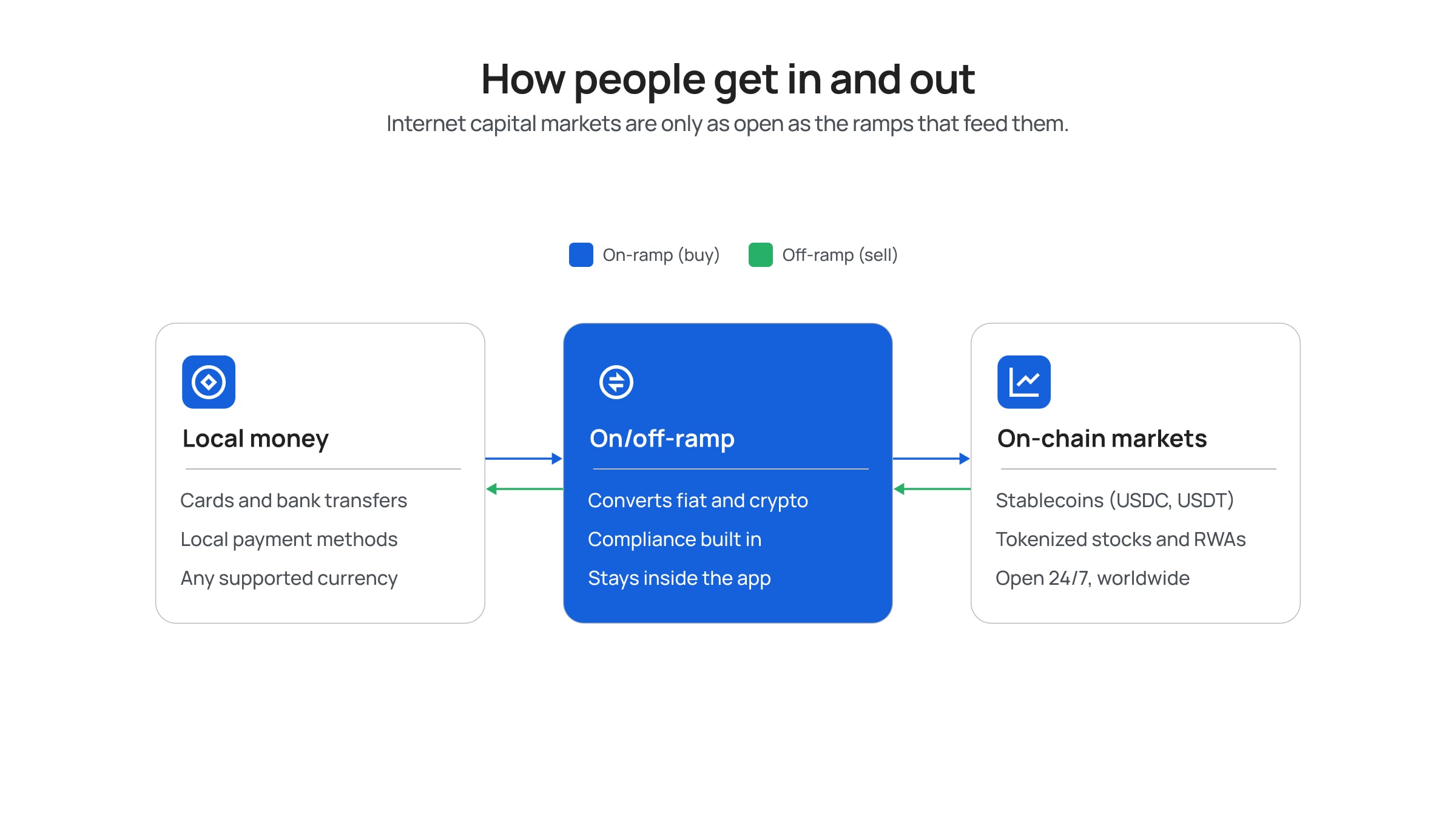
The case for internet capital markets rests on reaching people who are currently locked out, and most of those people are in emerging markets where the first barrier is simply turning local money into on-chain money and back.
For teams weighing where to focus, the lesson from the evolution of crypto payments is that most products do not lose users on protocol design. They lose them at the first funding step. The on-ramp is rarely the exciting part of an internet capital markets product. It is usually the part that decides whether anyone outside crypto ever uses it.
Where internet capital markets are heading
Strip away the noise and a steady trend remains. Real assets are coming on-chain, and the institutions that run traditional markets are building for it.
On-chain tokenized real-world assets, excluding stablecoins, passed roughly $32 billion in May 2026, more than triple a year earlier, led by tokenized Treasuries and a growing pool of tokenized stocks and commodities. Add stablecoins, the oldest and largest form of tokenized money, and the broader market runs well past $300 billion.
The largest asset managers are participating directly, and major exchange operators have started building round-the-clock tokenized securities infrastructure of their own. Forward estimates vary widely, but several point toward tokenized assets reaching trillions of dollars by 2030.
For builders, the serious opportunity is in tokenized real-world assets and compliant on-chain markets, not in chasing launchpad tokens.
If you are building in this space, decide how a new user in your target market turns local currency into on-chain assets and back, because that path, more than anything on-chain, decides who gets to participate. If that is the problem you are solving, explore how our on-ramp and off-ramp infrastructure works and where it fits your stack.
Frequently asked questions
What is an internet capital market?
An internet capital market is a market where assets are issued, priced, and traded on a public blockchain rather than through banks and brokers. Smart contracts replace intermediaries, settlement happens on-chain in seconds, and anyone with an internet connection and a wallet can take part.
What are the three types of capital markets?
By function, capital markets split into two: primary markets, where new securities are issued, and secondary markets, where existing securities trade between investors. By instrument, they are commonly grouped into three: equity (stock) markets, debt (bond) markets, and derivatives markets.
What is ICM in crypto?
ICM stands for internet capital markets. The term emerged in the Solana ecosystem in 2025. In crypto it describes moving the issuance, pricing, and trading of assets onto public blockchains. The term covers both a serious push toward tokenized real-world assets and a speculative wave of launchpad tokens tied to ideas, apps, and memes.
What are internet capital markets on Solana?
They are on-chain markets built on the Solana blockchain, which hosts the most activity in this area thanks to its speed and very low fees. Solana carries the bulk of on-chain tokenized stock trading and has published a roadmap to become the base layer for internet capital markets by 2027.
Are ICM tokens a good investment?
Most launchpad tokens are very high risk. One study found about 98.6% of tokens on a leading launchpad ended as scams, and bonding-curve pricing often rewards early sellers at the expense of later buyers. Tokenized real-world assets are a different category with real backing, but rules are still forming. Treat the two separately and assume you can lose your money.
How are internet capital markets different from an ICO?
Initial coin offerings were one-off fundraising events that peaked around 2017 and were frequently unregistered securities sales. Internet capital markets are broader. They include continuous on-chain trading, tokenized real-world assets, and ongoing price discovery, not just a single token sale.
Do you need crypto to take part in internet capital markets?
You need on-chain assets such as stablecoins or tokens, but you do not need to already own crypto to get them. A fiat on-ramp like Transak lets you buy on-chain assets with a card or bank transfer in your local currency, and an off-ramp lets you cash back out, which is how most newcomers enter and exit these markets.