
Takeaways
Most teams evaluating digital dollars treat "stablecoin" as one category. US law no longer does. The 2025 GENIUS Act carved out a regulated subset called the payment stablecoin, and that distinction now decides which coins a regulated business can legally touch.
If you get it wrong, you’ll end up building settlement rails on an asset that the compliance team has to rip out later.
This guide gives you the legal definition, the issuer rules, and the live coins that fit.
What is a payment stablecoin?
A payment stablecoin is a digital asset designed to be used as a means of payment or settlement, whose issuer is legally obligated to convert, redeem, or repurchase it for a fixed amount of money. Under the GENIUS Act, the US stablecoin law signed in July 2025, it is not a national currency, a bank deposit, or a security. That last point is what makes it usable.
By placing these assets outside securities law, deposit rules, and the definition of national currency, Congress gave businesses a clean legal lane. A payment instrument that was also a security would drag every transaction into securities compliance.
This is narrower than the everyday meaning of "stablecoin." Plenty of dollar-pegged tokens exist that no US regulator would call a payment stablecoin. The label is a legal status and not a marketing term.
How the GENIUS Act defines “payment stablecoins”
The GENIUS Act defines a payment stablecoin as a digital asset used or designed for payment or settlement, where the issuer must redeem it for a fixed monetary value and represents that it will hold a stable value. The Act expressly excludes national currencies, deposits, and securities.
Here is the structure of the legal test, drawn from the public law text:
- Purpose. The asset is, or is designed to be, used as a means of payment or settlement.
- Redemption obligation. The issuer must convert, redeem, or repurchase it for a fixed amount of monetary value.
- Stable-value representation. The issuer represents it will maintain a stable value relative to that fixed amount.
- Exclusions. It is not a national currency, not a deposit (including a deposit recorded on a distributed ledger), and not a security.
That redemption obligation is the heart of it. A payment stablecoin is a promise of par value backed by an enforceable claim, not a token that merely trades near a dollar on an exchange. For the wider rulebook around this definition, see our CEO's guide to the GENIUS Act.
Here’s a caveat. The Act says, for the avoidance of doubt, that an instrument does not become a security solely by meeting these conditions.
Who can issue one: the permitted payment stablecoin issuer
A permitted payment stablecoin issuer is a US-formed entity authorized to issue payment stablecoins under one of three routes, and it is the only entity that may lawfully issue one in the United States. Federal qualified nonbanks are approved by the Office of the Comptroller of the Currency (OCC). The category keeps issuance inside regulated, supervised institutions.
The Act names three paths to becoming a permitted payment stablecoin issuer:
|
Issuer type |
Who regulates it |
Practical fit |
|---|---|---|
|
Insured depository institution subsidiary |
The bank's federal agency (OCC, FDIC, or Fed) |
Banks and credit unions issuing via a subsidiary |
|
Federal qualified nonbank issuer |
The OCC |
Nonbanks operating nationally under federal approval |
|
State qualified issuer |
A state payment stablecoin regulator |
Issuers up to $10 billion outstanding |
A state qualified issuer that grows past $10 billion in outstanding coins must move to the federal framework, generally within 360 days. The cap stops large issuers from staying under lighter state oversight indefinitely.
The GENIUS Act was signed in July 2025, but its core requirements take effect on the earlier of January 18, 2027 or 120 days after final regulations. Issuers today are building to the standard and seeking approval, not holding a finished federal license. Treat current compliance claims as "structured to qualify," and confirm each issuer's live status before you commit.
Reserve, redemption, and disclosure rules
A permitted payment stablecoin issuer must hold reserves of at least one dollar for every dollar of stablecoins issued, keep those reserves in a narrow set of liquid assets, publish a monthly reserve report, and maintain a clear redemption policy. These four duties separate a regulated coin from an unbacked peg.
The reserve list is short by design. Eligible assets include cash, deposits at insured banks, short-dated Treasury bills, certain repurchase agreements backed by Treasuries, and government money market funds, as detailed in the FDIC's implementation notice. No corporate bonds. No lending the reserves out for yield.
Disclosure is monthly and externally checked. Issuers must publish the composition of reserves and the number of coins outstanding each month, and a registered public accounting firm must examine that report. This turns "trust us" into a verifiable public record.
Redemption rights are explicit. The issuer must publish procedures for timely redemption, and only a regulator can impose discretionary limits. That enforceable par-value claim is the entire point of choosing a regulated coin.
Payment stablecoins vs other stablecoin types
A payment stablecoin is distinct from algorithmic stablecoins, yield-bearing stablecoins, and the EU's e-money tokens. Each sits under different rules or none at all, and only the payment stablecoin carries the GENIUS Act's redemption and reserve guarantees. Lumping them together is the most common and most expensive mistake, because the differences change who is liable, what backs the coin, and whether a US regulated business can use it at all.
|
Type |
What backs it |
Regulatory status |
Settlement fit |
|---|---|---|---|
|
Payment stablecoin (US) |
1:1 cash and Treasuries |
GENIUS Act regulated; not a security |
Built for it |
|
Algorithmic stablecoin |
Code and incentives, no full reserve |
Outside the category; high failure risk |
Avoid |
|
Yield-bearing stablecoin |
Reserves that pay holders a return |
Often a security |
Usually unsuitable |
|
E-money token (EU, MiCA) |
1:1 single official currency |
Electronic money under MiCA |
EU-facing |
Algorithmic coins hold a peg through supply mechanics rather than hard reserves. The 2022 collapse of one major algorithmic coin wiped out tens of billions, and the Act effectively walls these out of the payment category.
Yield-bearing stablecoins pass investment returns to holders, which usually makes them look like a security and disqualifies them as a payment instrument under the Act.
The EU took a parallel road. Under MiCA, an e-money token references a single official currency and is treated as electronic money, giving holders a full-face-value redemption right. Same goal, different legal machinery, which matters if you settle across both regions.
Which live coins fit the payment stablecoin category
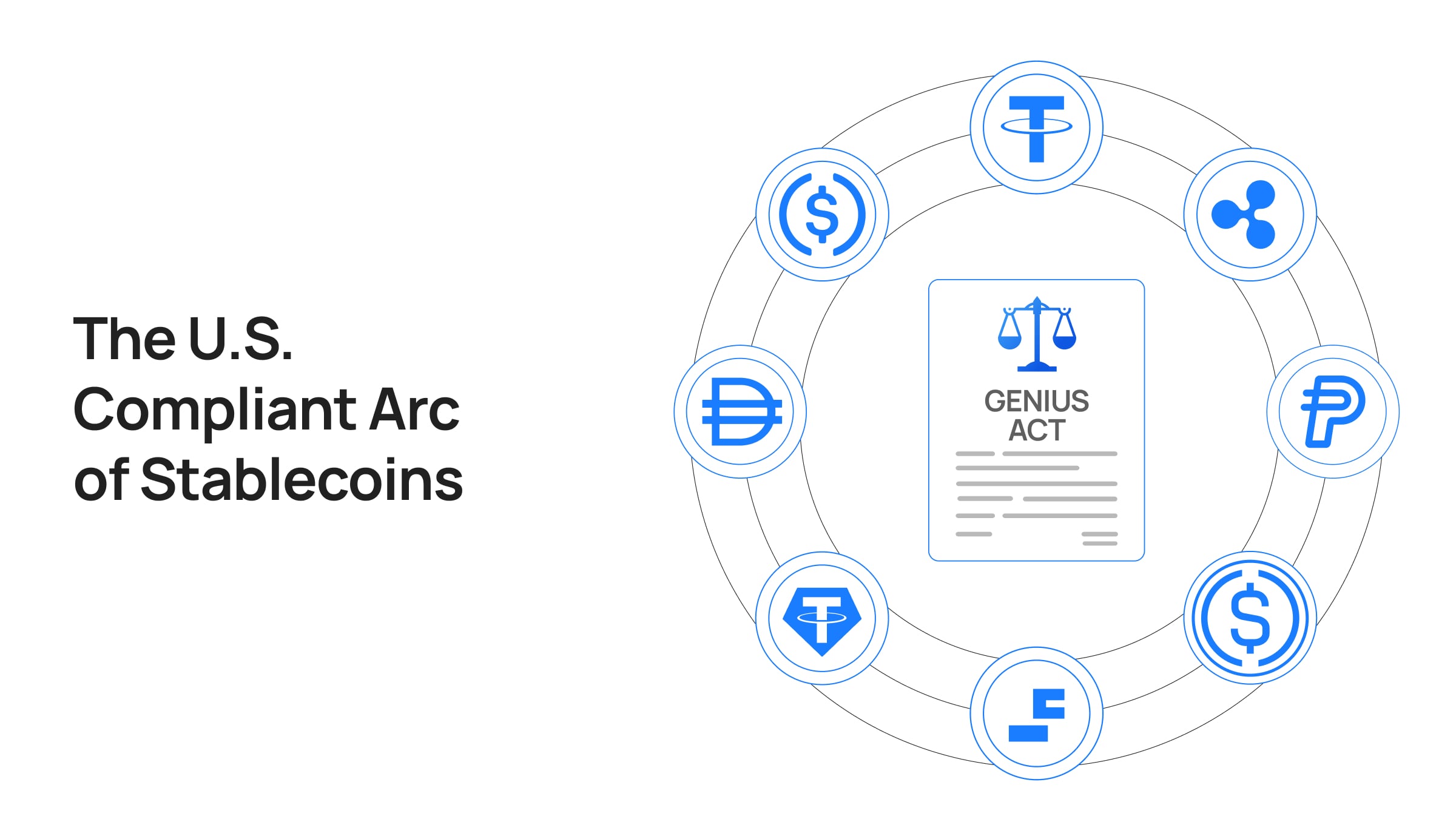
Several major dollar coins are structured to meet the payment stablecoin standard, including USDC, PYUSD, USDG, and RLUSD. All four are fully dollar-backed, redeemable one-for-one, and issued by regulated entities, though formal federal approval follows the Act's later compliance dates.
USDC is issued by Circle and remains the largest US-regulated dollar coin, with over $75 billion in circulation as of June 2026.
PYUSD and USDG are both issued by Paxos, a New York trust company supervised by the state's financial regulator. PYUSD carries the PayPal brand, while USDG launched as the first MiCA-compliant stablecoin from Paxos, giving it standing on both sides of the Atlantic.
RLUSD is Ripple's dollar stablecoin, issued by Standard Custody, a New York-chartered trust company. One external signal of this group's standing came in June 2026, when Mastercard added these regulated coins to its settlement network. Still, verify an issuer's current status before naming any coin as compliant in your own product.
Why the distinction matters for choosing settlement rails
For a business picking settlement rails, the payment stablecoin label is a compliance filter, not a feature checkbox. A coin inside the category gives you an enforceable par-value claim, audited reserves, and a regulated issuer. One outside it can expose you to securities rules, redemption failures, or a coin your bank refuses to accept.
A neobank that settles balances in a regulated payment stablecoin can answer an examiner with a monthly attestation. One that picks a yield-bearing coin may have just issued an unregistered security to its users.
Settlement reliability follows the same logic.
A coin with a hard one-to-one reserve and a regulator-backed redemption right behaves predictably during stress. Deciding which stablecoin your business should use starts with confirming it is a payment stablecoin in the first place.
How Transak helps
If you run a neobank adding USD accounts, a remittance app cutting settlement delays from days to minutes, a payroll or EOR platform paying contractors across borders, or a PSP adding stablecoin rails, the issuer category is your starting line and the integration is the harder part.
Transak is a regulated stablecoin payments infrastructure provider that moves money between fiat and regulated payment stablecoins through one API, covering on-ramp pay-ins, off-ramp payouts, named IBANs, and compliance, so your team settles in qualifying coins without becoming a crypto company.
To map your rails to the right payment stablecoin, talk to our team.
Frequently asked questions
What are the four types of stablecoins?
The four common types are fiat-backed (reserves in cash and Treasuries), crypto-collateralized (overbacked by other crypto), algorithmic (peg held by code, not reserves), and commodity-backed (tied to assets like gold). Only fully reserved fiat-backed coins can qualify as GENIUS Act payment stablecoins. The other three fall outside the category.
Is Bitcoin a payment stablecoin?
No. Bitcoin has no fixed redemption value and no issuer obligated to hold its price stable, so it fails the core test. Its price floats freely, which is the opposite of a payment stablecoin's design. Bitcoin is a volatile crypto asset, while a payment stablecoin is a redeemable claim on a fixed amount of money.