Takeaways
You hold crypto. You want money in your bank account. The thing that connects those two states is called an off-ramp, and it is the part of the journey most people only think about once they actually need it.
This guide explains what an off-ramp is, how the conversion works step by step, what it costs, how long it takes, and the two things worth checking before you start.
What is a crypto off-ramp?
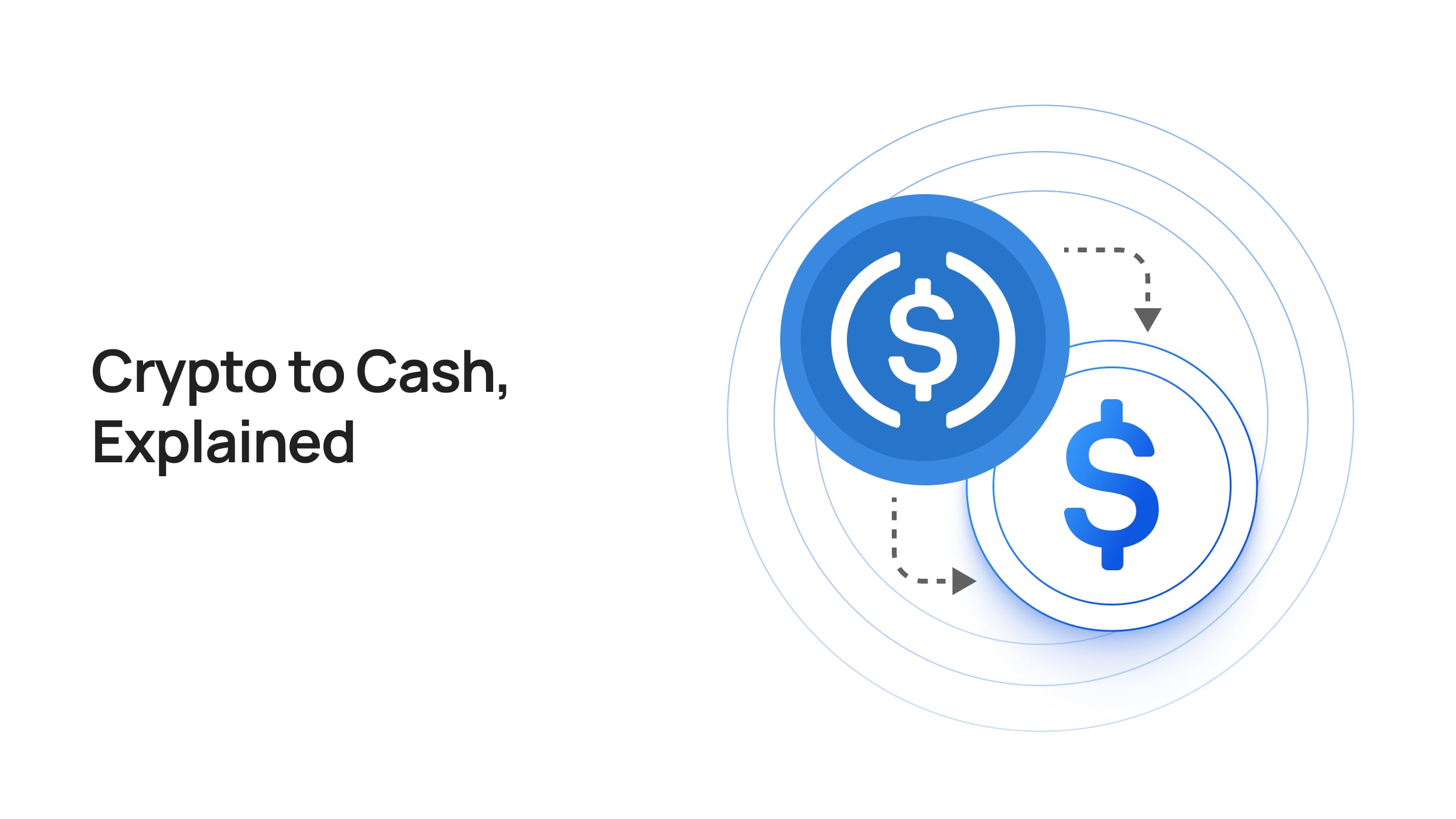
A crypto off-ramp is a regulated service that converts cryptocurrency into fiat currency and pays the proceeds out to a bank account, card, or other local payment method. You send crypto to the provider, it sells the asset and handles the currency conversion, and you receive money in the account you nominated.
The word “off-ramp” (and “on-ramp”) is borrowed from road design. An on-ramp takes you from the ordinary financial system onto blockchain rails, and an off-ramp brings you back down again. Both are conversion points between two systems that do not otherwise speak to each other.
An off-ramp is not the same as a crypto exchange.
An exchange is a marketplace where you trade one asset for another and where a balance sits until you withdraw it. An off-ramp is a one-directional service that exists to get value out and into your bank.
On-ramp vs off-ramp
|
Direction |
Fiat to crypto |
Crypto to fiat |
|
You start with |
Money in a bank, card, or wallet |
Crypto/stablecoins in a wallet or exchange |
|
You end with |
Crypto in a wallet you control |
Money in a bank account or on a card |
|
Typical trigger |
Buying an asset, funding a wallet |
Taking profit, paying a bill, covering expenses |
|
Verification |
Required by regulated providers |
Required by regulated providers |
How a crypto off-ramp works, step by step
The whole process is five steps, and only one of them happens on a blockchain.
- Choose the asset and amount. Users select which cryptocurrency to sell and how much, and Transak shows a quote with the rate and fees before users commit.
- Verify your identity. A first-time user completes identity verification. This is generally once per provider rather than once per transaction.
- Send the crypto. Users transfer the asset to the address that Transak providers.
- Transak converts it. The asset is sold and converted into local currency at the quoted rate.
- Money reaches the account. Funds are paid out to the bank account or card on a local payment rail.
Transak Stream Off-Ramp compresses steps three through five. You set withdrawal details once, receive a permanent address, and anything sent to it converts and pays out automatically without repeating the setup.
How long off-ramping takes and what it costs
Speed is primarily decided by the payout rail at the end. A transfer can confirm on-chain in seconds and still take days to appear in a bank account, because the delay sits with the receiving bank.
|
Payout method |
Typical speed |
|
Instant card payout |
Near immediate on eligible cards |
|
SEPA Instant |
Effectively immediate |
|
Standard card payout |
Up to 48 hours |
|
Standard SEPA transfer |
Up to five working days |
Most transactions through our off-ramp complete in around two minutes, and the cases that take longer are almost always the receiving bank rather than the conversion.
On cost, there are three components:
- The provider's fee
- The spread built into the exchange rate
- The network fee to move the asset on-chain
Transak Partners who may add their own fee of up to 5% on top of Transak’s off-ramp fee. The network fee is usually trivial on a fast chain and is the number people over-index on.
Why identity verification is always required
Converting crypto into money in a bank account is a regulated activity. Anti-money-laundering laws in every major market requires the business performing it to verify who its customers are, screen them against sanctions lists, and report suspicious activity.
A provider that does not ask for identity documents is either not regulated in your market or is not complying with the rules that apply to it. Neither is a good position for you if something goes wrong, because your recourse depends on the provider being accountable to a regulator.
Verification is generally a one-time step. Transak can also reuse a check that users have completed on an integrated app.
Conclusion
An off-ramp is the exit door of the crypto system.
If you are building a product and want your users to cash out without leaving your app, our off-ramp covers 64+ countries and 40+ cryptocurrencies, with the licensing, verification, and payout handled for you. Talk to our team.
Frequently asked questions
What is a crypto off-ramp?
A crypto off-ramp is a regulated service that converts cryptocurrency into fiat currency and pays it out to a bank account or card. You send crypto to the provider, it sells the asset and converts the proceeds, and the money arrives in the account you nominated. It is the reverse of an on-ramp.
What is the difference between an on-ramp and an off-ramp?
An on-ramp converts money into crypto, and an off-ramp converts crypto back into money. Both are conversion points between the banking system and blockchain rails, both are usually built by the same provider, and both require identity verification when the provider is regulated.
Can I convert crypto directly to cash in my bank account?
Yes. A regulated off-ramp pays out directly to a bank account in supported markets, and in many cases to a debit card as well. You do not need to route through an exchange account first, though the provider must support both your country and your chosen payout method.
How long does it take to convert crypto to cash?
It depends on the payout rail. Instant card payouts and SEPA Instant transfers can arrive almost immediately, while standard card payouts can take up to 48 hours and standard SEPA transfers up to five working days. Most conversions complete in around two minutes, with any delay usually sitting at the receiving bank.
What is the cheapest way to convert crypto to cash?
Compare the amount that actually lands in your account rather than the advertised fee, because the exchange-rate spread is often larger than the stated percentage and much less visible. Also factor in the payout method, since some rails carry a fixed charge and the network fee to move the asset on-chain is usually negligible.
Can I cash out crypto without KYC?
Not through a regulated provider. Identity verification is a legal requirement for businesses converting crypto to fiat in every major market. Services advertising no verification are typically operating outside those rules, which leaves you without regulatory recourse if funds go missing or a transaction fails.
Do I pay tax when I cash out crypto?
In most jurisdictions, converting crypto to fiat is a disposal and a taxable event, whether or not you withdraw the money afterwards. Rules vary substantially by country. Keep the full transaction record from your provider and speak to a qualified tax professional about your own position.
Why is it so hard to withdraw from crypto?
Usually one of three reasons. The provider does not support payouts in your country even though it supports purchases there, your verification is incomplete, or the payout rail itself is slow rather than the conversion. Checking payout coverage for your specific country before you start avoids most of it.