Launching a crypto exchange is no longer just a matter of building a trading interface and connecting users to a blockchain.
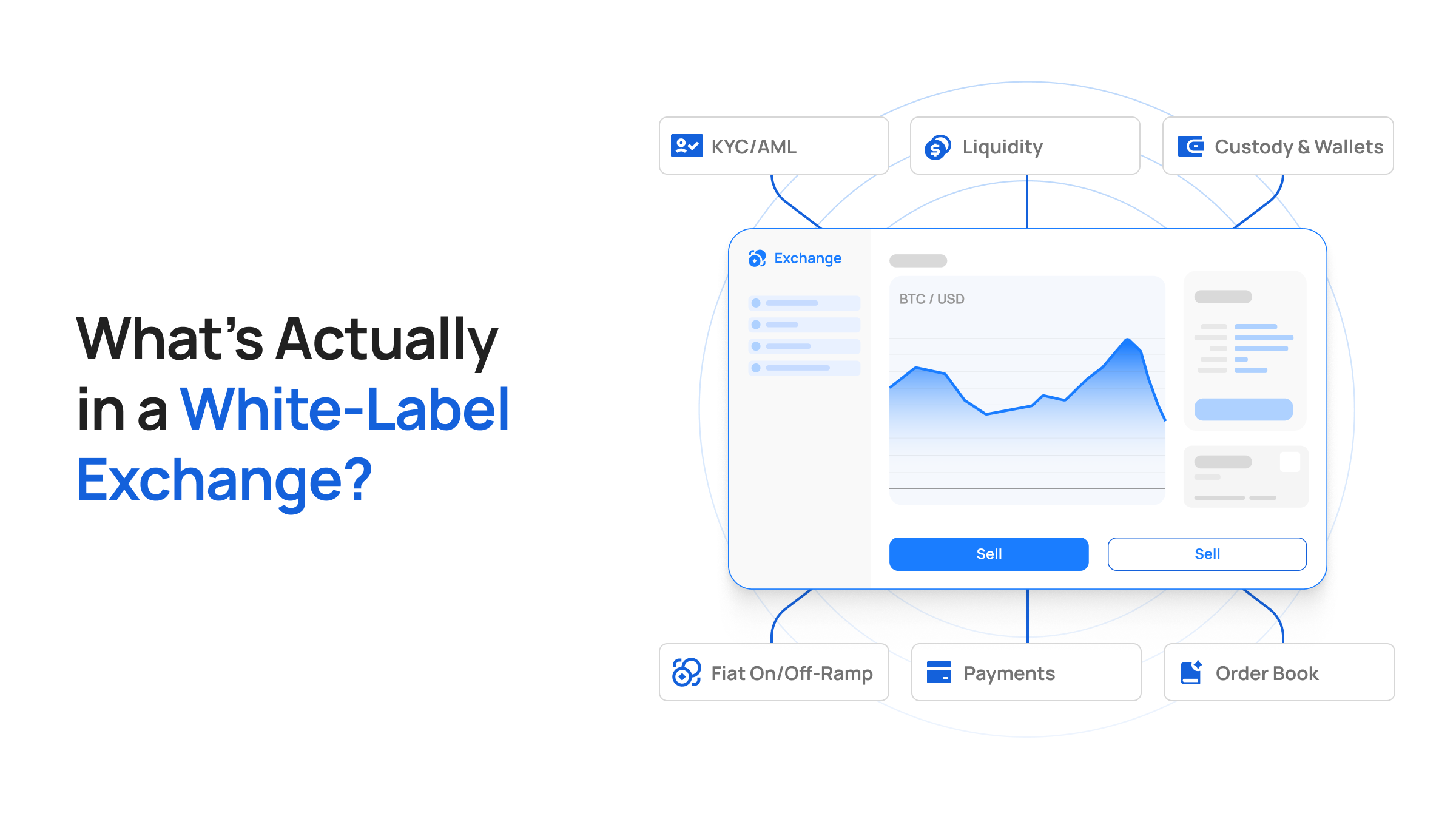
Behind every exchange is a stack of infrastructure that handles everything from trading and custody to liquidity, compliance, payments, and fiat conversion.
For businesses looking to launch quickly, a white-label crypto exchange can provide much of this infrastructure without requiring everything to be built from scratch.
But “white-label exchange” can mean different things. Some providers offer a complete exchange platform. Others provide individual infrastructure components that businesses can integrate under their own brand.
So what do you actually need? Let’s find out.
What is a white-label crypto exchange?
A white-label crypto exchange is an exchange platform or infrastructure stack developed by one company and offered to another business to launch under its own brand.
Instead of developing an exchange from the ground up, a business can use pre-built infrastructure for capabilities such as:
- Trading
- Liquidity
- Wallets and custody
- Crypto deposits and withdrawals
- Fiat on-ramps and off-ramps
- KYC and compliance
- Transaction monitoring
- Payment processing
- APIs and integrations
Also Read: 8 Best White-Label Crypto On/Off-Ramp Providers 2026 (Compared)
The business typically controls the brand, customer relationship, and user experience while the infrastructure provider operates some or all of the underlying technology.
This approach can reduce development time and allow businesses to focus their resources on the parts of the exchange that differentiate them.
But not every exchange needs the same stack.
The Core Infrastructure Behind a Crypto Exchange
Before choosing a white-label provider, it's important to understand the individual components that make an exchange work.
1. Trading infrastructure
The trading engine is at the center of a traditional crypto exchange.
It matches buy and sell orders and needs to handle:
- Order books
- Market and limit orders
- Trade execution
- Order matching
- Market data
- Trading pairs
- High transaction volumes
For exchanges where active trading is the core product, the performance and reliability of this layer are critical.
Some businesses may want to build or deeply customize their trading infrastructure. Others may choose to use a white-label trading engine.
2. Liquidity
A trading interface is only useful if users can actually execute trades.
Liquidity determines how easily users can buy or sell assets without significantly moving the market price.
An exchange may source liquidity through:
- Internal market making
- External liquidity providers
- Other exchanges
- Aggregators
- Institutional counterparties
When evaluating white-label exchange infrastructure, businesses should understand where liquidity comes from and who manages it.
A provider that gives you a polished exchange interface but limited liquidity may not provide much value in practice.
3. Wallet and custody infrastructure
Users need somewhere to hold their crypto before and after trading.
This means an exchange needs infrastructure for:
- Deposits
- Withdrawals
- Address management
- Transaction signing
- Blockchain connectivity
- Asset balances
- Hot and cold storage
- Key management
Custody is also one of the areas where businesses need to carefully consider whether they want to build, outsource, or use a third-party custodian.
Not every white-label exchange provider is a custody provider, and these shouldn't automatically be treated as the same infrastructure layer.
4. Fiat On-Ramp and Off-Ramp Infrastructure
This is one of the most important (and often overlooked) parts of the exchange stack.
A user may discover your exchange because they want to buy crypto. But if they can't easily move money from their bank account or card into the platform, the exchange has a conversion problem.
A fiat on-ramp allows users to purchase crypto using traditional currencies.
An off-ramp enables users to convert crypto back into fiat and withdraw it.
Together, they connect the crypto exchange to the traditional financial system that your users are already familiar with.
A modern exchange may need to support:
- Credit and debit cards
- Bank transfers
- Mobile wallets
- Local payment methods
- Multiple fiat currencies
- Crypto-to-fiat conversion
- Fiat-to-crypto conversion
Building these capabilities independently can mean integrating with multiple payment providers, managing regional payment methods, handling compliance requirements, and maintaining payment flows across markets.
For many exchanges, this is a good example of infrastructure that can be white-labeled rather than built internally.
For example, Transak offers white-label on-ramp and off-ramp infrastructure that exchanges can integrate into their own branded experience. This allows the exchange to maintain its customer-facing experience while using existing infrastructure to facilitate fiat-to-crypto and crypto-to-fiat transactions.
The exchange doesn't necessarily need to outsource its entire product. It can own the exchange experience while white-labeling specific infrastructure underneath it.
5. KYC and Compliance
Crypto exchanges operate in a heavily regulated environment.
Depending on the jurisdiction and business model, an exchange may need infrastructure for:
- Identity verification
- KYC
- AML screening
- Sanctions screening
- Transaction monitoring
- Risk assessment
- Travel Rule requirements
- Suspicious activity monitoring
Some providers bundle compliance tools into their exchange infrastructure. Others expect businesses to integrate separate compliance providers.
This is an important distinction when evaluating a white-label solution.
Don't assume that “white-label exchange” means compliance is taken care of.
The business still needs to understand which regulatory responsibilities remain with it.
6. Payment Infrastructure
Fiat access also requires payment infrastructure capable of processing transactions reliably.
This can include connections to:
- Card networks
- Banks
- Payment processors
- Mobile wallets
- Local payment rails
Payment infrastructure becomes particularly complicated when an exchange expands internationally.
A payment method that works well in one market may have little relevance in another.
This is one reason businesses often choose specialized providers rather than attempting to build every payment connection themselves.
7. Blockchain Infrastructure
Exchanges also need reliable connectivity to the blockchain networks supporting their assets.
This can involve:
- Node infrastructure
- RPC providers
- Blockchain indexing
- Transaction monitoring
- Deposit detection
- Withdrawal processing
- Confirmation tracking
- Gas management
Supporting one blockchain is relatively straightforward compared with supporting dozens or hundreds.
As asset coverage grows, the infrastructure requirements grow with it.
8. APIs and Integration Infrastructure
A white-label exchange doesn't exist in isolation.
It may need to connect with:
- Banking partners
- Payment providers
- Custodians
- KYC providers
- Liquidity providers
- Analytics platforms
- Internal systems
- Customer support tools
Well-designed APIs make it easier to integrate these services and customize the exchange without rebuilding the underlying platform.
For businesses evaluating providers, API quality can therefore be just as important as the front-end experience.
The Benefits of a Modular White-Label Approach
A modular approach can give exchanges more flexibility than adopting an all-in-one platform.
Faster launch
Pre-built infrastructure can significantly reduce development time.
Lower engineering overhead
Teams don't need to maintain every payment, blockchain, compliance, and infrastructure integration themselves.
Easier expansion
Specialized providers can make it easier to add new markets, payment methods, assets, or capabilities.
More focus on differentiation
Engineering resources can be concentrated on the exchange's UX, liquidity strategy, trading features, and customer experience.
Greater flexibility
Businesses can replace or upgrade individual infrastructure components without rebuilding the entire exchange.
What white-label packages usually leave out
This is the part that catches teams out. The trading stack is included. The money stack usually is not.
Licensing
The permission to accept customer money in each market you serve. In the United States that means state-level money transmitter licences plus federal registration, in Canada an MSB registration, in Australia a digital currency exchange registration. Vendors supply software, not permissions.
Banking
A bank willing to hold customer fiat for a crypto business. This is the single hardest thing on the list to obtain, and losing it stops deposits the same day.
Card acquiring
An acquirer willing to process crypto merchant category codes, along with the higher decline rates and chargeback exposure that come with them.
Local payment methods
The rails users in each market actually expect. Every additional market usually means a new integration, a new counterparty, and new compliance work.
Payment-side compliance
KYC at the point of payment, sanctions screening, transaction monitoring, and Travel Rule reporting on the fiat leg, plus the staff to run it daily.
Also Read: What Infrastructure Is Needed to Enable Crypto and Stablecoin Payments in an App
Where Transak fits
Transak is not a white-label exchange platform. We are the fiat layer that most white-label platforms leave out.
If you are licensing a trading stack from a platform vendor, we handle the on-ramp and off-ramp beside it. That means:
A white-labeled payment flow. Your branding, your journey, our rails underneath. MetaMask built its Deposit feature this way.
We are the regulated party on the payment leg, so the licensing barrier does not sit between you and launch.
Modular scope. Take the on-ramp, the off-ramp, or both, and add markets as configuration rather than as projects.
Also Read: Case Study: How MetaMask Launched 'Deposit' using Transak's White-Label APIs
How to Choose a White-Label Crypto Exchange Provider
The right provider isn't necessarily the one offering the longest feature list.
Look at the infrastructure underneath the product.
Geographic coverage
Which countries and fiat currencies are supported?
Payment methods
Can users pay through the methods they already use?
Compliance
Which compliance responsibilities does the provider handle, and which remain with you?
Liquidity
Where does trading liquidity come from?
Custody
Who controls user assets and private keys?
APIs
Can you customize the experience and integrate the infrastructure into your existing systems?
Scalability
Can the infrastructure support your expected transaction volumes and future markets?
Branding
How much of the customer-facing experience can you control?
Economics
Look beyond the headline price. Consider transaction fees, engineering costs, operational overhead, and the cost of adding new markets.
Conclusion
Build the parts that make your exchange different. White-label the infrastructure that doesn't.
That could mean owning the trading experience and customer relationship while using specialized providers for custody, compliance, liquidity, blockchain connectivity, and fiat payments.
For fiat specifically, white-label on-ramp and off-ramp infrastructure can give exchanges a way to offer familiar payment experiences without developing and maintaining every payment integration themselves.
This is where providers such as Transak can fit into a broader exchange stack. Rather than replacing the exchange itself, Transak's white-label infrastructure can provide the fiat conversion layer underneath the exchange's own branded experience.
The result is a more modular approach to building an exchange:
Your brand. Your customer experience. Specialized infrastructure underneath.
Frequently asked questions
What does white-label mean for a crypto exchange?
It means running a trading platform built and maintained by another company under your own brand. Your users see your name and interface. The vendor supplies the matching engine, wallets, and back office, and usually charges a licence fee plus a share of trading revenue.
Does a white-label crypto exchange include fiat on-ramps?
Rarely in full. Most packages include the trading stack and either exclude fiat entirely or offer a basic card integration. Licensing, banking relationships, and local payment methods are usually left to you, which is why many exchanges add a dedicated on-ramp provider alongside the platform.
Do I need a licence to run a white-label exchange?
Yes, in almost every market. Licensing follows the activity, not the software, so buying a platform does not transfer any permission to you. The exception is the payment leg, where an integrated provider can be the regulated party for that specific step.
How much does white-label exchange infrastructure cost?
Pricing usually combines a setup fee, a monthly licence, and a percentage of trading volume. The larger cost is often what sits outside the contract, meaning licensing, banking, compliance staff, and the fiat layer. Compare total cost to launch rather than headline platform fees.
How long does it take to launch a white-label exchange?
The software can be live in weeks. Licensing and banking commonly take months and set the real launch date. Teams that plan around the software timeline alone are the ones that end up with a finished exchange and no way to accept deposits.
What is the difference between a white-label exchange and an exchange API?
A white-label exchange is a complete branded platform you operate. An API is a component you build into your own product. White-label suits teams launching a standalone exchange, while APIs suit teams adding trading or payments to an application that already exists.
Can I white-label just the on-ramp instead of the whole exchange?
Yes, and it is common. If you already have a product, you can add a branded fiat on-ramp and off-ramp without licensing a full exchange platform. The payment flow carries your branding while the provider handles licensing, payment processing, and compliance on that leg.
Also Read: Whitelabel API vs Widget: Which Crypto On-Ramp Integration Should Your Wallet Choose?
How do I compare white-label providers fairly?
Score every vendor against the same list. Regulated party, fiat coverage, branding control, compliance split, failure handling, realistic launch date, and exit terms. Vendors present their strengths in different formats, and a fixed scorecard is the only way to see what is missing.