Takeaways
- Tokenized securities put traditional assets on blockchain rails.
- Tokenized stocks can represent real ownership or synthetic exposure.
- Trading can happen through order books, ATSs, or onchain venues.
- Tokenization can enable faster settlement and more flexible trading.
- Ownership, liquidity, custody, and platform risks still matter.
Tokenized securities trading means buying and selling investments, such as stocks, bonds, or fund shares, that use blockchain technology to record or transfer ownership. The investment has a digital token form, but it remains a financial product with specific rights and risks.
For a user, the process may look familiar, something like, open an account, add funds, choose an investment, and place a trade.
The important differences sit behind the screen. What does the token represent? Who holds the underlying assets? How does the trade settle? And how do you get your money out?
This guide explains each part, with examples and recent developments that show how the market is taking shape.
What are tokenized securities?
A tokenized security is a security represented by a digital token. Its ownership record is maintained partly or fully through a blockchain. Examples include company shares, bonds, and investment fund shares.
You can think of tokenization as a change in how an investment is recorded and moved rather than an automatic change in what the investment is.
Franklin Templeton’s OnChain U.S. Government Money Fund is a good example. It uses blockchain to record fund share ownership. The fund still invests in government securities, cash, and qualifying repurchase agreements. Using blockchain does not turn its portfolio into a cryptocurrency investment.
What does the investor actually own?
Not all tokenized stocks are the same.
| Structure | What it means for the investor |
|---|---|
| Issuer-sponsored token | The issuer or its agent uses blockchain records as part of the security’s ownership system. |
| Third-party backed token | An intermediary holds securities and issues tokens representing direct or indirect interests in them. The custody arrangements matter. |
| Synthetic token | A separate instrument provides exposure to a security’s performance. It does not, by itself, make the holder a shareholder in the referenced company. |
How does tokenized securities trading work?
The exact process depends on the product and platform. So, here are the generic steps.
1. Check access and complete verification
Start by checking whether the platform and investment are available to you.
Account opening may involve identity checks and other eligibility requirements. A token may also be restricted to approved wallets.
For example, Franklin Templeton’s fund uses a permissioned system that limits which wallets can hold and transfer its shares.
2. Fund the account and choose how to hold the tokens
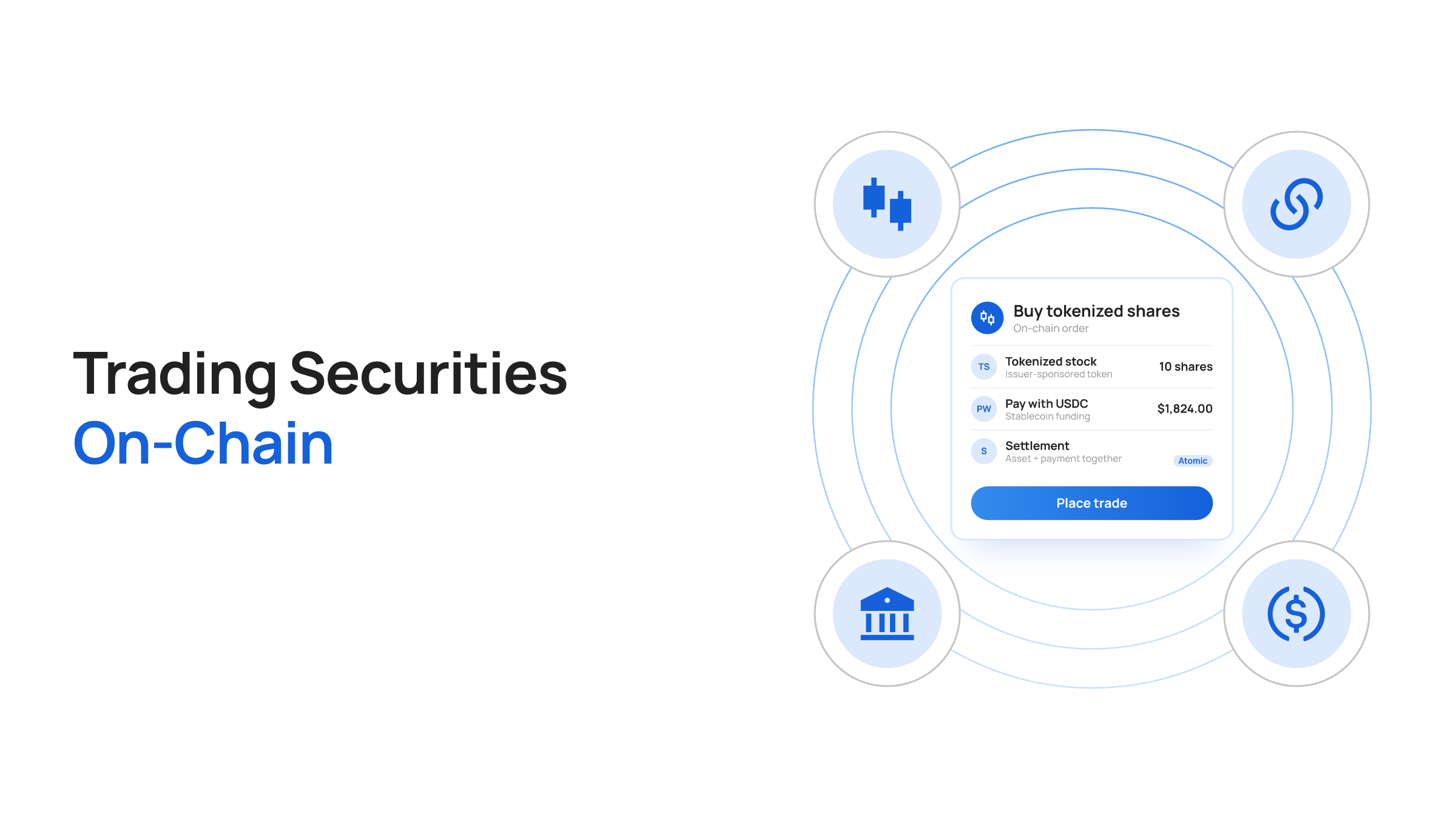
Funding and settlement methods vary. Some products use bank money. Others support stablecoins. Institutional systems can also use tokenized bank deposits or central bank money.
You also need to understand custody.
With a custodial service, a provider holds the private keys that control the tokens. With self-custody, you manage those keys yourself. A private key is the credential used to authorize transactions.
3. Review the price and place a trade
Tokenized securities do not all use the same trading system.
An order book matches buy and sell orders. An automated market maker, or AMM, uses programmed rules to let users trade against a pool of assets. That pool supplies the assets needed for swaps.
On an AMM, pool size and trade size can affect the price. A large order in a small pool may receive a worse price than expected. The final execution price can also change between the initial quote and completion.
4. The trade settles
Execution is the agreement to trade. Settlement is the completion of the asset and payment transfer.
Some systems support atomic settlement, where the security and payment move together in one transaction. This can reduce the risk of one side delivering its asset without receiving the other. Securitize’s May 2026 announcement described approval to support this model for tokenized securities and stablecoins through its broker-dealer.
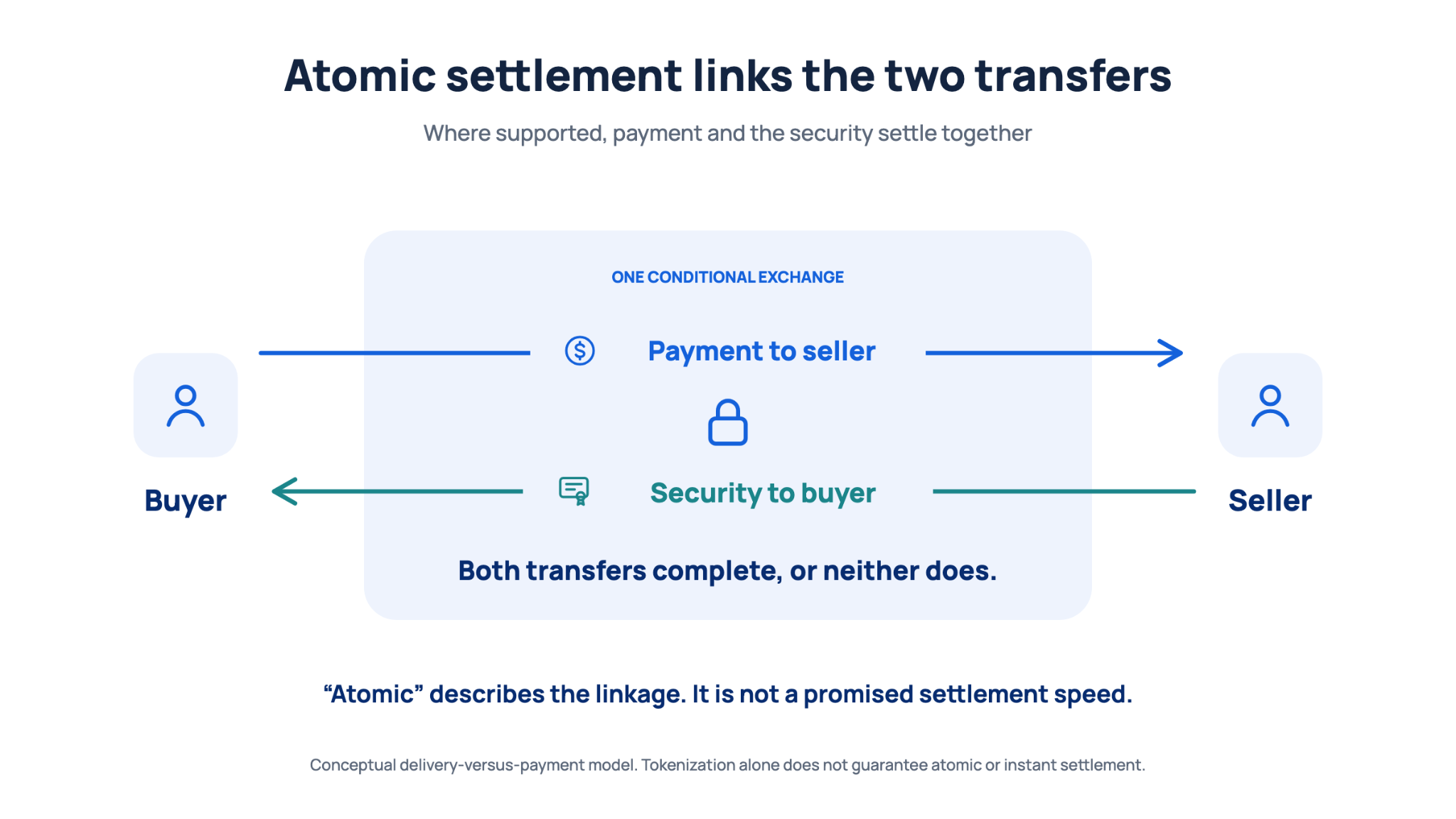
But tokenization does not guarantee instant settlement.
Under Nasdaq’s approved tokenized securities model, trades handled by the Depository Trust Company continue to settle on T+1, meaning the next business day.
5. Sell or redeem the investment
Your exit route matters as much as your entry route.
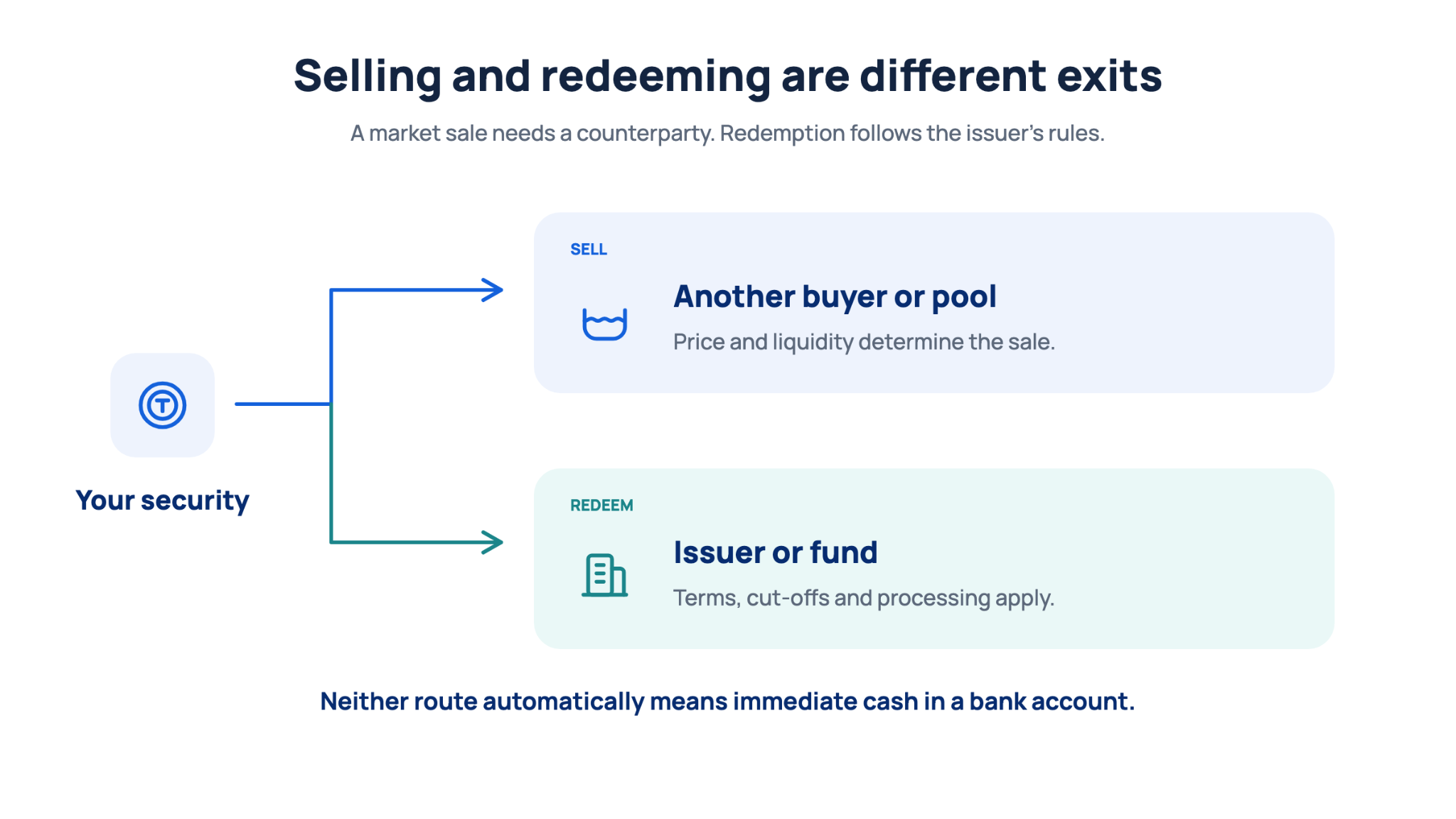
A sale transfers the investment to another buyer, including a liquidity pool where that model is supported. Redemption returns the investment to the issuer or fund under its rules. These are different processes.
Redemption may not be available around the clock. Franklin Templeton’s August 2026 summary prospectus, for example, says purchase and redemption requests can be submitted at any time, but processing takes place during normal business hours on business days.
Where can tokenized securities be traded?
There is no single marketplace for all tokenized securities. In the United States, different market structures are developing.
Tokenized securities venues
On September 17, 2026, the SEC introduced temporary, conditional relief for qualifying tokenized securities venues, or TSVs.
These venues use permissioned AMMs and liquidity pools to trade eligible tokenized U.S.-listed stocks. Conditions include trading limits, equivalent shareholder rights, public disclosures, and coordination with trading halts in the underlying stock.
Registered securities exchanges
An existing exchange can support tokenized securities within its established trading system.
Nasdaq’s approved model places eligible tokenized and conventional shares on the same order book with the same execution priority. Tokenization, in this case, does not require a separate crypto-style market.
Alternative trading systems
An alternative trading system, or ATS, provides another route for securities trading.
In the United States, an ATS must meet Regulation ATS requirements, including broker-dealer registration and the required filings. The SEC notes that filing Form ATS is not an application for SEC approval of the platform.
What are the benefits of tokenized securities trading?
More efficient processing
Blockchain-based systems can bring several tasks closer together, including issuance, trading, settlement, custody, and ongoing administration.
That may reduce the need for different institutions to maintain and repeatedly compare separate records. Smart contracts can automate parts of the process, including conditional payments.
Also Read: What Are Smart Accounts?
More flexible access and settlement
Tokenized systems can support longer operating hours and faster asset transfers. That may help users who operate across time zones or need to move assets between supported services.
Better visibility into transactions
Shared records can improve transparency and make some transactions easier to inspect. The Financial Stability Board identifies efficiency and transparency among tokenization’s potential benefits.
How Transak helps tokenized securities platforms
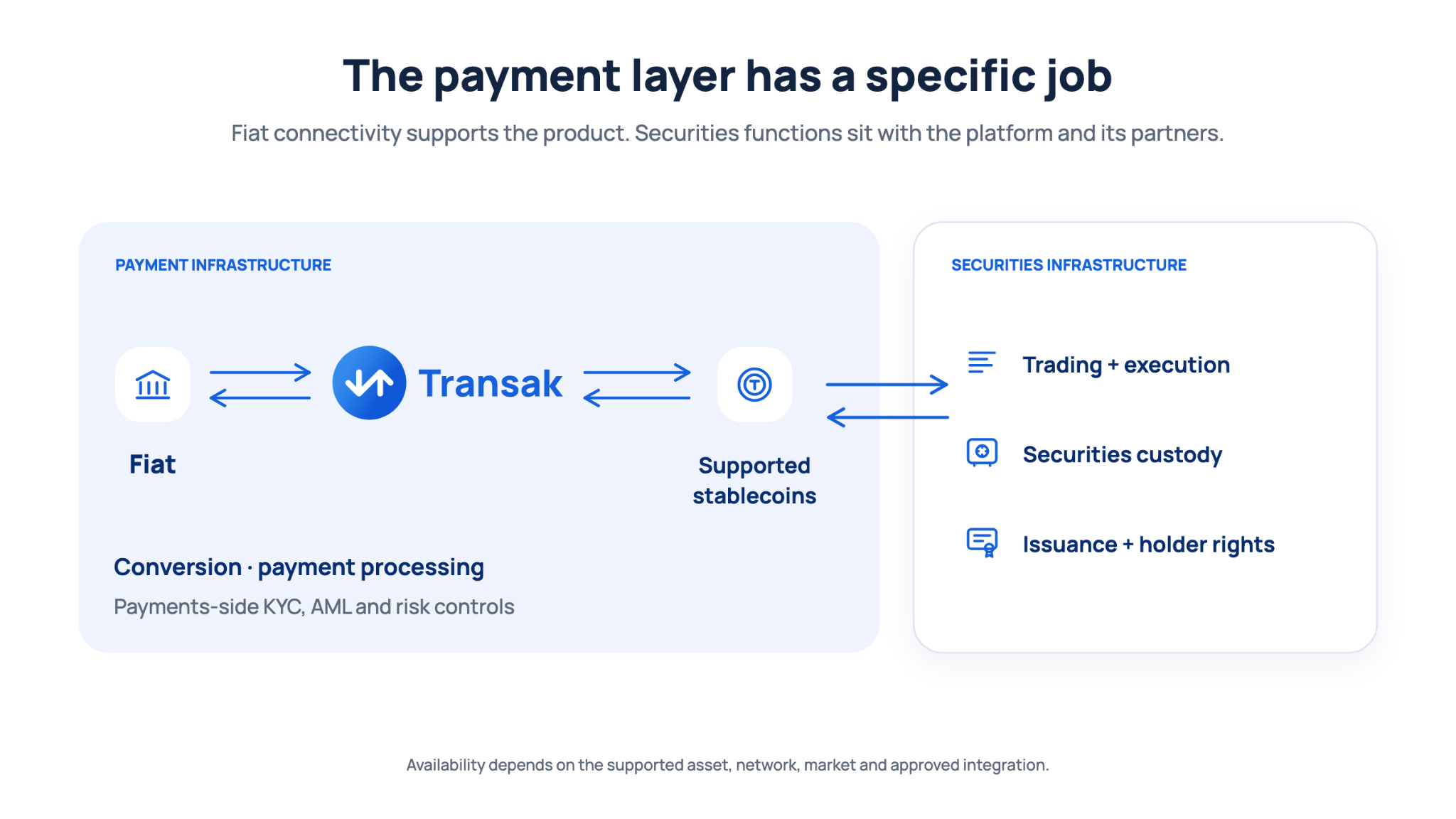
Tokenizing a security solves only part of the infrastructure problem. Users still need a convenient way to move money into and out of the onchain environment where those assets are traded.
This is where Transak comes in.
Businesses building tokenized investing, brokerage, or wealth products can use Transak to connect traditional payment methods with supported stablecoins and other digital assets. Users can fund their accounts using familiar methods such as bank transfers and cards, while Transak handles the underlying fiat conversion, payment routing, and payments-side compliance.
The same infrastructure can support the reverse journey.
When users sell or redeem an eligible tokenized asset, supported onchain funds can be converted back into local currency and paid out through traditional financial rails.
Transak does not replace the securities venue, broker, custodian, or issuer. Instead, our modular infrastructure can provide the fiat and stablecoin connectivity that will help bridge traditional money with increasingly onchain capital markets.
For businesses, that can mean adding tokenized-asset funding and withdrawal flows without having to build a global fiat-to-crypto payments stack from scratch.
Frequently asked questions
Is tokenized securities trading the same as cryptocurrency trading?
No. The technologies can overlap, but the investments differ. A tokenized share or bond represents a security. A blockchain’s native cryptocurrency is a different type of asset. Assess what the product represents rather than grouping all tokens together.
Can tokenized securities trade 24/7?
Some systems can support continuous trading or transfers, but access depends on the product and platform. Trading hours, settlement hours, and redemption processing are separate. Around-the-clock token transfers do not guarantee around-the-clock withdrawals.
Does tokenization remove securities regulation?
No. The token format does not remove the application of securities laws. Requirements depend on the instrument and activity. The SEC’s TSV framework, for example, provides limited, conditional relief rather than an exemption from every securities requirement.