Payments have traditionally followed a simple model: send money from one account to another, and the transaction is complete. But as digital finance evolves, money can do more than simply move from A to B.
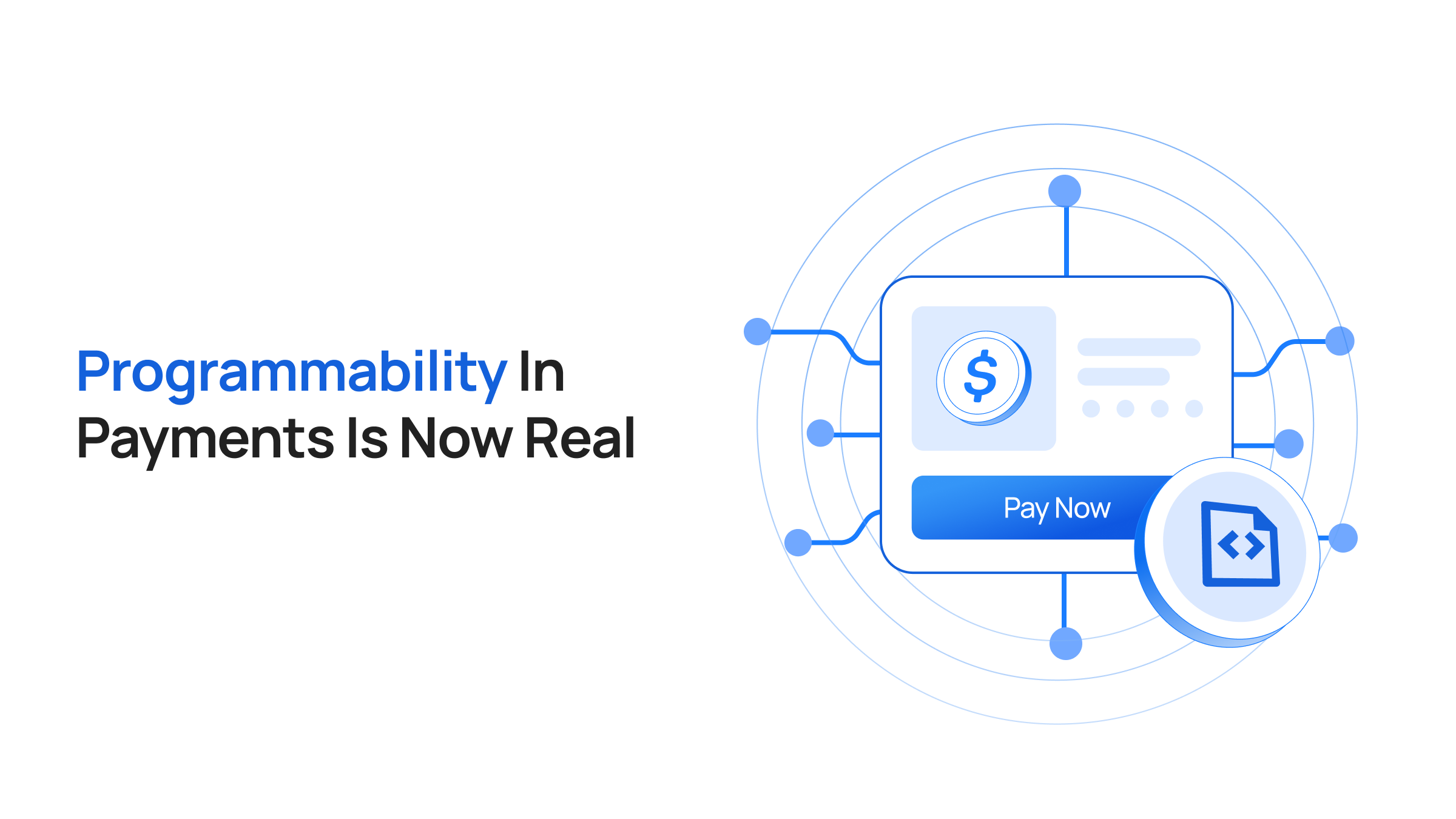
Programmable payments allow money movement to be tied to predefined conditions, rules, or events. Instead of requiring a person or business to manually initiate every payment, software can determine when, how, and where funds should move.
This capability is particularly relevant to stablecoins, blockchain-based payments, fintech applications, and automated financial workflows.
A programmable payment is one where the instruction and the conditions travel with the money itself. Funds sit in a smart contract and release only when a defined event happens, without anyone approving the release. The difference from a scheduled payment is that a programmable payment checks something before it moves.
What is a programmable payment?
Programmable payments are transactions where payment logic is built into the process of moving money.
For example, a business could configure a payment to occur only when:
- A service has been delivered
- A specific date or milestone is reached
- A required document is verified
- A payment condition is satisfied
- A particular event occurs
The key difference is that the payment isn't just a transfer. It becomes part of an automated workflow.
Smart contracts are one way to implement this on blockchain networks. In other systems, APIs, payment rules, and automated backend infrastructure can provide similar functionality.
Three pieces have to be in place.
- Tokenized value. Usually a stablecoin, so the amount holds its worth between the instruction and the release
- A smart contract. Code that holds the funds and enforces the terms
- A trigger. Something the contract can verify, either onchain or through an external data feed
Programmable payments are not the same as a standing order or a direct debit. Those are automated, but they are not conditional. A standing order pays on the first of the month whether or not the work was delivered.
A programmable payment can hold the same funds until delivery is confirmed, then release them in seconds.
What can a condition actually be?
Anything the contract can verify. In practice that falls into four groups.
- Onchain events. A token arrives, a balance clears a level, another contract executes
- Verified real-world events. Proof of delivery, an inspection result, a shipment scan, passed through an oracle
- Time. A release window opens, or a timeout returns the funds to the sender
- Approvals. Two of three signatories confirm before anything moves
The last one matters more than it looks. Multi-party approval is currently a workflow that lives in email and an ERP system. As a condition, it becomes part of the payment.
How do conditional payments work?
A conditional payment generally consists of three components:
- Funds: Money is made available for a transaction, such as a stablecoin payment or digital currency transfer.
- Conditions: Rules determine when the payment can be released or how it should be distributed.
- Execution: Once the conditions are met, software automatically initiates or authorizes the payment.
Consider an escrow arrangement. A buyer deposits funds, but the seller doesn't receive them immediately. The payment is released once the agreed condition, such as successful delivery, is confirmed.
Instead of relying entirely on manual intervention, the payment process itself can enforce the agreed logic.
What does programmable money actually enable?
1. Automated recurring payments
Businesses can automate payments based on schedules or usage.
For example, a company could automatically pay a supplier every 30 days, provided the relevant conditions are met. This can reduce repetitive administrative work and make cash flows more predictable.
2. Milestone-based payments
Programmable payments can release funds as specific milestones are completed.
This could be useful for:
- Freelance work
- Construction projects
- Software development
- International trade
- Manufacturing
Rather than paying the entire amount upfront, funds can be distributed according to predefined stages.
3. Escrow without constant manual intervention
Programmable payment infrastructure can automate parts of escrow.
Funds can remain locked or restricted until predefined requirements are satisfied. Once those requirements are verified, the payment can proceed according to the rules established beforehand.
4. Usage-based payments
Payments can also be connected to actual usage.
Imagine an API, cloud service, or digital platform that charges customers based on consumption. Programmable payment systems could automatically calculate and settle payments as usage changes.
This creates the possibility of machine-to-machine payments, where software systems can initiate transactions without requiring a person to manually approve each one.
5. Automated business payouts
Platforms that manage many recipients can use programmable payments to automate distributions.
For example, a marketplace could automatically split incoming revenue between a seller, platform, logistics provider, and other participants according to predefined rules.
This can simplify complicated payment flows that would otherwise require multiple manual transfers.
6. Streaming payments
Value moves continuously rather than in lumps. Usage-based services can charge by the second as data is consumed, and payroll can accrue by the hour instead of monthly. Legacy rails cannot do this at all, because each transfer carries a fixed cost.
7. Multi-party splits
Marketplaces, royalty pools and affiliate structures pay every participant at the moment revenue lands, rather than running a reconciliation cycle first.
Programmable payments and stablecoins
Stablecoins are particularly interesting for programmable payments because they combine digital money with programmable infrastructure.
A stablecoin can move across blockchain networks while smart contracts or applications define how transactions should occur.
This can make conditional payments useful for cross-border transactions, treasury operations, payroll, remittances, and business settlements.
However, the blockchain itself does not automatically know whether an off-chain condition has occurred. External data, verification systems, or trusted parties may still be required to confirm events such as delivery, identity verification, or completion of a service.
Why programmable payments matter for businesses
Traditional payment systems often separate payment execution from the business process surrounding it.
A company might use one system to manage invoices, another to verify delivery, and another to execute the actual payment.
Programmable payments can bring more of this logic together.
The potential benefits include:
- Less manual processing
- Faster settlement
- Fewer repetitive payment operations
- More transparent payment rules
- Better control over complex payment flows
- Greater automation for global transactions
This is especially valuable as businesses increasingly operate across borders and digital platforms.
Are programmable payments fully automatic?
Not necessarily.
"Programmable" doesn't mean that every payment can operate without human oversight. The conditions themselves need to be defined, and systems may still require approval, verification, compliance checks, or dispute handling.
There are also practical challenges around security, smart-contract bugs, incorrect external data, regulatory requirements, and handling exceptions.
The goal isn't necessarily to remove humans from payments. It's to automate predictable parts of the payment process while preserving appropriate controls.
What still gets in the way
Four honest limitations.
- Oracles are a dependency. A contract executing on inaccurate delivery data executes correctly on the wrong information
- Execution is final. There is no chargeback, so disputes, refunds and timeouts have to be written into the contract before it is deployed
- Code is a risk surface. The payment is only as reliable as the contract holding it
- Adoption is early. Of the tens of trillions moved in stablecoin transfers during 2025, industry estimates put genuine real-economy payments in the hundreds of billions
That last point is worth keeping in view. The capability is real. The volume running through it is still small.
Conclusion
The broader idea behind programmable payments is that money movement can become part of software logic.
Instead of thinking of a payment as an isolated transaction, businesses can treat it as one step in an automated workflow.
As stablecoins, blockchain infrastructure, APIs, and financial automation mature, this could enable everything from automated supplier settlements to machine-to-machine commerce and sophisticated cross-border payment flows.
Programmable payments therefore aren't just about sending money automatically. They enable money to move conditionally, based on rules, events, and business logic, making financial transactions more responsive to how modern digital businesses actually operate.
FAQ
What is the difference between programmable payments and automated payments?
An automated payment executes on a schedule. A programmable payment checks a condition before executing. A direct debit pays on a date regardless of circumstances, while a conditional payment can hold funds until delivery is verified and then release them immediately.
Do programmable payments require stablecoins?
Not technically, but in practice yes for most business use. A conditional payment denominated in a volatile asset changes value between instruction and release, which makes it unsuitable for payroll, invoices or supplier terms.
What is smart contract escrow?
Funds are held by a smart contract rather than a third-party agent, and released automatically when a coded condition is satisfied. It is best suited to objective triggers, such as delivery confirmation or an uptime measurement, rather than subjective ones.
Can programmable payments be reversed?
Not by default. Once a contract executes, the transaction is final. Refunds, timeouts and dispute paths have to be written into the contract before deployment, which is a design requirement rather than an afterthought.