Takeaways
- Build = control; buy = speed and scale.
- Fiat gateways are extremely logistical. They include KYC checks, compliance adherence, fraud monitoring, liquidity sourcing, and more.
- Building in-house requires significant ongoing resources to maintain payment infrastructure.
- Buying often accelerates market and payment-method expansion.
- Focus engineering resources on what differentiates your exchange, not infrastructure that can be outsourced.
For a crypto exchange, the trading experience doesn't begin when a user places an order. It begins when they try to fund their account.
That makes the fiat gateway a critical part of the exchange stack. Users expect to move from local currency to crypto using the payment methods they already trust, i.e., cards, bank transfers, mobile wallets, and local payment rails, without unnecessary friction.
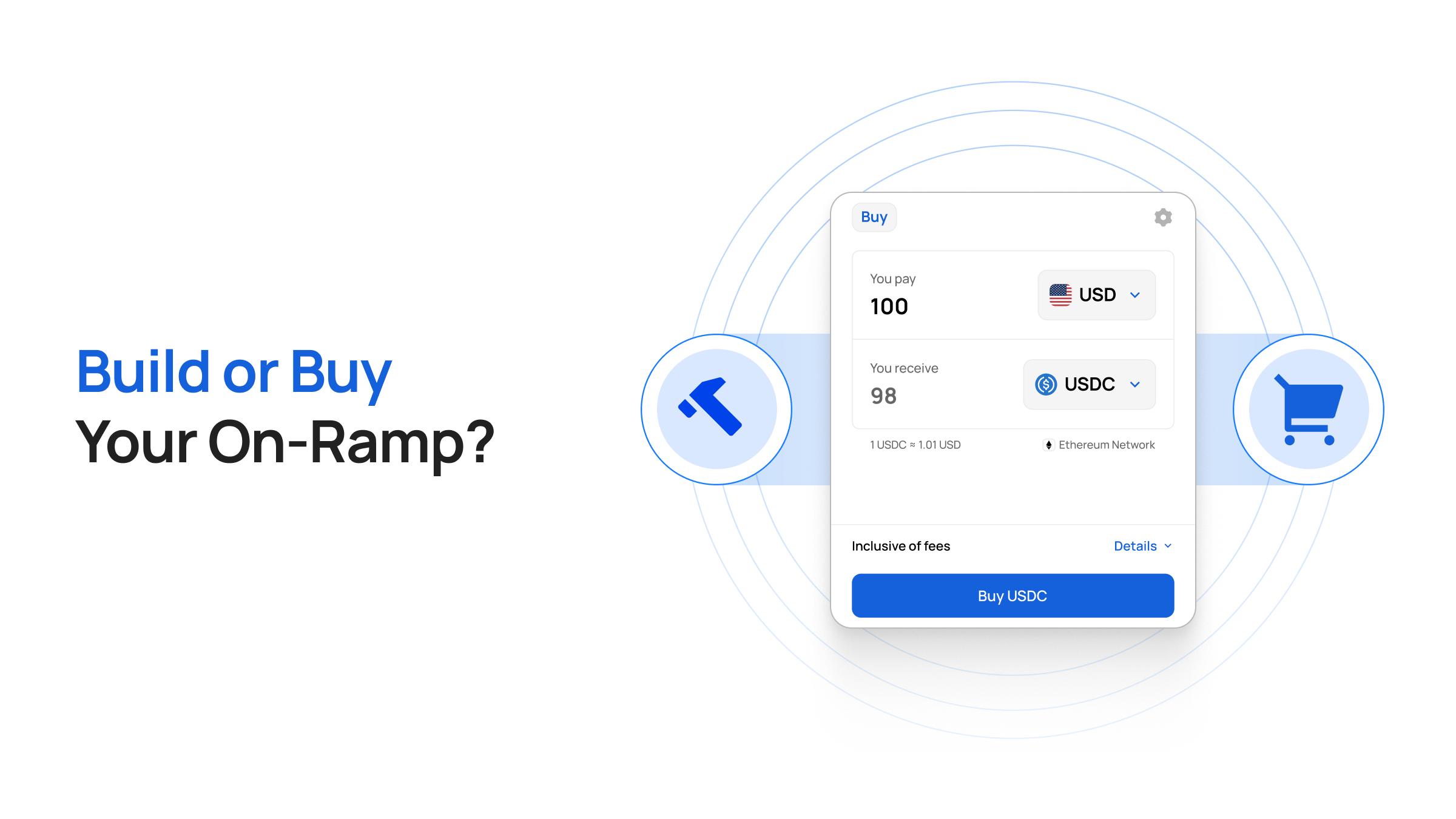
And in the process of enabling this capability in the app, exchanges spend weeks debating if they should build their own or integrate infrastructure from an existing provider like Transak.
The right answer will be unique to your case. This article will steer you in the right direction and, hopefully, by the end, you will have your answer or at least much of the necessary information to make a decision for yourself.
What is a fiat gateway?
A fiat gateway connects traditional payment methods to a crypto platform.
For an exchange, it allows users to use fiat currency, such as USD, CAD, AUD, or other local currencies, to purchase crypto assets directly through the exchange.
Behind that seemingly simple transaction is a complex infrastructure layer involving:
- Payment method integrations
- Fiat-to-crypto conversion
- Identity verification and KYC
- Fraud and risk controls
- Payment processing
- Compliance requirements
- On- and off-ramp liquidity
- Local payment rails
- Transaction monitoring
- Refunds and payment failures
- Regional payment requirements
The exchange can build and operate these capabilities itself, or rely on a specialized fiat-on-ramp provider.
Building a fiat gateway for your crypto exchange
Building in-house gives an exchange maximum control over its payment infrastructure.
Your team can design the user experience, decide which payment methods to support, control the underlying integrations, and build the system around your specific requirements.
For exchanges with significant scale and dedicated payments teams, this can be attractive. But it comes with many trade-offs that could potentially put the company out of business before even taking off.
Typically, building means assembling four independent systems, each with its own approval process and its own failure mode.
|
Layer |
What it involves |
Who can own it |
|
Licensing |
Money transmitter or equivalent permissions in every market you serve. State by state in the US, FinCEN registration federally, FINTRAC in Canada, AUSTRAC in Australia |
Your entity, or a payments infrastructure partner like Transak |
|
Banking |
A bank willing to hold customer fiat and settle for a crypto business, plus a backup for when the first one exits |
Your entity, or a payments infrastructure partner like Transak |
|
Card acquiring |
An acquirer that accepts crypto merchant category codes, with the decline rates and chargeback exposure that come with them |
Your entity, or a payments infrastructure partner like Transak |
|
Compliance operations |
KYC, sanctions screening, transaction monitoring, Travel Rule reporting, fraud review, and the staff to run all of it daily |
Shared. The gateway can carry the payment leg, you still own your platform obligations |
Advantages of building your own fiat gateway
Greater control
An in-house gateway gives you control over the payment experience, infrastructure architecture, supported assets, transaction flows, and data.
Customization
You can build payment flows specifically around your exchange's UX and user journeys rather than adapting an existing provider's solution.
Potential long-term economics
At sufficient scale, owning more of the infrastructure can potentially improve unit economics by reducing reliance on third-party providers.
Direct ownership of the payment stack
For businesses where payments are a core strategic capability, building can provide deeper control over how that layer evolves.
Trade-offs of building your own fiat gateway
Building a fiat gateway means building and maintaining a payments business. The challenge is that a fiat gateway isn't simply a payment form connected to an exchange.
Every new market can introduce new payment methods, regulatory considerations, banking relationships, currencies, compliance requirements, and operational processes.
Your team may need to manage:
- Multiple payment processors and banking partners
- Regional payment methods
- KYC and AML workflows
- Fraud prevention
- Chargebacks and disputes
- Payment reconciliation
- Transaction monitoring
- Liquidity
- Regulatory obligations
- Failed and reversed transactions
- Ongoing maintenance of payment integrations
Buying a fiat gateway
The preferable alternative is to integrate with an established fiat-on-ramp provider like Transak.
Instead of developing every payment connection internally, your exchange integrates an existing infrastructure layer through APIs, SDKs, widgets, or other integration options.
This can significantly reduce the amount of payments infrastructure the exchange needs to build itself.
Advantages of integrating Transak as the fiat gateway for crypto exchanges
Faster time to market
Rather than spending months building integrations across payment methods and markets, an exchange can integrate Transak and launch its fiat purchase experience faster.
Access to existing payment infrastructure
Transak already has relationships and integrations across cards, bank transfers, mobile wallets, and local payment methods.
Reduced operational complexity
Transak can handle significant parts of the payment, compliance, risk, and transaction infrastructure, depending on the integration and market.
Easier geographic expansion
For exchanges entering new markets, Transak can offer access to local payment methods without requiring the exchange to establish every payment relationship independently.
Focus on the core product
An exchange's competitive advantage may be its trading engine, liquidity, asset coverage, user experience, or institutional offering, but not payment processing.
Build vs. Buy: What Should an Exchange Consider?
|
Consideration |
Build |
Buy (generic provider) |
Buy (Transak) |
|
Time to market |
Longer |
Faster |
Fastest |
|
Upfront engineering effort |
High |
Medium |
Low |
|
Infrastructure control |
High |
Low |
Flexible (modular integrations) |
|
Customization |
High |
Depends on provider |
High (when white-labeled) |
|
Payment integrations |
Build and maintain |
Pre-existing |
Pre-existing and updating |
|
Time to expansion into new markets |
Long |
Dependent on provider and contract |
Instantly scales with Transak |
|
Compliance operations |
Primarily internal |
Partially outsourced |
Primarily outsourced |
|
Ongoing maintenance |
Internal |
Provider-supported |
Primarily Transak |
|
Long-term unit economics |
Potentially favorable at scale |
Unfavorable |
Favorable (flexible enterprise pricing) |
When does building make sense?
Building can make sense for exchanges that have:
- A large existing payments operation
- Dedicated compliance and risk teams
- Strong banking and processor relationships
- Significant transaction volume
- A presence across mature payment markets
- The engineering resources to maintain the infrastructure
- A strategic reason to own the payment layer
At significant scale, the additional control may justify the operational complexity.
For smaller or newer exchanges, however, the opportunity cost can be considerable.
Every engineering hour spent building payment integrations is an hour that isn't spent improving the exchange's core product.
When Does Buying Make Sense?
An existing fiat gateway can be particularly useful when an exchange wants to in the following cases.
Launch quickly
If getting fiat onboarding live is a priority, integrating existing infrastructure can shorten the path from development to production.
Enter new markets
Local payment infrastructure can be difficult to replicate market by market. A provider with existing regional coverage can make expansion more straightforward.
Support more payment methods
Users increasingly expect to pay through the methods they already use in everyday life. Supporting those methods independently can require substantial integration and operational work.
Reduce internal complexity
Outsourcing parts of the fiat infrastructure lets an exchange avoid becoming responsible for every layer of the payment stack.
Test demand before investing heavily
For an exchange entering a new geography or testing a new fiat corridor, integrating a provider can be a way to validate demand before committing significant resources to building local infrastructure.
A third option: Buy the infrastructure, own the experience
Build vs. buy doesn't necessarily have to mean choosing between a completely outsourced payment experience and a completely proprietary one.
An exchange can integrate a fiat gateway while maintaining control over the user journey.
For example, the exchange can determine:
- Where users access the fiat purchase flow
- Which assets are available
- Which payment methods are presented
- How the transaction fits into the exchange experience
- How users see balances and transaction status
The underlying provider can handle the payment infrastructure required to execute the transaction.
This approach allows exchanges to focus on the customer experience and core trading product while relying on specialized infrastructure where building it internally doesn't create a meaningful competitive advantage.
With modular integration components and white-labeling, Transak enables digital asset exchanges to own what their users experience end-to-end while the grunt work of compliance and upkeep is handed off.
Also Read: Modular Payments Infrastructure: Why Your App Should Only Take the Parts It Needs
What to Look for in a Fiat Gateway Provider
Geographic coverage
Does the provider support the markets and currencies your users need today and the markets you plan to enter tomorrow?
Payment method coverage
Look beyond cards. Depending on the market, users may expect bank transfers, mobile wallets, local payment methods, and other rails.
Compliance and risk infrastructure
Understand what the provider handles and what remains the exchange's responsibility. Clear ownership matters.
Integration flexibility
APIs, SDKs, widgets, and white-label options can give exchanges different levels of control over the experience.
Reliability and transaction performance
Fiat onboarding is often a user's first interaction with an exchange. Payment failures can directly affect activation and conversion.
Asset and liquidity coverage
The gateway needs to support the assets and transaction flows relevant to your exchange.
Pricing
Compare not only headline transaction fees but also the total cost of operating the infrastructure internally, including engineering, compliance, payment relationships, maintenance, and operational support.
Conclusion
Building provides control. Buying provides speed, coverage, and operational leverage.
For exchanges with the scale and resources to make payments a strategic competency, building may eventually make sense.
For exchanges focused on growing their core trading product, entering new markets, or getting fiat access to users quickly, integrating specialized infrastructure can be the more efficient path.
Transak provides fiat-to-crypto infrastructure that exchanges and financial applications can integrate to give users access to familiar payment methods without having to build every payment connection and operational layer from the ground up.
The goal isn't to build less. It's to build where it matters most.
Interested? Talk to our experts today.
Frequently asked questions
What is the difference between a fiat gateway and a payment processor?
A payment processor moves money between bank accounts and card networks. A fiat gateway does that and converts between fiat and crypto, adds crypto-specific compliance such as Travel Rule reporting and blockchain screening, and delivers the asset on-chain. A processor alone cannot complete a crypto purchase.
Can an exchange accept fiat without its own licence?
In many markets, yes, by integrating a licensed provider that holds the permissions and is the regulated party for the payment leg. The exchange still carries its own platform obligations, including its own registration where required. The arrangement removes the licensing barrier to launch, not every obligation.
How much does a fiat gateway cost?
Gateways charge a percentage of transaction value, typically varying by payment method, currency and volume. Card carries the highest cost because of interchange and risk, bank transfer the lowest. Compare it against fully loaded build costs, meaning licensing, banking, acquiring, compliance salaries and pre-funded capital, not against engineering time alone.
What are the biggest risks of building fiat rails in-house?
Losing your banking partner is the most severe. Banks exit crypto relationships with limited notice, and without a live backup, deposits stop the same day. Card chargebacks are the most persistent risk, because crypto delivery is irreversible while card payments are not.
How long does it take to integrate a fiat gateway?
Weeks rather than quarters for the integration itself, since the licensing and banking layers already exist on the provider side. The realistic gate is your own release cycle and the commercial and compliance review, not the API work.
Does a fiat gateway handle KYC for our users?
The provider performs KYC for the payment it is executing and is responsible for that verification. Where reusable verification is supported, a user already verified with the provider can transact again without repeating the process, which reduces drop-off at funding. Your platform obligations remain yours.
Also Read: KYC Reliance Explained: Reuse Verification Across Wallets and Exchanges
Can we start with a gateway and build our own rails later?
Yes, and it is a common sequence. Launch with a gateway, use real volume to learn which markets and payment methods matter, then build selectively where the economics justify it. Building first means guessing at that data, and guessing wrong is expensive in licensing.
Do we still need our own banking relationship?
For the fiat leg handled by the provider, no. You will still need corporate banking for your own operations, and depending on your jurisdiction and model you may need client money arrangements for balances you hold yourself. What disappears is the requirement to find a bank willing to process customer deposit flow for a crypto business.