Takeaways
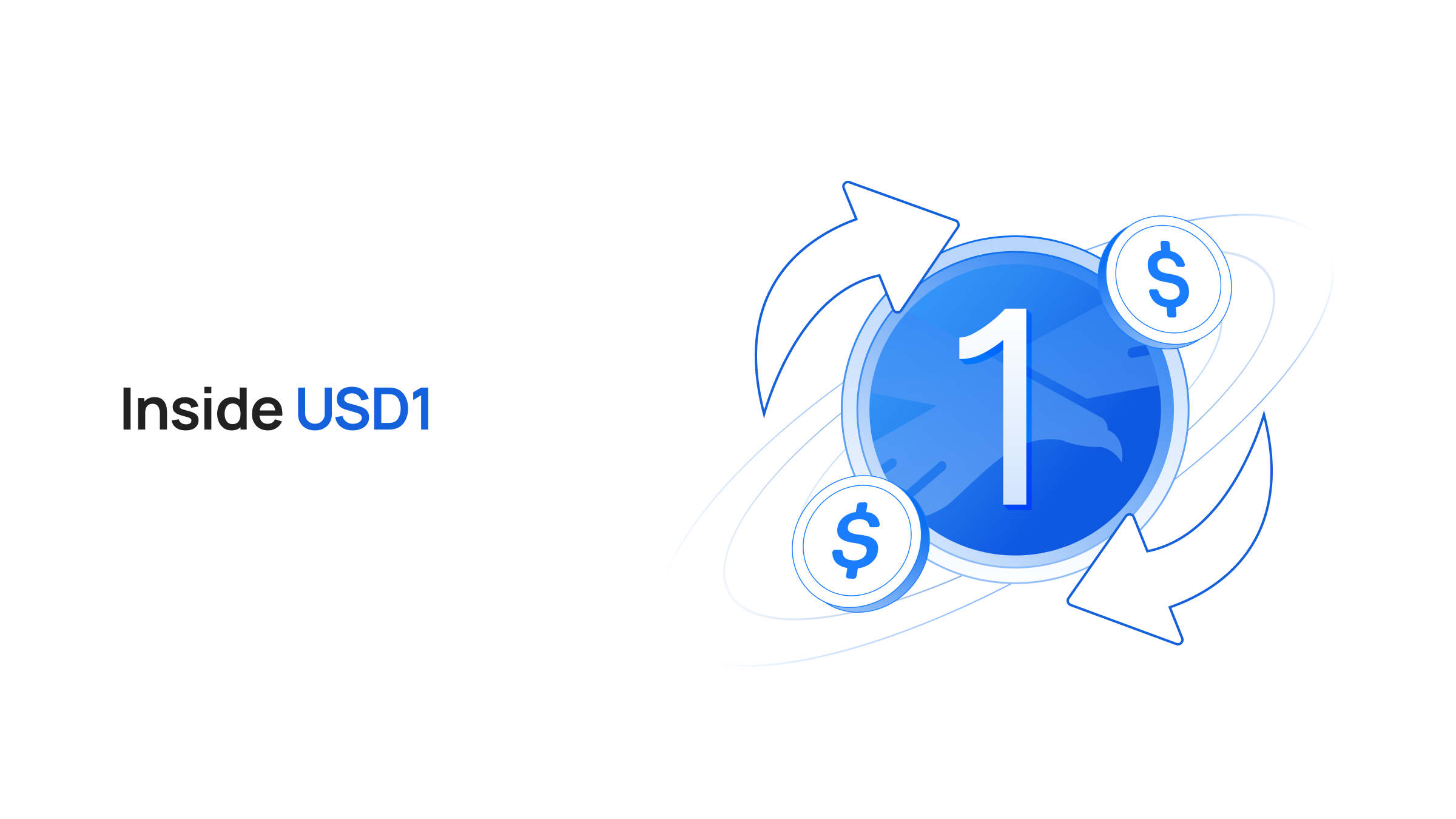
A new US Dollar stablecoin went from zero to billions in circulation in under two years, then settled a $2 billion deal between one of the world's largest exchanges and a sovereign-backed fund. That coin is USD1.
In this guide, we cover how USD1 works, what sits in the reserve, and where it fits alongside the stablecoins that already move money at scale.
What is USD1?
USD1 is a US Dollar stablecoin issued by World Liberty Financial. Each token is designed to be worth one dollar, redeemable 1:1, and backed by an equivalent reserve of cash and short-term US government debt. It exists to move dollars across borders and blockchains in minutes, not to appreciate in value.
On paper, USD1 sits in the same category as USDC and USDT. It is a claim on a dollar held in reserve, issued as a token so it can travel on public networks at any hour.
Note that a separate token, also called USD1, issued by Unitas, is a different asset with a different structure. This guide covers World Liberty Financial's USD1, which trades under the ticker USD1 and is sometimes listed as USD1-WLFI.
Who owns USD1 and who issues it?
USD1 is issued by World Liberty Financial, a US crypto venture in which the Trump family holds a majority stake. The company launched the token in March 2025 and also issues a separate governance token, WLFI, which is a distinct asset and should not be confused with the stablecoin.
Reserve custody sits with BitGo Trust Company, a regulated US custodian, rather than with the issuer directly. That separation between issuer and custodian is standard practice for fiat-backed stablecoins and is one of the first things institutional buyers check.
What backs USD1 and how are reserves verified?
USD1 is fully reserved. World Liberty Financial states the token is backed by US cash, US government money market funds, and other cash equivalents, held so that reserves match or exceed tokens outstanding.
Verification runs on two tracks:
- A monthly attestation (not the same as a full financial audit) report is prepared by an independent accounting firm under 2025 AICPA criteria for asset-backed fiat-pegged tokens.
- A real-time proof-of-reserves dashboard powered by a Chainlink oracle publishes total reserves, the collateralisation ratio, and supply by network on an ongoing basis.
Also Read: How do stablecoin issuers make money?
Which blockchains does USD1 run on?
USD1 launched on Ethereum and BNB Chain and has since expanded across roughly ten networks. Cross-chain transfers are routed through Chainlink CCIP rather than through independent bridges, which keeps a single canonical supply across deployments.
|
Network |
Role |
|
Ethereum |
Original deployment, reserve and proof-of-reserves layer |
|
BNB Chain |
Largest venue by activity, around 15% of the chain's stablecoin supply |
|
Solana |
High-throughput payments and trading |
|
Tron |
Transfer and remittance activity |
|
Aptos, Mantle, Monad, Plume |
Newer deployments extending network reach |
For a payments team, the network list matters less than where liquidity actually sits. Supply is concentrated on BNB Chain and Ethereum, and that concentration is what determines whether a large transfer can be settled without moving the price.
USD1 vs USDC vs USDT
All three are fiat-backed US Dollar stablecoins that aim to hold a one-dollar value. They differ on issuer, scale, and how long the market has stress-tested them.
|
Issuer |
World Liberty Financial |
Circle |
Tether |
|
Launched |
March 2025 |
2018 |
2014 |
|
Approximate market cap |
$4.1 billion |
Tens of billions |
Largest of the three |
|
Reserve backing |
Cash, US government money market funds, Treasuries |
Cash and short-dated Treasuries |
Cash, Treasuries and other assets |
|
Reserve custody |
BitGo Trust Company |
Regulated banking partners |
Multiple counterparties |
|
Track record |
Under two years |
Multiple market cycles |
Longest in market |
USD1 grew quickly, but USDC and USDT have been through liquidity crunches, depeg scares, and redemption waves that a 2025 launch has not yet faced.
Also Read: Stablecoin market cap in 2026: key numbers and growth
What is USD1 used for?
USD1 is built for settlement. Its highest-profile use so far was Abu Dhabi investment firm MGX settling a $2 billion investment into Binance entirely in USD1, reported as the largest institutional investment funded solely through a stablecoin.
The day-to-day use cases are the ones common to any dollar stablecoin.
- Cross-border transfers that clear in minutes rather than days.
- Treasury movement between exchanges and counterparties outside banking hours.
- On-chain settlement between businesses that would otherwise wait on correspondent banking.
Is USD1 an investment, and how does its price work?
USD1 is designed to stay at one dollar, so it is not structured to generate a return from price movement.
USD1 trades in a narrow band, typically within a fraction of a cent of its peg, and any yield associated with holding a dollar stablecoin comes from the platform rather than from the token appreciating. Further, under the GENIUS Act, signed into law in July 2025, permitted payment stablecoin issuers cannot pay interest or yield to holders.
Also Read: The Q2 2026 compliance cliff for payments companies
Conclusion
USD1 is a straightforward fiat-backed dollar stablecoin with an unusually fast growth curve, a regulated custodian, and monthly attestations behind it.
When evaluating dollar stablecoins for a payments product, start with the reserve report and the redemption terms rather than the market cap. Then work out the part that actually decides whether the product ships, which is how customers get fiat in and out at each end.
If you need expert help, talk to our team about stablecoin payments infrastructure.
Frequently asked questions
Who owns USD1?
USD1 is issued by World Liberty Financial, a US crypto venture in which the Trump family holds a majority stake. Reserves are not held by the issuer directly. They sit with BitGo Trust Company, a regulated US custodian.
How much is USD1 worth today?
USD1 is designed to trade at one US Dollar and typically holds within a fraction of a cent of that peg. It is a stablecoin, so it is not built to rise or fall in value. Live pricing is published on major market data sites and on the issuer's proof-of-reserves dashboard.
Is USD1 safe to use?
USD1 is fully reserved, custodied by a regulated US trust company, and covered by monthly attestations from an independent accounting firm plus a real-time proof-of-reserves feed. The main consideration is track record. It launched in March 2025, so it has less market history than stablecoins that have run through multiple cycles.
Is USD1 a good investment?
Like most cryptoassets, USD1 is not designed as an investment. It is a payment instrument built to hold a fixed value of one dollar, so there is no expected appreciation. Under the GENIUS Act, permitted payment stablecoin issuers are also prohibited from paying interest or yield to holders.
Where can I buy USD1?
USD1 trades on major centralised exchanges and on decentralised exchanges across the networks it is deployed on, primarily BNB Chain and Ethereum. Availability varies by country and platform, and access depends on the exchange's own registration and verification requirements.
What is the difference between USD1 and USDC?
Both are fiat-backed US Dollar stablecoins redeemable 1:1. USDC is issued by Circle, launched in 2018, and is many times larger by market capitalization. USD1 is issued by World Liberty Financial, launched in March 2025, and holds around $4.1 billion in circulation. The practical differences are scale, liquidity depth, and time in the market.
What is the difference between USD1 and WLFI?
They are separate tokens from the same issuer. USD1 is the dollar-pegged stablecoin designed to hold a value of one dollar. WLFI is World Liberty Financial's governance token, which floats in price and does not carry a peg or reserve backing.