Takeaways
- A fiat on-ramp converts bank or card money into crypto. An off-ramp does the reverse.
- Every on-ramp follows the same path. Quote, identity check, payment, purchase, delivery on the blockchain.
- Your real cost is the provider fee, the spread, the payment fee and the network fee added together.
- Choose a provider by licensing, total cost, payment methods and the networks it supports.
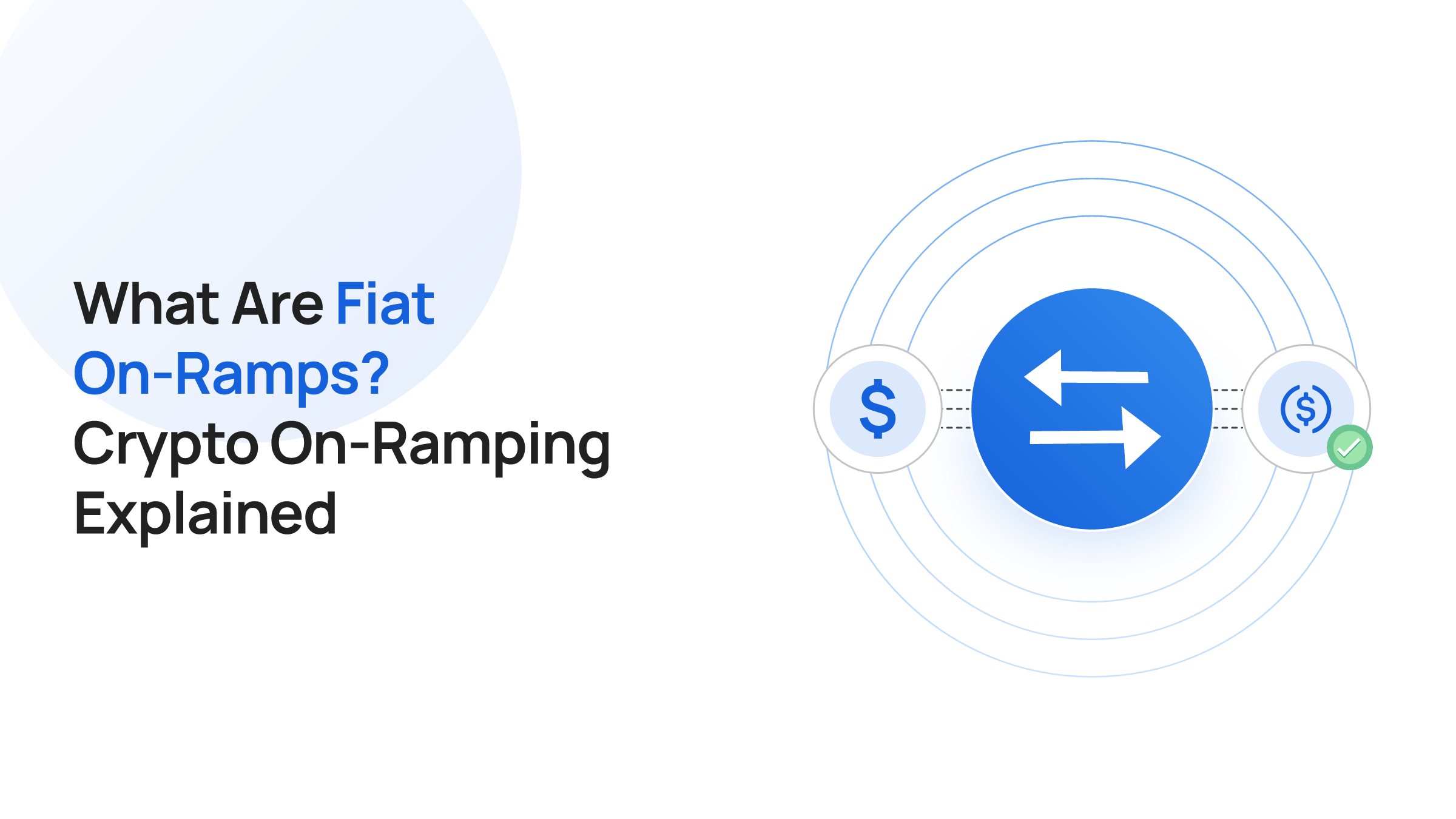
A fiat on-ramp is a service that allows users to buy cryptocurrencies and stablecoins using traditional money, such as US dollars. It connects traditional payment systems, including bank accounts and credit cards, with blockchain networks.
Total stablecoin supply reached about $308 billion in August 2026, up 14.3% from a year earlier, according to DefiLlama data. For many people, an on-ramp is the first step to holding any of it.
Read more: Stablecoin Market Cap Breakdown
For example, someone who wants to buy $100 worth of Bitcoin or USDC can use a fiat on-ramp to pay with their debit card and receive the cryptocurrency in their wallet.
Fiat on-ramps are essential to the crypto ecosystem because they allow people to access blockchain-based financial services without already owning cryptocurrency.
This guide explains how crypto on-ramping works, the different types of fiat on-ramps, their costs, and how businesses can integrate them.
What Is a Fiat On-Ramp in Crypto?
A fiat on-ramp, also called a crypto on-ramp, is a payment service that converts government-issued currency into cryptocurrencies or stablecoins.
Fiat currency refers to money issued by governments, such as USD, GBP, and CAD.
Blockchains do not directly process traditional bank transfers or card payments. Therefore, users need a service that connects these payment methods to cryptocurrency networks.
That is the role of a fiat on-ramp.
For example, a user opening a crypto wallet for the first time might want to buy Ethereum (ETH). Instead of creating an account on a separate cryptocurrency exchange, they can use an on-ramp integrated into their wallet to purchase ETH directly.
The on-ramp handles the payment, currency conversion, identity verification, and delivery of the cryptocurrency.
How Does Crypto On-Ramping Work?
A crypto on-ramp works in six steps. It shows you a quote, verifies your identity, takes your fiat payment, buys the crypto from a liquidity source, and sends it to your wallet on the blockchain you chose. A card purchase often completes in minutes.
- Choose the asset and network: Pick the token you want, such as USDC, and the blockchain it should arrive on, such as Ethereum or Solana. Enter the amount.
- Get a quote: The on-ramp shows how much crypto you will receive after fees. The price is held for a short time.
- Verify your identity: Regulated providers, like Transak, run a Know Your Customer (KYC) check. These checks exist to stop fraud and money laundering, and many countries also apply the Travel Rule, which requires providers to share sender and recipient details on certain transfers.
- Pay: Use a card, Apple Pay, a bank transfer or a local payment method. Instant bank rails, such as Instant ACH in the US, are faster than older transfers.
- The provider buys the crypto: The on-ramp sources tokens from exchanges and market makers, which are called liquidity providers. It may also hold its own liquidity.
- Delivery on the blockchain: The provider sends a transaction to your wallet address. Once the network confirms it, the tokens appear in your wallet. You can look up the transaction on a block explorer.
What is the difference between an on-ramp and an exchange?
An exchange is a marketplace where you trade assets against each other, with order books and charts. An on-ramp does one narrower job, which is turning fiat into crypto.
Many wallets and apps embed an on-ramp so you can buy without opening an exchange account. Exchanges include their own on-ramp, and many apps run another company's on-ramp behind their Buy button.
For example, MetaMask uses Transak under the hood to allow its users to load the wallet with crypto and stablecoins. At the same time, Binance US has partnered with Transak to expand its coverage of localized payment methods.
How Much Do Fiat On-Ramps Charge?
The price of an on-ramp is the sum of four parts. A provider fee, the exchange-rate spread, a payment-method fee and the blockchain network fee. Cards usually cost more than bank transfers. Compare the final amount of crypto you receive, not the headline fee.
| Cost | What it is |
|---|---|
| Provider fee | What the on-ramp charges for the service |
| Spread | The gap between the market price and the rate you are given |
| Payment fee | The cost of the card or bank rail, usually higher for cards |
| Network fee | Gas paid to the blockchain to process the transfer |
To compare providers, enter the same amount and look at the "you receive" figure. Two providers with the same stated fee can pay out different amounts because of the spread.
Types of Fiat On-Ramps
There are several ways to convert fiat currency into cryptocurrency.
1. Centralized Cryptocurrency Exchanges
Centralized exchanges allow users to deposit traditional money and purchase cryptocurrency through their trading platforms.
However, users may need to create an exchange account, complete verification, purchase the asset, and withdraw it to an external wallet.
2. Embedded Fiat On-Ramps
Embedded fiat on-ramps allow businesses to offer cryptocurrency purchases directly within their applications.
For example, a crypto wallet can integrate a fiat on-ramp so users can buy tokens without visiting a separate exchange.
Providers such as Transak supply the payment infrastructure needed to support these transactions.
3. Peer-to-Peer (P2P) On-Ramps
P2P platforms connect buyers and sellers who exchange fiat currency for cryptocurrency directly. These transactions may use bank transfers or other local payment methods.
However, their pricing, safeguards, counterparty risks, and regulatory requirements can differ substantially from those of integrated payment providers.
Fiat On-Ramp vs. Fiat Off-Ramp: What's the Difference?
Fiat on-ramps and off-ramps perform opposite functions.
| Feature | Fiat on-ramp | Fiat off-ramp |
|---|---|---|
| Purpose | Buy cryptocurrency | Sell cryptocurrency |
| Conversion | Fiat → Crypto | Crypto → Fiat |
| Starting asset | USD, EUR, GBP, etc. | BTC, ETH, USDC, etc. |
| Final destination | Crypto wallet or account | Bank account, card, or supported payout destination |
| Example | Buying USDC with a debit card | Selling USDC for USD |
Both services connect traditional financial systems to blockchain networks.
An on-ramp allows money to enter the crypto ecosystem, while an off-ramp allows users to convert their crypto holdings back into traditional currency.
Read more: What Is a Crypto Off-Ramp?
Why Are Fiat On-Ramps Important?
Without fiat on-ramps, users who do not already own cryptocurrency would have difficulty accessing blockchain-based products.
On-ramps make these products accessible through familiar payment experiences.
Several types of businesses rely on this infrastructure:
- Crypto wallets: Allow users to fund their wallets with local currency.
- Decentralized applications (dApps): Enable users to acquire the tokens needed to interact with blockchain applications.
- Crypto exchanges: Provide users with fiat payment options to fund cryptocurrency purchases.
- Stablecoin payment apps: Convert traditional money into stablecoins for transfers, payments, and other financial services.
- Web3 games: Allow players to buy supported cryptocurrencies used within blockchain games.
For businesses, fiat on-ramps can also create opportunities to generate transaction revenue. For example, some providers allow partner applications to charge additional fees on purchases made through their integrated on-ramp.
Read more: How On-Ramps Make Wallets Money.
How Transak Helps Businesses Offer Fiat On-Ramps
Transak provides fiat-to-crypto payment infrastructure that allows businesses to offer cryptocurrency purchases directly within their applications.
Instead of building banking integrations, fiat payment processing, crypto liquidity connections, and compliance systems from scratch, businesses can integrate Transak's existing infrastructure.
With Transak, businesses can offer:
- Fiat-to-crypto purchases: Users can buy supported cryptocurrencies and stablecoins using cards, bank transfers, Apple Pay, Google Pay, and available local payment methods.
- Integrated KYC and compliance: Transak manages identity verification, AML checks, and transaction risk controls for supported on-ramp flows.
- Multi-chain support: Applications can enable purchases of supported cryptocurrencies across multiple blockchain networks.
- Flexible integrations: Businesses can use a prebuilt widget or white-label APIs to create customized purchase experiences.
- In-app onboarding: Users can fund their crypto wallets without navigating to a separate exchange.
Transak offers two primary integration approaches:
- Transak Widget: A prebuilt checkout experience that businesses can embed into their applications.
- Transak White-Label API: An API-based integration that gives businesses more control over the interface and purchase experience while Transak handles the underlying payment infrastructure. Certain verification steps may still require a provider-hosted flow.
Whether you are building a wallet, exchange, fintech application, or stablecoin payment product, Transak helps connect your users' traditional money to blockchain-based assets.
Explore Transak's fiat on-ramp documentation or contact Transak to discuss an integration.
Conclusion
Fiat on-ramps connect traditional payment systems with blockchain networks.
They allow users to buy cryptocurrencies using familiar payment methods while handling the conversion, verification, and transfer processes.
For businesses building blockchain-based applications, integrating fiat on-ramp infrastructure can make it easier for new users to fund their accounts and use their products.
With providers like Transak, businesses can offer these capabilities without building the entire fiat-to-crypto payment infrastructure themselves.
Frequently Asked Questions
Is a fiat on-ramp the same as a cryptocurrency exchange?
No. A fiat on-ramp specifically enables the conversion of traditional currency into cryptocurrency. A cryptocurrency exchange may provide on-ramping alongside trading, custody, withdrawals, and other services.
Do fiat on-ramps require KYC?
Regulated fiat on-ramp providers generally require identity verification. The level of verification depends on factors such as the user's location, transaction amount, and applicable regulations.
How long does crypto on-ramping take?
Crypto purchases can complete within minutes, but some take longer. Processing times depend on the fiat payment method, identity verification, banking settlement, and blockchain confirmations.
Can I buy stablecoins using a fiat on-ramp?
Yes. Many fiat on-ramps support stablecoins such as USDC and USDT. Supported assets and blockchain networks vary by provider and jurisdiction.
Can fiat on-ramps send crypto directly to a self-custodial wallet?
Yes. Embedded on-ramp services can deliver purchased cryptocurrency directly to compatible self-custodial wallets. Users must ensure that the destination wallet supports the selected cryptocurrency and blockchain network.
Do I need cryptocurrency to use a fiat on-ramp?
No. The purpose of an on-ramp is to allow people who do not already own cryptocurrency to buy it using traditional money. However, subsequent on-chain transactions may require cryptocurrency to pay network gas fees.