Takeaways
- The SEC innovation exemption is a temporary order that lets qualifying onchain venues trade tokenized U.S.-listed stocks through permissioned AMM liquidity pools without registering as an exchange.
- It was issued September 17, 2026 and also spares certain liquidity providers from dealer registration.
- It lasts five years, until September 17, 2031, and comes with symbol caps, volume caps and disclosure duties.
On September 17, 2026, the U.S. Securities and Exchange Commission (SEC) introduced an Innovation Exemption that allows certain tokenized U.S. stocks to trade on blockchain-based marketplaces without those marketplaces having to register as securities exchanges.
For companies building tokenized securities products, this removes an important regulatory barrier to onchain secondary trading.
However, the exemption comes with strict conditions around eligible assets, trading activity, investor rights, and market infrastructure.
This guide explains what the SEC Innovation Exemption allows, who qualifies, and what tokenized securities product teams need to consider before launching.
What Is the SEC Innovation Exemption?
The SEC Innovation Exemption is a temporary regulatory framework that permits qualifying Tokenized Securities Venues (TSVs) to facilitate secondary trading of tokenized U.S.-listed stocks using blockchain-based automated market makers (AMMs) and liquidity pools.
Traditionally, a platform bringing together buyers and sellers of securities may need to register as a national securities exchange or operate under an applicable regulatory framework, such as Regulation ATS.
The Innovation Exemption provides conditional relief from the Exchange Act's definition of an exchange for qualifying TSV activities.
It also provides separate, limited relief from the definition of a dealer for certain liquidity providers that use their own capital.
The exemption is effective from September 17, 2026, through September 17, 2031, unless the SEC modifies it.
Importantly, this is not a general exemption from U.S. securities laws. Antifraud rules, applicable registration requirements, and other investor protections remain in effect.
Why Did the SEC Introduce the Innovation Exemption?
Blockchain technology makes it possible to represent traditional financial securities as digital tokens that can be transferred and traded onchain.
These are known as tokenized securities.
However, existing securities regulations were largely developed around traditional exchanges, brokers, custodians, and clearing systems.
This created uncertainty for companies experimenting with blockchain-based trading models, particularly automated liquidity pools.
The SEC introduced the Innovation Exemption to allow controlled experimentation while it evaluates whether permanent regulatory changes are needed.
The exemption could support:
- Onchain securities trading: Eligible stocks can trade through blockchain-based liquidity pools.
- Extended trading hours: Platforms can potentially trade outside conventional stock market hours, subject to required trading halts.
- Automated settlement: Smart contracts can coordinate the exchange of tokenized securities and onchain payment assets.
- New market structures: Developers can test AMM-based trading models rather than relying exclusively on traditional order books.
The objective is to allow innovation without removing essential investor protections.
Which Tokenized Securities Qualify?
The exemption primarily applies to tokenized National Market System (NMS) stocks.
NMS stocks generally include shares listed on major U.S. securities exchanges, along with certain exchange-traded products.
Under the SEC's order, eligible tokens may be created by the underlying issuer or by an unaffiliated third party, provided the conditions are satisfied.
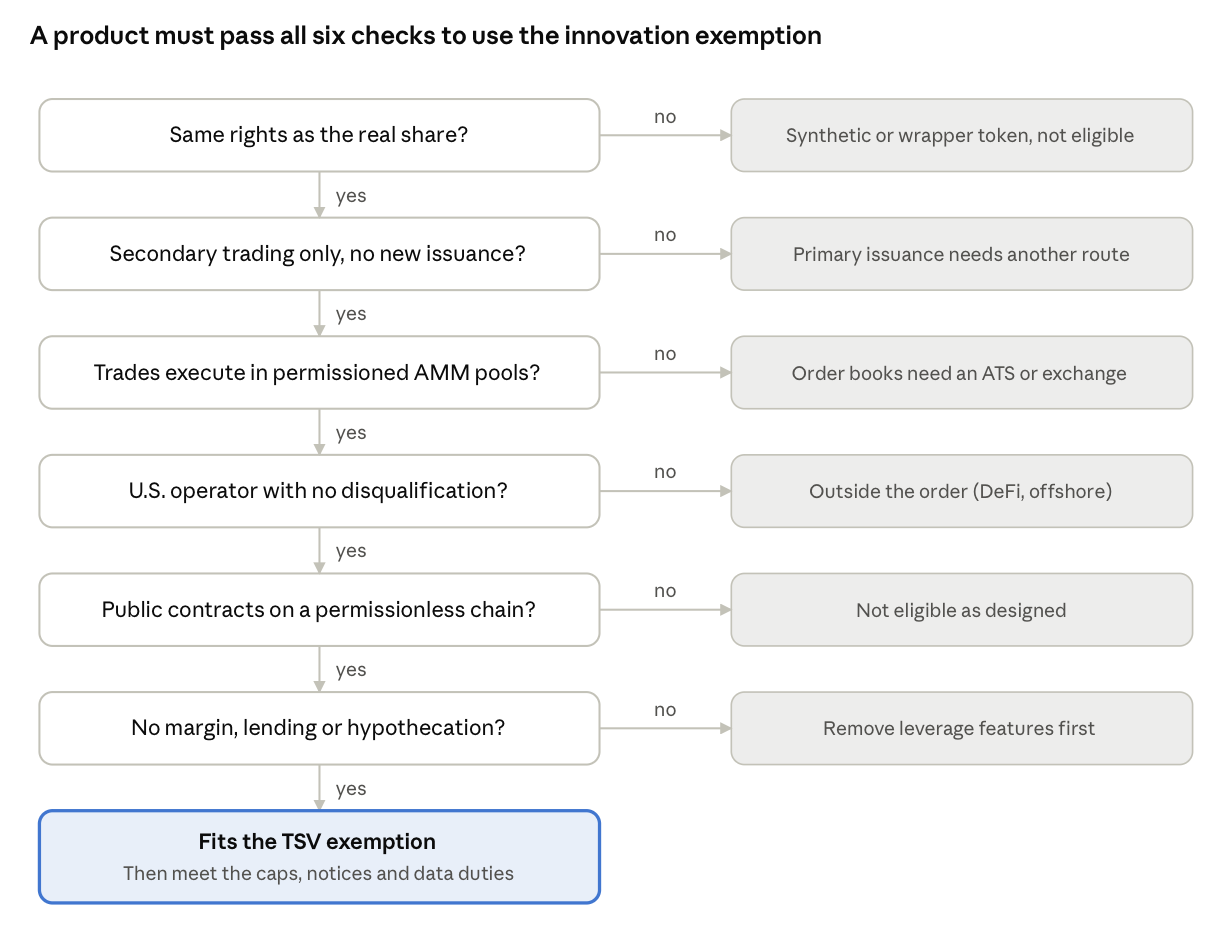
The token must provide holders with the same rights and privileges as the equivalent traditional security.
What does not qualify?
The exemption does not cover every asset that can be represented on a blockchain.
| Asset type | Covered by the exemption? |
|---|---|
| Eligible tokenized U.S.-listed stocks | Yes, subject to conditions |
| Eligible tokenized exchange-traded products | Potentially, subject to additional applicable laws |
| Synthetic stocks offering price exposure only | No |
| Tokenized security-based swaps | No |
| Tokenized private-company shares | No |
| Tokenized corporate bonds | No |
| Tokenized real estate | No |
| Rights and warrants | No |
How Does the SEC Innovation Exemption Work?
A company intending to operate a qualifying onchain trading marketplace must meet the definition of a Tokenized Securities Venue.
A TSV brings together buyers and sellers through permissioned automated market makers and liquidity pools.
An automated market maker (AMM) is a system that uses smart contracts and liquidity pools to facilitate trades instead of relying exclusively on a traditional order book.
For example, consider a hypothetical platform that offers trading between a tokenized U.S. stock and a dollar-backed stablecoin.
The process could look like this:
- A user completes the venue's required eligibility and identity screening.
- The platform permits an approved wallet to access the trading pool.
- The user exchanges a supported stablecoin for eligible tokenized shares.
- The AMM executes the transaction using smart contracts.
- The platform records and reports the transaction according to the SEC's requirements.
The tokenized shares must preserve the holder's applicable shareholder rights.
The platform must also follow restrictions on trading volumes, disclosure, security, and market operations.
What Can Trade on a Tokenized Securities Venue?
Only tokenized NMS stock that gives holders the same rights as the real share. In practice, that means U.S.-listed stocks and exchange-traded products, tokenized by the issuer or by an unaffiliated third party. Each token must trade against another tokenized stock, a non-security crypto asset such as a payment stablecoin, or a tokenized money market fund.
Eligible and excluded assets
- In scope: NMS stock (not options), whether tokenized by or for the issuer, or by an unaffiliated third party.
- In scope, with a catch: ETF shares that are NMS stock can trade, but the order gives no Investment Company Act relief. Tokenized funds still face separate fund rules on share classes and pricing.
- Out of scope: Rights and warrants, plus any token that only gives synthetic exposure, such as tokenized linked securities or tokenized security-based swaps. Davis Polk adds that wrapped tokens are likely ineligible too.
Allowed trading pairs
Every pool must contain tokenized stock. A pool of only crypto assets falls outside the exemption.
| Pool side A | Pool side B | Covered? |
|---|---|---|
| Tokenized NMS stock | Tokenized NMS stock | Yes |
| Tokenized NMS stock | Non-security crypto asset, such as a GENIUS Act payment stablecoin | Yes |
| Tokenized NMS stock | Tokenized money market fund | Yes |
| Stablecoin | Bitcoin (no stock in the pool) | No |
Symbol and volume caps
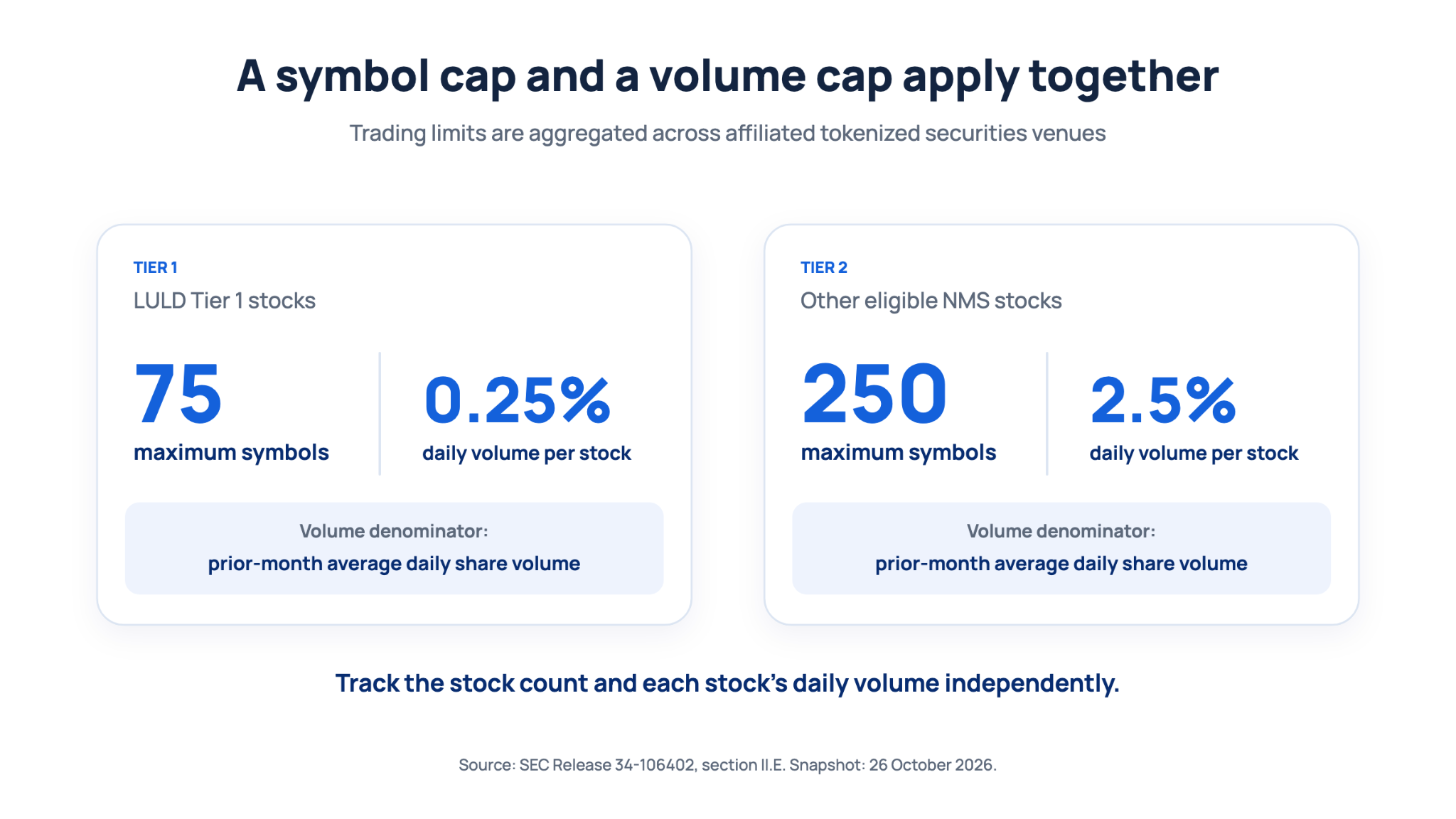
The order borrows the two tiers from the limit up/limit down (LULD) plan. Caps count across all affiliated venues together.
| Tier | Which stocks | Max symbols | Max daily volume per stock |
|---|---|---|---|
| Tier 1 | S&P 500 and Russell 1000 constituents, plus certain ETPs | 75 | 0.25% of the prior month's average daily share volume |
| Tier 2 | All other NMS stocks, excluding rights and warrants | 250 | 2.5% of the prior month's average daily share volume |
Here is what that looks like.
If a Tier 1 stock averaged 50 million shares a day last month, your venue can trade about 125,000 shares' worth of its token per day.
The first time a stock breaches its volume cap, you only need to stay under it from then on. Every later breach forces an immediate three-month pause in that stock. Symbol caps get no second chance. Exceed one and you lose the exemption.
How trades must execute
Trades execute through permissioned AMM liquidity pools.
A standalone central limit order book is not covered. Venues may still show non-binding interest, such as requests for quotes. Any website or browser extension the venue offers counts as part of the TSV and can connect only to its own pools.
Key SEC Innovation Exemption Requirements
Building a TSV involves more than deploying a token contract and creating a liquidity pool. The SEC has established several requirements that directly affect product design.
1. Public blockchain, permissioned trading
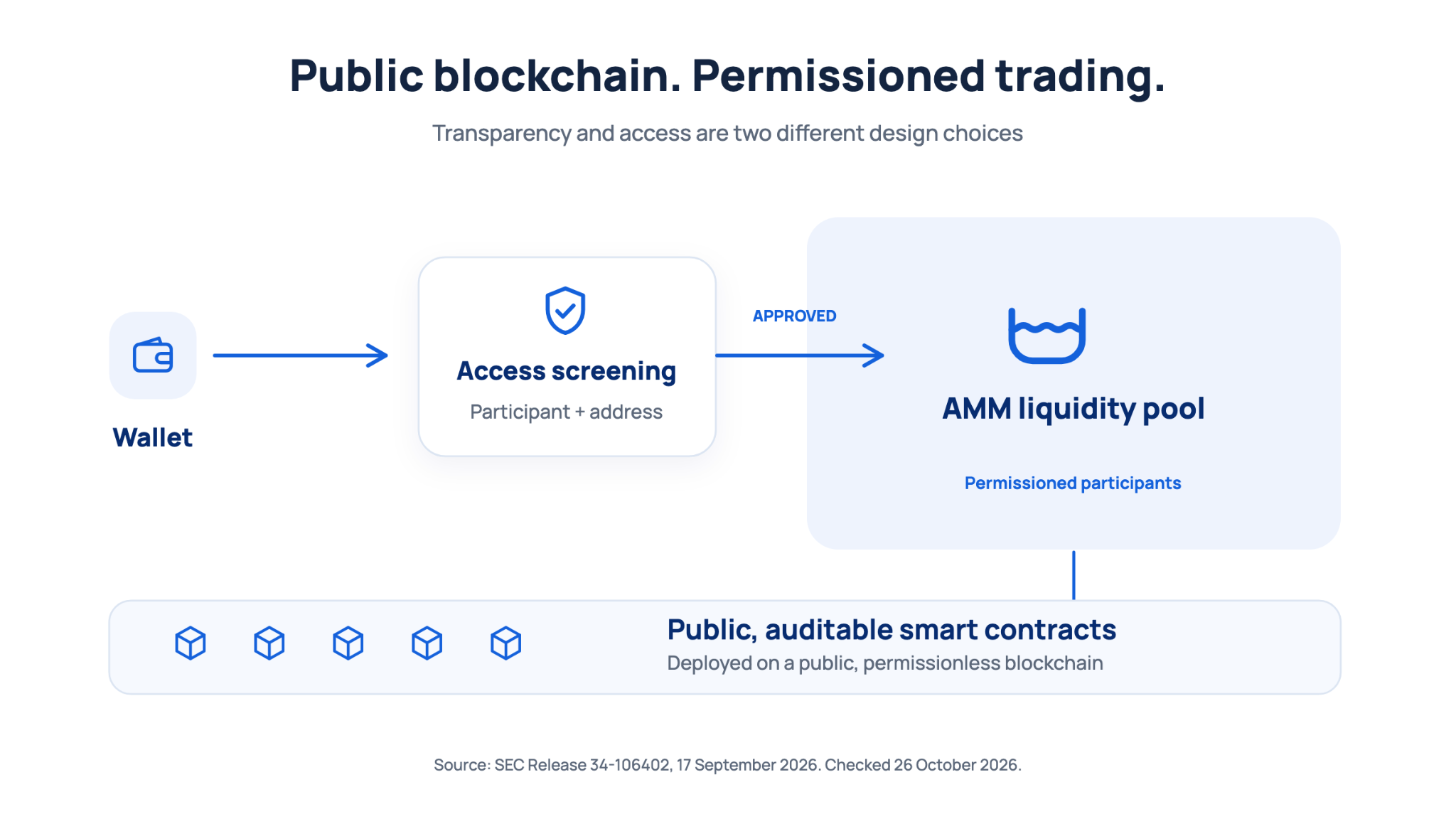
TSV smart contracts must be public, auditable, and deployed on a public, permissionless blockchain. However, access to trading must be permissioned.
Product teams need systems that can screen participants, verify associated wallet addresses, and enforce trading access restrictions.
Eligible tokenized shares must provide holders with the same rights and privileges as their traditional equivalents.
These include:
- Dividend rights
- Voting rights
- Economic interests in the underlying company
- Applicable liquidation rights
- Access to relevant shareholder communications
Product teams must establish how these rights will be delivered, particularly when tokens are issued by third parties.
For example, a tokenized stock platform needs a mechanism to distribute proxy materials and enable holders to exercise voting rights.
3. Issuers can object to third-party tokenization
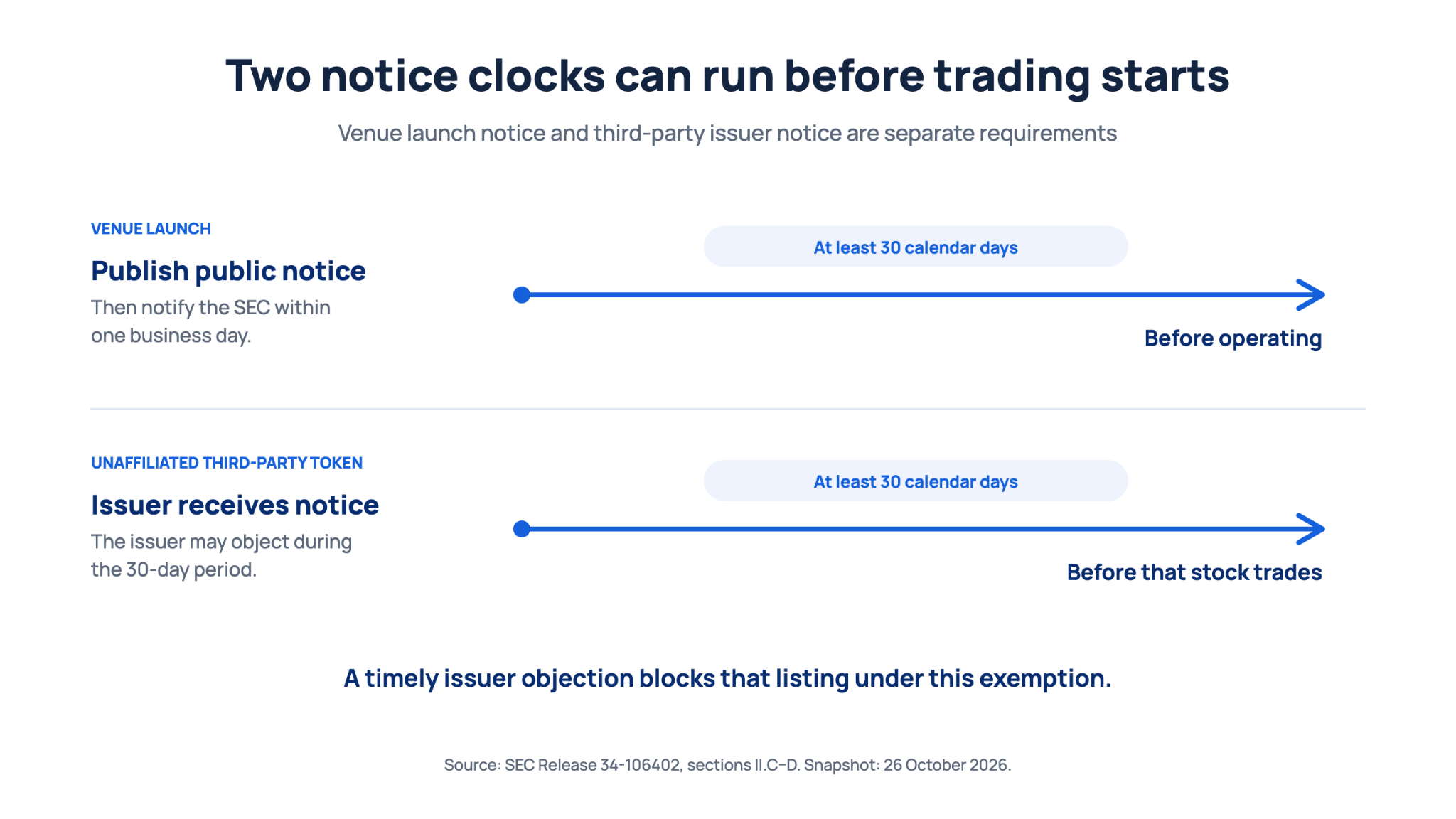
If a stock is tokenized by a third party unaffiliated with its issuer, the TSV must notify the underlying company before making that token available for trading.
The issuer has a 30-calendar-day objection period following receipt of that notice.
If the issuer objects within that period, the TSV cannot make that third-party-tokenized stock available for trading under the exemption.
This is particularly important for product teams planning to offer tokenized versions of popular U.S. equities without direct issuer partnerships.
An eligible token design alone does not guarantee that a stock can be listed.
4. Trading volume and symbol limits
The SEC divides eligible tokenized NMS stocks into two tiers based on the existing Limit Up-Limit Down framework.
| Requirement | Tier 1 | Tier 2 |
|---|---|---|
| Maximum number of stock symbols | 75 | 250 |
| Maximum share of the underlying stock's prior-month average daily trading volume | 0.25% | 2.5% |
| General classification | Larger, more actively traded stocks and certain ETPs | Other eligible NMS stocks |
These caps apply under the order's calculation rules, including aggregation across affiliated TSVs.
A first breach of a volume threshold requires corrective compliance going forward. Subsequent breaches for that stock require a three-month trading pause.
Product teams must build monitoring systems to enforce these limits.
5. Trading transparency
TSVs must make transaction data publicly available in U.S. dollars within 10 minutes of each transaction.
At least 30 days of transaction data must remain freely accessible in a machine-readable format.
Required information includes transaction prices, sizes, timestamps, trading direction, and relevant liquidity pool information.
For developers, this creates requirements for market-data infrastructure, APIs, and recordkeeping.
6. Trading halts and risk controls
A TSV must stop trading a tokenized stock whenever trading in the underlying stock is halted or suspended on its primary listing exchange.
This applies even if the blockchain and liquidity pool remain operational.
Therefore, platforms offering extended-hours trading need reliable connections to traditional market-status information.
The exemption also prohibits TSVs from providing certain financing activities, including extending credit to users for purchasing tokenized NMS stocks or arranging prohibited borrowing and rehypothecation.
7. Public notices and regulatory reporting
A TSV must publish a detailed public notice at least 30 calendar days before beginning operations.
It must then notify the SEC within one business day of publishing that notice.
The disclosure must explain the venue's operations, access standards, trading mechanisms, fees, risks, and other required information.
Significant operational incidents must also be reported, and the platform must maintain records available for regulatory examination.
Does the Innovation Exemption Replace Other Securities Regulations?
No. The SEC's order addresses specific exchange and dealer definitions. It does not automatically exempt a company from other legal obligations.
Depending on the product and business model, companies may still need to consider requirements involving:
- Securities registration and exemptions
- Broker-dealer activities
- Custody and transfer agents
- Antifraud and market-manipulation rules
- Anti-money laundering and sanctions compliance
- Investment Company Act requirements
The exemption also does not authorize primary securities issuance on TSVs. It provides a framework for qualifying secondary trading activities.
Is the SEC Innovation Exemption Already in Effect?
Yes. The SEC issued the exemption on September 17, 2026, and it is currently effective.
As of October 20, 2026, the SEC's published TSV notice list included TSV LLC, OKXICE, and Perpetuals.com. However, appearing on the list does not mean that the SEC has approved a platform or confirmed its compliance with the exemption.
The SEC also published updated FAQs on October 20, 2026, clarifying issues including public notices and issuer objections.
For product teams, the exemption is a live regulatory framework rather than a future proposal.
Timeline
| Date | What happened |
|---|---|
| Oct 19, 2026 | OKXICE's updated notice shows 16 issuer objections, adding Microsoft, Alphabet, Goldman Sachs, Qualcomm, Caterpillar, McDonald's and Western Digital |
| Oct 4 to 5, 2026 | OKXICE publishes the first TSV public notice, listing 63 tickers from 62 companies for planned 24/7, stablecoin-settled trading |
| Sept 17, 2026 | SEC issues the innovation exemption, effective the same day |
| Sept 15, 2026 | CLARITY Act fails a Senate procedural vote, 49 to 50 |
| Apr 17, 2026 | SEC approves NYSE's rule to trade tokenized stocks and ETFs on its existing order book |
| Mar 18, 2026 | SEC approves Nasdaq's proposal to trade tokenized securities alongside traditional shares |
| Dec 2025 | DTC's tokenization pilot receives SEC staff no-action relief |
| 2025 | Atkins floats the innovation exemption under Project Crypto |
How Transak Fits Into Tokenized Securities Infrastructure
Moving securities trading onchain requires more than tokenization and smart contracts.
Users also need a practical way to move money between bank accounts and supported blockchain assets.
Transak provides fiat and stablecoin payment infrastructure that can help financial applications enable users to acquire supported onchain assets through familiar payment methods.
For tokenized securities platforms, this can support the funding layer, while the platform and its partners remain responsible for satisfying applicable securities-trading, custody, and shareholder-rights requirements.
Learn more about RWA tokenization and atomic settlement.
Conclusion
The SEC Innovation Exemption represents a meaningful development for tokenized securities markets in the United States.
It creates a conditional route for eligible tokenized stocks to trade through blockchain-based liquidity pools without requiring qualifying venues to operate under the traditional exchange registration framework.
However, the exemption is deliberately narrow.
For teams, the opportunity is to build compliant onchain trading systems that combine blockchain infrastructure with investor protections, shareholder rights, transparent market data, and effective risk controls.
Frequently Asked Questions
Does the SEC Innovation Exemption allow 24/7 stock trading?
It can allow eligible tokenized stocks to trade outside normal exchange hours. However, trading must stop when the underlying stock is halted or suspended on its primary listing exchange, and other regulatory conditions continue to apply.
Can any crypto exchange use the Innovation Exemption?
No. A venue must meet the SEC's definition of a TSV and comply with all applicable conditions. Ordinary crypto exchange operations do not automatically qualify.
Can companies issue tokenized stocks under the exemption?
The exemption permits qualifying secondary trading, not primary issuance on a TSV. Issuing tokenized securities remains subject to applicable securities laws.
Does the exemption cover synthetic stocks?
No. Synthetic instruments that provide price exposure without the required underlying shareholder rights are outside the exemption's scope.
Is the SEC Innovation Exemption permanent?
No. It is scheduled to expire on September 17, 2031, unless modified. The SEC may use experience gained during this period to develop longer-term rules for onchain securities markets.