Takeaways
- A stablecoin balance is a custody decision first and a product decision second.
- There are three custody models. Which one you pick changes your licensing, not just your architecture.
- Balance features rarely fail on the balance. They fail on funding.
- Paying yield on a stablecoin balance is a separate question with its own rules. Do not assume it is available.
- You can offer the balance without holding the asset yourself.
Stablecoin balances have become a standard request on neobank roadmaps. Users want to hold digital dollars next to their local currency, and the product case writes itself in emerging markets in particular.
Then the build starts and the question changes shape. It stops being "how do we show a balance" and becomes "who actually holds this, under what permission, and how does anyone get money in or out of it."
This guide explains how financial apps can add stablecoin balances and the infrastructure required to make them useful.
What is a stablecoin balance in a banking app?
A stablecoin balance represents a user's holdings of a digital asset designed to maintain a stable value relative to a reference currency, most commonly the US dollar.
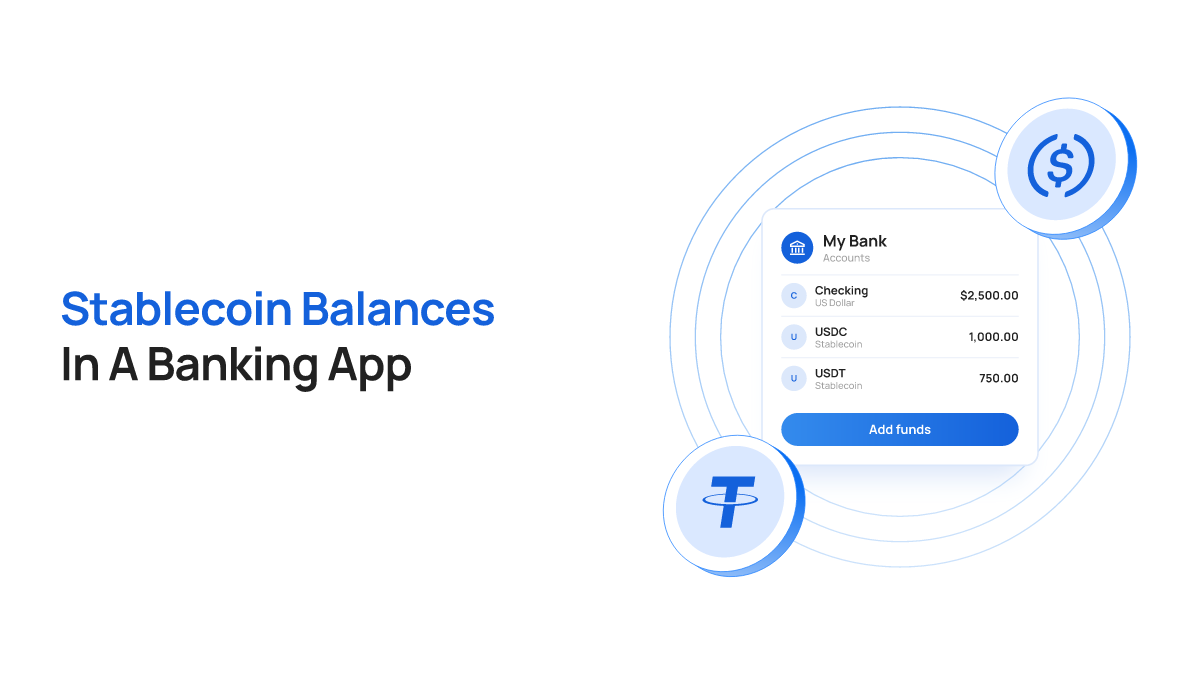
For example, an app might allow a user to see:
USD balance: $2,500
USDC balance: $1,000
The important distinction is that the USDC balance is not simply another entry in a traditional bank ledger. USDC exists on blockchain networks, meaning the app needs infrastructure that can interact with those networks and the user's blockchain wallet.
From the user's perspective, though, this complexity can be abstracted away.
The goal is to make the experience feel similar to holding and moving any other digital balance.
Why are banking apps adding stablecoin balances?
Stablecoins can give financial apps capabilities that are difficult or expensive to achieve using traditional payment infrastructure alone.
1. Global money movement
Stablecoins can move across borders without relying entirely on traditional correspondent banking networks.
This can be particularly useful for fintechs serving customers who regularly send or receive international payments.
2. 24/7 settlement
Blockchain networks operate continuously. Stablecoin transfers don't necessarily need to wait for traditional banking hours or settlement windows.
3. Access to onchain financial services
A stablecoin balance can become a user's gateway to other blockchain-based products, including payments, trading, lending, and other financial applications.
4. Programmable money movement
Stablecoins can be integrated into software workflows, allowing businesses to build conditional or automated payment flows around digital-dollar balances.
The opportunity, therefore, isn't necessarily to turn a banking app into a crypto wallet.
It is to make stablecoins another useful form of money within an existing financial experience.
What infrastructure does a banking app need?
Adding a stablecoin balance typically requires several layers of infrastructure.
A simplified architecture looks something like this:
User → Banking App → Wallet Infrastructure → Blockchain → Stablecoin
But that's only part of the stack.
To make the balance useful, the app may also need:
- Stablecoin wallet infrastructure
- Blockchain connectivity
- Stablecoin custody or wallet management
- Fiat-to-stablecoin on-ramp infrastructure
- Stablecoin-to-fiat off-ramp infrastructure
- Transaction monitoring
- KYC/KYB and compliance workflows
- Blockchain analytics
- Liquidity and settlement infrastructure
- Internal ledger and balance management
The exact architecture depends on whether the fintech wants to custody assets itself, use a third-party wallet provider, or offer a non-custodial experience.
Also Read: How Neobanks Add Native Crypto and Stablecoin Buy/Sell Without a Licence
Three custody models to choose between
| Who controls the asset | The user | A licensed custodian you contract | A regulated provider in your flow |
|---|---|---|---|
| Your safeguarding duty | Minimal | Yours, delegated to the custodian | Sits with the provider |
| Licensing weight | Lightest | Heaviest | Light to moderate |
| User experience | Keys, recovery, and support burden | Familiar, bank-like | Familiar, bank-like |
| Time to launch | Medium | Longest | Shortest |
| Best suited to | Crypto-native audiences | Banks and licensed institutions | Fintechs adding a feature |
Funding is what decides whether the feature gets used
A stablecoin balance is only worth building if money can reach it easily. In practice users fund it one of three ways, and each carries a different conversion rate.
Card
Fastest to integrate and highest friction at scale. Decline rates on crypto purchases are meaningfully higher than on ordinary retail payments.
Bank transfer
Cheaper and better for larger amounts, but slower and dependent on local rail coverage.
A dedicated account number
The user sends money to an account in their own name, and the stablecoin appears in their balance. Closest to how a bank account already behaves, which is why it converts best.
Can you provide yield on stablecoin balances?
Paying a return on a stablecoin balance can change what the product is. In the United States the GENIUS Act addresses yield on payment stablecoins directly, and in several markets a yield-bearing balance starts to resemble a deposit or an investment product, with the licensing that follows.
Also Read: What Is the GENIUS Act? US Stablecoin Law Explained
What to check before you build
Six questions surface most of the problems while they are still cheap to fix.
Which stablecoins, and issued by whom?
Issuer matters for reserve quality, redemption, and how regulators view the asset. Supporting two well-understood stablecoins beats supporting eight.
What happens at redemption?
Trace the full path from a user tapping withdraw to money arriving in their bank account. If any step in that chain is undefined, the balance is not finished.
Which markets are actually covered?
Check funding and exit separately, per market. Providers commonly cover more countries for buying than for cashing out, and users discover the gap at the worst moment.
Who is the regulated party at each step?
Write it down per leg. Funding, custody, and redemption can each sit with a different entity, and knowing which is which is the whole basis of your compliance position.
How does reconciliation work?
On-chain settlement and bank settlement run on different clocks. Decide early how your ledger reflects a balance that has moved on-chain but not yet in your records.
What does support look like on a bad day?
Failed funding, a withdrawal to a wrong address, a stuck transaction. These are routine, and the quality of a provider shows in how these are handled rather than in the happy path.
Stablecoin balances in banking apps with Transak
Transak can serve as the fiat access layer for a banking or fintech application introducing stablecoin balances.
Instead of requiring users to transfer money to an external crypto exchange, purchase stablecoins there, and then send them back to the application, a fintech can integrate an on-ramp directly into its product experience.
The reverse is possible through off-ramp infrastructure: users can sell supported digital assets and receive fiat through available local payment methods.
This allows a fintech company to build the stablecoin experience around its own brand and user interface while relying on specialized infrastructure for fiat-to-crypto and crypto-to-fiat conversion.
For applications looking for a white-label experience, this can also help keep the stablecoin functionality consistent with the rest of the product rather than sending users to a third-party exchange.
Also Read: How Emerging-Market Neobanks Offer Usable US Dollar Accounts on Stablecoin Rails
Conclusion
The opportunity is bigger than a crypto balance
Adding stablecoins to a banking app isn't simply about adding another asset to an account screen.
Done properly, stablecoin infrastructure can give fintechs another way to move, store, convert, and program money—while keeping the experience familiar for the end user.
The underlying technology may involve wallets, blockchains, smart contracts, and onchain transactions.
But the product doesn't have to feel complicated.
For the user, it can simply look like another balance in their financial app.
When you are ready to work out the funding and exit legs, talk to our team.
Frequently asked questions
Do I need a licence to offer stablecoin balances?
It depends on whether you hold the asset. Safeguarding customer crypto generally brings obligations beyond those for facilitating a purchase, and requirements differ by market. Models where a regulated provider holds the asset and your app displays the position usually carry a lighter position for you, but never assume it.
What is the difference between a stablecoin balance and a crypto wallet?
A wallet exposes the mechanics, meaning addresses, keys, and network choices. A balance hides them and presents a number the way a bank account does. The underlying asset can be identical. The difference is how much of the machinery the user is asked to understand.
Can users earn interest on a stablecoin balance?
Sometimes, and it is a separate product with separate rules. Paying a return can reclassify the balance as a deposit or an investment depending on the market, and the GENIUS Act addresses yield on payment stablecoins in the United States. Treat it as its own legal workstream.
Which stablecoins should a banking app support?
Start with one or two widely held, well-reserved stablecoins rather than a long list. Each additional asset adds reconciliation, liquidity, and support work, and users rarely ask for breadth. They ask for the dollar they recognise.
How do users fund a stablecoin balance?
Card, bank transfer, or a dedicated account number in the user's own name. Cards are fastest to integrate and carry higher decline rates. Account-number funding converts best because it behaves like a normal bank transfer, which is what users already expect.
How long does it take to build a stablecoin balance feature?
The integration work is weeks. The custody decision, legal review, and provider due diligence usually take longer and set the real timeline. Teams that start with the custody question finish faster than teams that start with the interface.
What happens if a user wants to withdraw to their bank?
That is the off-ramp, and it needs designing at the same time as funding. Check which markets support cashing out, what the settlement time is, and who is responsible if a payout fails. Coverage for buying is usually broader than coverage for selling.
Also Read: What Is a Crypto Off-Ramp? Convert Crypto to Cash
Can we offer a stablecoin balance without holding the crypto ourselves?
Yes, and it is the most common route for fintechs adding this as a feature. A regulated provider holds or moves the asset and your app owns the interface and the customer relationship. You avoid becoming a custodian while the user still sees a balance in your product.
How do we reconcile stablecoin balances with our ledger?
Decide how your records treat a transaction that has settled on-chain but not yet in your system, because the two clocks do not match. Agree the source of truth, the frequency of reconciliation, and who investigates a mismatch before launch rather than after the first one.