Takeaways
- Tokenized stocks may offer dividends and voting rights.
- Shareholder rights depend on the token's legal structure.
- Dividends may be paid directly or automatically reinvested.
- Synthetic stocks generally do not provide shareholder voting rights.
- One-to-one stock backing does not guarantee shareholder rights.
Yes, some tokenized stocks offer dividends and voting rights, but not all of them do. It depends on how the token is issued, what it represents, and the rights attached to it.
A tokenized stock may represent actual ownership of company shares, an indirect claim on shares held by a custodian, or simply exposure to a stock's price. These arrangements can give investors very different rights.
For example, some tokenized stocks pass on dividends but do not allow investors to vote. Others automatically reinvest dividends, while certain products provide neither benefit.
In this guide, we'll explain how dividends and voting rights work for tokenized stocks, examine real-world examples, and explain what investors should check before buying.
What Rights Do Traditional Stockholders Have?
Here’s what investors normally receive when they buy company shares.
- Dividend rights: Shareholders may receive a portion of a company's profits when it declares a dividend. Not every company pays dividends, and payments are not guaranteed.
- Voting rights: Holders of voting shares can participate in certain company decisions, including electing directors and approving major corporate changes.
For example, if you own 100 voting shares of a company through a traditional brokerage account, you can generally receive eligible dividends and exercise your voting rights through the broker.
Whether you receive the same benefits from tokenized stocks depends on the legal structure behind the tokens.
Why Do Different Tokenized Stocks Have Different Rights?
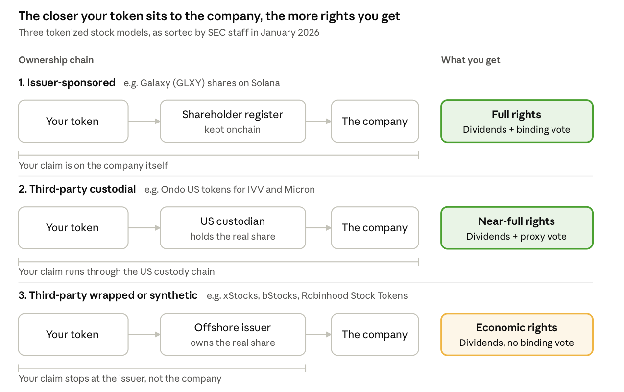
The U.S. Securities and Exchange Commission (SEC) identifies three main models of tokenized securities.
1. Issuer-sponsored tokenized stocks
These are shares issued directly on a blockchain by the company itself or its authorized agent.
If a company tokenizes its existing class of common stock, the tokenized shares generally carry the same rights as traditional shares of that class, including applicable dividend and voting rights.
However, companies may also issue a different class of tokenized shares with different rights.
2. Custodial tokenized stocks
With this model, a financial institution holds real company shares, while blockchain tokens represent investors' interests in those shares.
A properly structured custodial security entitlement can provide investors with the same shareholder benefits available through a traditional brokerage account.
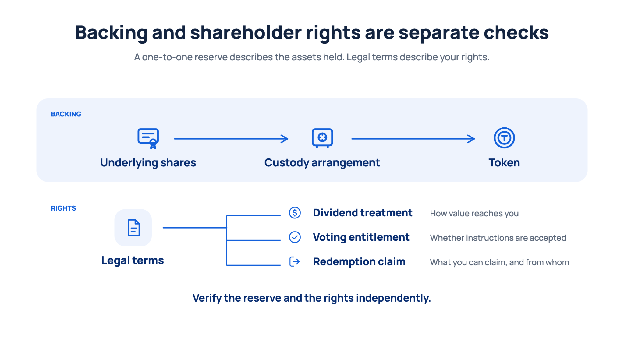
However, a token being backed 1:1 by real shares does not, by itself, guarantee voting rights. Investors must check the legal terms to understand exactly what rights pass through to token holders.
3. Synthetic tokenized stocks
Synthetic stocks are blockchain-based financial products that track the price or performance of traditional stocks without giving investors direct ownership of the company.
Their holders generally do not receive traditional shareholder rights.
However, the issuer may agree to replicate certain economic benefits, including dividend payments, as part of the product's terms.
Do Tokenized Stocks Pay Dividends?
Yes, tokenized stocks can provide dividend benefits. There are three common approaches.
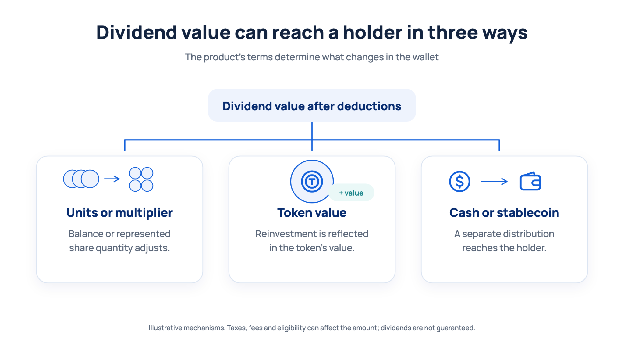
Most tokenized stocks backed by real shares pass on dividend value, but rarely as cash. The issuer collects th e dividend, takes out tax, and reinvests what's left for you. You see it as more tokens, a higher token price, or a higher multiplier. A few platforms pay out a stablecoin or cash instead.
The three ways dividends reach you
| Method | What changes for you | Used by |
|---|---|---|
| Reinvested through a multiplier | Each token now tracks slightly more than one share, so your balance or token value rises | xStocks, Robinhood Stock Tokens, Coinbase tokenized stocks, Binance bStocks in self-custody |
| Built into the price (total return) | The token's price drifts above the stock's price | Ondo Global Markets on Ethereum |
| Paid out | You receive a stablecoin or cash | Dinari (USD+), Binance bStocks in spot wallets, Robinhood EU Classic Stock Tokens (euros) |
The same token can behave differently on different chains. Ondo's tokens show dividends as a higher price on Ethereum, but as more tokens on Solana.
xStocks, Binance bStocks and Ondo all reinvest dividends after a 30% US withholding tax, per Kraken's xStocks FAQ and Binance. A direct shareholder in a country with a US tax treaty can often claim a lower rate through their broker. With a token, the tax is withheld at the issuer's level, so you generally can't claim a treaty rate yourself.
Payouts also have small rules. Dinari, for example, doesn't pay out distributions under $0.10 and requires a KYC-verified account.
Do Tokenized Stocks Give Voting Rights?
Some do, but many popular tokenized stock products do not.
Voting rights determine whether an investor can participate in company decisions such as appointing directors, approving mergers, and voting on certain shareholder proposals.
For a tokenized stock to provide these rights, its legal structure must give the token holder a valid voting entitlement.
This can happen when the token represents an actual voting share or when an authorized intermediary passes voting instructions from investors to the underlying company.
However, many third-party tokens are designed to provide financial exposure without shareholder governance rights.
In those cases, the underlying shares may be registered through a custodian or another intermediary. How those shares are voted, or whether the votes are exercised at all, depends on the arrangement.
Holding a token in a crypto wallet does not automatically provide the ability to vote at the underlying company's shareholder meetings.
Real Examples of How Popular Tokenized Stock Platforms Handle Dividends and Voting
| Provider | What you hold | Dividends | Voting |
|---|---|---|---|
| Galaxy (GLXY) via Superstate | Real Class A shares, recorded onchain by the transfer agent | Same as any GLXY share | Same as any GLXY share |
| Ondo US custodial (IVV, MU) | Entitlement to shares held in the US custody chain | Not detailed in launch materials | Onchain voting through Broadridge ProxyVote.com |
| Ondo Global Markets | Token from a non-US issuer that owns the shares | Reinvested after 30% US tax (price rises on Ethereum, balance on Solana) | Voting preferences through Broadridge, announced April 2026 |
| xStocks (Backed) | Certificate from Backed Assets (JE), backed 1:1 | Reinvested through a multiplier after 30% US tax | Voting preferences for eligible holders since August 2026 |
| Robinhood Stock Tokens | Debt security from Robinhood Assets (Jersey), backed 1:1 | Reinvested through an onchain multiplier | None today; Robinhood says it's coming |
| Binance bStocks | Certificate from BTech Holdings, backed 1:1 | Cash in Binance spot wallets; multiplier in self-custody; after 30% US tax | None |
| Coinbase tokenized stocks (Base) | Beneficial interest through Coinbase Onchain SPV (Abu Dhabi) | Reinvested through an onchain multiplier | Set by the SPV's terms |
| Dinari dShares | Tokenized stocks for eligible US investors | Paid in the USD+ stablecoin to KYC-verified accounts | None listed in its docs |
| Robinhood EU Classic Stock Tokens | Derivative contract with Robinhood Europe | Paid in euros | None |
Terms change often. Check the issuer's prospectus or terms before you buy, not just the exchange's product page.
What Do Regulations Say About Tokenized Stock Rights?
The rules surrounding tokenized securities are developing.
In January 2026, the SEC published guidance explaining that tokenized securities can have different legal structures, including company-issued securities and products issued by third parties.
A major development followed on September 17, 2026, when the SEC introduced its temporary Innovation Exemption for certain Tokenized Securities Venues (TSVs).
Under this framework, tokenized stocks traded through qualifying TSVs must provide holders with the same rights as equivalent traditional shares, including dividend and voting rights.
The exemption also excludes purely synthetic stock trackers from this particular trading framework.
However, this requirement applies specifically to securities trading under the exemption. It does not mean that every tokenized stock available worldwide must provide identical shareholder rights.
Investors must still review the rules applicable to their particular product and jurisdiction.
How to Check Whether a Tokenized Stock Offers Dividends and Voting Rights
Before buying a tokenized stock, investors should review the provider's documentation and answer these questions:
- What am I actually buying? Is the token an actual share, a custodial security entitlement, or a derivative tracking a stock?
- How are dividends handled? Are they paid in cash or stablecoins, automatically reinvested, or excluded entirely?
- Do I have voting rights? Can I participate in shareholder meetings or submit voting instructions through an intermediary?
- Who holds the underlying shares? If the token is asset-backed, identify the custodian and check whether the investor has a legally enforceable claim.
- What happens during corporate actions? Check how the provider handles stock splits, mergers, delistings, and other events that could affect token holders.
The issuer's prospectus, product terms, and custody disclosures are generally more reliable than marketing claims.
How Transak Helps Tokenized Stock Platforms
For companies offering tokenized stocks, making it easy for users to move money between traditional banking systems and blockchain networks is essential.
Transak provides fiat on-ramp and off-ramp infrastructure that helps these platforms simplify the payment experience.
With Transak, tokenized stock platforms can:
- Simplify investor onboarding: Let users buy supported stablecoins using cards, bank transfers, Apple Pay, and Google Pay.
- Enable fiat withdrawals: Allow users to convert supported crypto assets into local currencies after selling their tokenized stocks.
- Reduce compliance complexity: Use Transak's built-in KYC, AML, and payment compliance infrastructure for supported transactions.
- Offer a seamless experience: Integrate fiat payment options directly into their applications through APIs or widgets.
Transak handles the fiat-to-crypto payment infrastructure, allowing tokenized stock companies to focus on trading, asset management, and user experience.
Tokenized stock issuance, dividend distribution, voting rights, and securities-specific regulatory obligations remain the responsibility of the relevant providers.
Explore Transak's payment infrastructure
Frequently asked questions
Do xStocks pay dividends?
Yes, but not in cash. After a 30% US withholding tax, the dividend is reinvested by raising each token's multiplier, so your tokens track slightly more shares. The update happens around 8:00 PM EST on the day before the ex-dividend date. You don't need to claim anything.
Do Robinhood Stock Tokens have voting rights?
Not today. Robinhood Stock Tokens are debt securities issued by Robinhood Assets (Jersey), and holders have no legal rights in the underlying shares. In September 2026, Robinhood's CEO said voting and in-kind redemption are coming for eligible holders, without giving a date.
Why did my tokenized stock balance go up by itself?
That's usually a reinvested dividend or a stock split. Many issuers use a multiplier that changes how many shares each token represents. Some wallets show this as more tokens. Others keep the token count the same and show a higher value per token.
Are reinvested token dividends taxable?
They may be. You receive no cash, but many tax systems still treat the reinvested amount as dividend income. The 30% US tax withheld by the issuer may not be something you can claim back. Keep records of each multiplier change and check with a local tax adviser.
Often not. xStocks, for example, can't be moved to a traditional brokerage account. Robinhood says in-kind redemption is in development. Issuer-sponsored tokens like Galaxy's GLXY don't need redemption, because the token already is the share.
Is owning a tokenized stock the same as owning the stock?
Only if the company issued it, and close to it for some US custodial tokens. Otherwise, you own a claim on the token issuer. You get price exposure and usually dividend value, but you may lack voting, may not be able to redeem, and rely on the issuer and its custodian.