Synthetic stock assets let people gain exposure to the price of publicly traded companies without buying their actual shares.
For example, someone can trade a blockchain-based asset that follows the price of Apple, Tesla, or NVIDIA stock without holding those shares in a traditional brokerage account.
These products are called synthetic stocks. They use financial contracts to reproduce the price movements of real stocks.
But, owning a synthetic stock does not mean you own part of the company.
This guide explains how synthetic stocks work, their role in decentralized finance (DeFi), and how they differ from tokenized stocks.
What Are Synthetic Stocks in Crypto?
A synthetic stock is a financial instrument designed to track the value of a company's shares without giving the holder ownership of those shares.
In traditional finance, synthetic stock exposure can be created using derivatives such as options and swaps.
In crypto, similar exposure can be created using blockchain-based tokens, smart contracts, and perpetual futures.
These products are designed to follow the price of an underlying stock. If the stock rises, a synthetic long position generally gains value. If it falls, the position generally loses value.
However, synthetic stocks typically do not provide:
- Ownership of the underlying company's shares.
- Shareholder voting rights.
- Direct entitlement to dividends.
- The right to redeem the product for actual company shares.
The exact rights depend on the product's legal and financial structure.
How Do Synthetic Stocks Work on Blockchain?
Blockchain-based synthetic stocks use smart contracts, market price data, and financial backing mechanisms to create exposure to real-world stocks.
Here's how the process works.
1. A Stock Is Selected as the Reference Asset
A protocol chooses a real-world stock, such as Apple (AAPL), whose price the synthetic product will track.
The protocol does not necessarily need to purchase any Apple shares. It only needs a mechanism for providing financial exposure to Apple's price.
2. Price Oracles Supply Stock Market Data
Blockchains cannot independently access stock exchange prices.
They rely on oracles, which are services that bring real-world information onto a blockchain.
For example, an oracle might report that Apple shares are trading at $250.
The protocol uses that information to calculate the value of positions, manage collateral, or settle trades.
Services such as Chainlink provide price data infrastructure used by DeFi protocols.
3. Collateral or Margin Supports the Position
Synthetic products need a mechanism to cover potential losses and settlement obligations.
In a collateral-backed model, someone deposits cryptocurrency or stablecoins into a smart contract. The protocol may require collateral worth more than the synthetic assets being created.
In a perpetual futures market, traders instead deposit margin to open positions. The exchange's risk-management and liquidation systems help ensure positions remain adequately funded.
The requirements differ between protocols.
4. Smart Contracts Manage Transactions
Smart contracts are programs that execute predefined rules on a blockchain.
Depending on the product, they can handle the creation of synthetic assets, collateral requirements, price-based settlements, and liquidations.
They can also allow synthetic positions to interact with other DeFi services.
5. Traders Gain or Lose Based on Stock Price Movements
Here’s an example.
A stock trades at $100. You buy $100 worth of an unleveraged synthetic token designed to track that stock.
If the stock rises to $110, your synthetic position would ideally be worth approximately $110.
If the stock falls to $90, the synthetic position would ideally fall to approximately $90.
These figures exclude trading fees and tracking differences.
You gain exposure to the stock's price movement, but you never become a shareholder.
Importantly, an oracle reporting the correct price does not guarantee that a synthetic token will trade at that price. Market liquidity, redemption mechanisms, and arbitrage also affect how closely it tracks the underlying stock.
Types of Synthetic Stocks on Blockchain
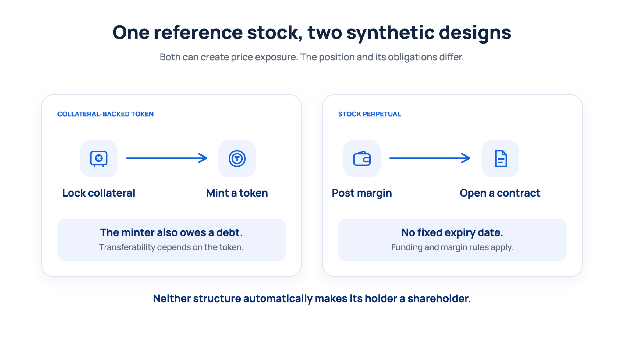
There are two main ways traders encounter synthetic stock exposure in DeFi.
- Collateral-backed synthetic stock tokens
- Stock perpetual futures
1. Collateral-Backed Synthetic Stock Tokens
These are tokens designed to mirror the value of a particular stock.
A protocol can issue these tokens against collateral locked in smart contracts. Depending on its design, users may be able to hold, transfer, or trade them like other crypto assets.
Synthetix helped popularize this approach through synthetic assets known as Synths.
Its earlier infrastructure supported price-tracking tokens, although Synthetix has since shifted its primary focus toward perpetual futures and derivatives infrastructure.
2. Stock Perpetual Futures
Stock perpetual futures, also called equity perps or stock perps, let traders speculate on stock prices without buying shares.
Unlike standard futures contracts, perpetual futures have no fixed expiration date.
They commonly use funding payments between long and short traders to help keep contract prices aligned with the underlying reference price.
Perpetual futures can also support leverage, allowing traders to control positions larger than their deposited margin. This increases both potential gains and losses.
For instance, Hyperliquid's HIP-3 framework allows independent market operators to deploy perpetual futures referencing assets such as stocks. Markets tracking NVIDIA, Tesla, and Apple have emerged through this infrastructure.
These are derivatives linked to stock prices, not ownership of the companies.
Synthetic Stocks vs. Tokenized Stocks: What's the Difference?
Synthetic stocks and tokenized stocks are often confused because both can provide stock market exposure through blockchain technology.
However, tokenization and synthetic exposure describe different things.
Tokenization refers to representing an asset or financial instrument on a blockchain. Synthetic exposure refers to replicating an asset's financial performance without owning it.
Some tokenized stocks represent genuine shares or rights to shares held by a custodian. Others are synthetic instruments that only follow stock prices.
| Feature | Synthetic stocks | Share-backed tokenized stocks |
|---|---|---|
| Underlying shares | Not required | Shares or share entitlements form the backing |
| Price exposure | Yes | Yes |
| Shareholder rights | Generally none | Depends on the legal structure |
| Dividends | Only if the contract provides for them | Depends on the rights and product terms |
| Main risks | Tracking, collateral, leverage, counterparty risk | Custody, issuer, and legal-claim risks |
For example, a synthetic Tesla product might follow Tesla's share price using an oracle and collateral system.
A share-backed tokenized Tesla product might instead represent an interest in Tesla shares held by a custodian.
Both could display similar prices, but the legal rights behind them can be very different.
The SEC's January 2026 statement on tokenized securities formally distinguishes custodial tokenized securities from synthetic tokenized securities.
What Are the Benefits of Synthetic Stocks?
Access to Global Stock Market Exposure
Synthetic stocks can make it possible to trade the performance of overseas equities through blockchain platforms.
A user may be able to fund a position with stablecoins instead of transferring money through a traditional international brokerage account.
However, access still depends on local regulations and the platform's eligibility requirements.
Trading Beyond Traditional Market Hours
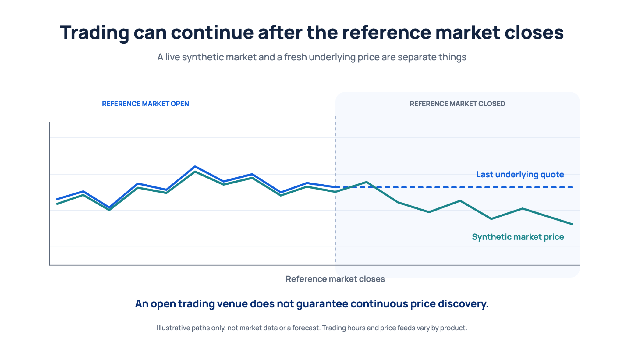
Some blockchain-based synthetic markets operate around the clock, even when traditional stock exchanges are closed.
This provides more flexibility for traders in different time zones.
However, when the underlying market is closed, reliable reference prices may be unavailable. Synthetic prices can therefore diverge from the last official stock price.
Fractional Exposure
Some synthetic products allow users to take positions worth less than the price of a full company share.
For example, a user could gain $20 of exposure to a stock trading at $400, where the product supports such small positions.
This is fractional price exposure, not necessarily fractional share ownership.
Integration With DeFi
Transferable synthetic stock tokens can potentially interact with decentralized exchanges, lending protocols, and other blockchain applications.
Their usefulness depends on whether these applications actually support the tokens.
What Are the Risks of Synthetic Stocks?
Synthetic stocks introduce risks that go beyond ordinary stock price movements.
Holding a synthetic stock generally gives you no ownership rights in the underlying business.
If a company distributes dividends, synthetic holders do not automatically receive them. Some derivatives provide dividend-equivalent adjustments, but only according to their contract terms.
Oracle and Price-Tracking Risk
Synthetic products depend on accurate pricing.
If an oracle delivers outdated or incorrect information, a protocol may value positions incorrectly.
Even with reliable oracle data, weak liquidity can cause synthetic prices to differ from the underlying share price.
Liquidation Risk
Leveraged synthetic positions can be liquidated when losses cause collateral or margin to fall below required levels.
For example, a trader using 5x leverage could lose a substantial portion of their margin following a much smaller percentage movement in the stock.
Smart Contract and Counterparty Risk
Blockchain-based synthetic assets depend on software, collateral arrangements, and sometimes third-party issuers.
Smart contract vulnerabilities, insufficient collateral, platform failures, or issuer insolvency can cause losses even when the underlying stock performs as expected.
Trading Costs and Corporate Actions
Synthetic stock positions may involve trading fees, spreads, funding payments, or financing costs.
Stock splits, mergers, and special dividends can also require adjustments to the product's reference price or contract terms.
A product that handles these events poorly may fail to reproduce the stock's intended performance.
Are Synthetic Stocks Legal?
Synthetic stocks are not automatically legal or illegal simply because they use blockchain technology.
Their regulatory treatment depends on the type of instrument, how it is structured, where it is offered, and who can trade it.
In January 2026, SEC staff explained that certain synthetic tokenized securities could qualify as linked securities or security-based swaps under U.S. securities laws.
In September 2026, the SEC also introduced a temporary Innovation Exemption for certain Tokenized Securities Venues (TSVs).
Importantly, the exemption excludes synthetic products, requiring eligible tokenized stocks traded on these venues to provide rights equivalent to traditional shares, including dividends and voting rights.
This does not amount to a blanket ban on every form of synthetic stock exposure. Different products remain subject to different legal requirements.
How Can You Trade Synthetic Stocks?
Synthetic stock exposure may be available through supported crypto derivatives exchanges, decentralized protocols, or issuers of synthetic financial products.
Before using one, check what the product actually represents.
Does it give you ownership of shares, or only exposure to their price? What collateral supports it? Does it use leverage? What fees apply? How does it handle dividends, stock splits, and market closures?
Also verify the platform's availability and regulatory status in your country.
These questions matter more than whether the product carries a familiar stock ticker.
How Transak Helps Synthetic Stock Trading Platforms
For platforms offering synthetic stock trading, a major challenge is making it easy for users to move money between traditional finance and blockchain-based markets.
Users may want to trade synthetic versions of Apple, Tesla, or NVIDIA stocks, but they first need a way to convert their local currency into the cryptocurrency or stablecoin supported by the platform.
Transak helps bridge this gap with fiat-to-crypto and crypto-to-fiat payment infrastructure.
By integrating Transak, eligible synthetic stock trading platforms can:
- Simplify user onboarding
- Enable fiat-to-stablecoin conversion
- Support fiat withdrawals
- Offer a branded experience
- Reduce payment infrastructure complexity
For example, a synthetic stock trading application could integrate Transak to help users convert local currency into USDC, which they could then use to fund eligible trading positions.
Transak provides the payment infrastructure connecting fiat currencies and crypto assets, while the trading platform remains responsible for synthetic stock issuance, pricing, execution, custody arrangements, and applicable trading regulations.
Conclusion
Synthetic stocks bring traditional stock market exposure into blockchain-based financial markets without necessarily bringing the underlying shares onto the blockchain.
They can support flexible trading, fractional exposure, and DeFi integration. However, they also introduce risks involving price tracking, collateral, leverage, and legal rights.
Most importantly, tracking a stock's price is not the same as owning the stock.
Frequently Asked Questions
Are Synthetic Stocks Real Stocks?
No. Synthetic stocks are financial instruments that replicate the price movements or economic performance of real shares. They generally do not provide ownership in the underlying company.
Do Synthetic Stocks Pay Dividends?
Not automatically. Some synthetic financial products include dividend-equivalent payments or price adjustments, but these depend on the contract's terms. Holders do not receive dividends simply by being shareholders, because they generally are not shareholders.
Are Synthetic Stocks the Same as Stock Perpetuals?
Not exactly. Stock perpetual futures are one type of synthetic stock exposure. Other types include collateral-backed synthetic tokens, options-based positions, and swaps.
Can Synthetic Stocks Be Traded 24/7?
Some blockchain-based synthetic products support 24/7 trading. However, their prices may become less reliable or diverge from the underlying stock when traditional exchanges are closed.
Not necessarily. Most synthetic structures do not require holding the actual shares. They may instead rely on cryptocurrency collateral, stablecoins, margin systems, or contractual payment obligations.